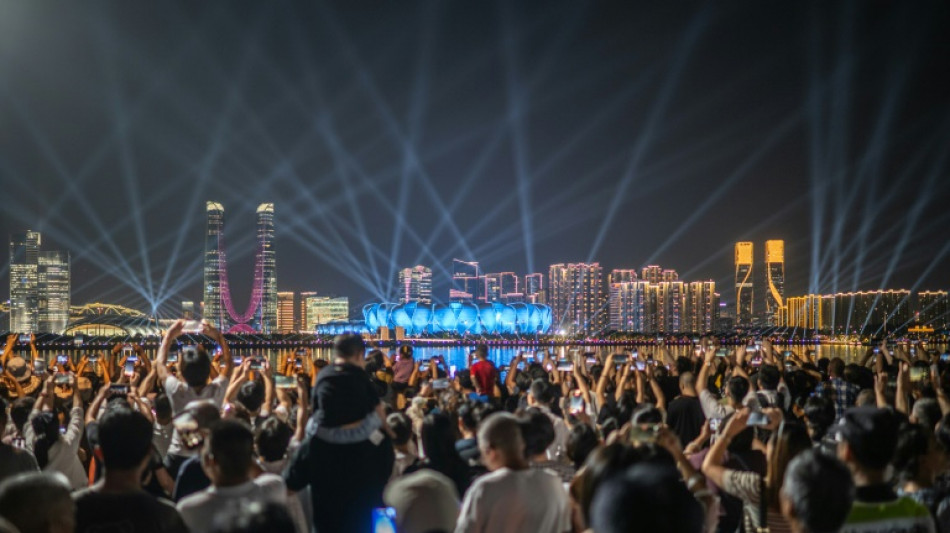
Xi to open biggest ever Asian Games, after a year's delay / Photo: Philip FONG - AFP

 Malaysia Sues Google for $146m Over Harmful Content

 Black Wind Turbine Blades Reduce Bird Deaths by 74% in Spain Study

 Brazil’s Landless Movement Partners with China to Build Affordable Tractors for Family Farms

 Twickenham Grounds Team Prepares Pitch for Six Matches in Three Days

 Luxembourg Pay Rise Delayed as Regional and World Headlines Develop

 Audience to Choose the Set List at Luxembourg's First FAMIL Jukebox Night

 Raheem Sterling Receives Suspended Sentence After Lamborghini Crash

 Black Friday Discounts Cut Prices on Two Top-Rated Wiper Blades

 Arizona Gun Regulation Battle Intensifies Under New Democratic Legislative Majority
Chinese President Xi Jinping will declare the Asian Games open at a glittering ceremony in Hangzhou on Saturday, kickstarting a sporting behemoth that boasts more athletes than the Olympics.
After being delayed by a year due to China's strict zero-Covid regime, more than 12,000 competitors from 45 nations and territories across Asia and the Middle East are in the eastern city to compete in 40 sports.
Xi is scheduled to open proceedings officially in one of the country's most prosperous regions, in front of invited guests including Syrian President Bashar al-Assad.
But rain could put a dampener on the occasion, with persistent drizzle lingering.
Assad -- on his first visit to China since war erupted in Syria in 2011 -- will join leaders from ally Cambodia, Kuwait, and Nepal, among others at Hangzhou's Olympic stadium, state media said.
The Games are "likely to be China's post-pandemic soft power exercise in the fully packed stadium with the presence of political and business leaders in Asia," Jung-Woo Lee, sport policy expert at the University of Edinburgh, told AFP.
But they have already been rocked by a row between New Delhi and China, with a trip to Hangzhou by India's sports minister cancelled on Friday.
It followed three women martial arts fighters from the Indian state of Arunachal Pradesh claiming they were denied accreditation, a move China disputed.
The northeastern state of Arunachal Pradesh is claimed almost in full by Beijing, which calls it "South Tibet".
China's status as a sporting destination took a severe hit during the first three years of the pandemic, when snap lockdowns and travel rules saw almost all international events cancelled in the country.
- 'Open to all' -
The hosts are overwhelming favourites to top the medals table, boosting a nearly 900-strong delegation, with Japan and South Korea battling for second.
Notably, North Korea has sent a team to end nearly three years of isolation from the global sporting arena.
They will fight for medals in sports ranging from athletics, swimming and football to bridge, along with a host of regional specialities including dragon boat racing, Chinese martial art wushu and kabaddi, a popular contact sport on the Indian subcontinent.
Nine sports, among them boxing, break dancing and tennis, will serve as Asia qualifiers for next year's Paris Olympics.
A sprinkling of world and Olympic champions adds some stardust, including India's javelin king Neeraj Chopra, Qatari high jumper Mutaz Barshim and Chinese swimming royalty Qin Haiyang and Zhang Yufei.
Olympic Council of Asia honorary life vice-president Wei Jizhong said having so many sporting disciplines was about giving opportunity to as many athletes as possible.
"We are open to all. This means our Games are not concentrated only for elite sportspeople," he said.
"When developing countries' athletes get medals their people are happy, their government is happy, and they support sport. Sport has a high social position. So I think this policy of OCA is successful."
The Games will be staged at 54 venues -- 14 newly constructed -- mostly in Hangzhou but also extending to cities as far afield as Wenzhou, 300 kilometres (180 miles) south.
The centrepiece is the "Big Lotus" Olympic stadium with a capacity of up to 80,000 where athletics and the opening and closing ceremonies will be staged.
Hangzhou, a city of 12 million people an hour's bullet train from Shanghai, is the unofficial home of China's tech industry and the Games will feature driverless buses, robot dogs and facial recognition.
It is the first cashless Games, with Hangzhou a cashless city.
Organisers are also touting their environmental credentials, with a low-carbon policy in place that will see venues powered by 'green' electricity.
G.Machado--PC