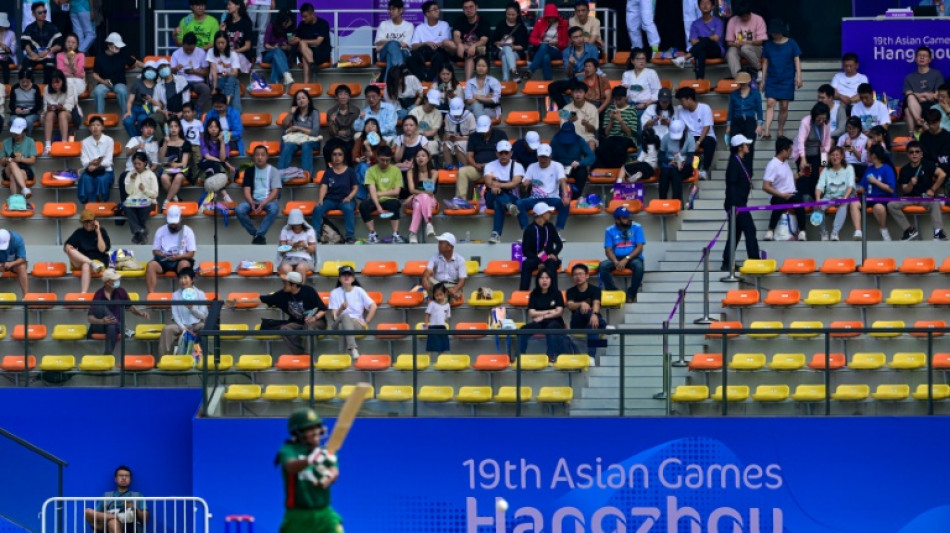
Leather, willow and sunflowers: China gets to grip with cricket / Photo: Ishara S. KODIKARA - AFP

 Malaysia Sues Google for $146m Over Harmful Content

 Black Wind Turbine Blades Reduce Bird Deaths by 74% in Spain Study

 Brazil’s Landless Movement Partners with China to Build Affordable Tractors for Family Farms

 Twickenham Grounds Team Prepares Pitch for Six Matches in Three Days

 Luxembourg Pay Rise Delayed as Regional and World Headlines Develop

 Audience to Choose the Set List at Luxembourg's First FAMIL Jukebox Night

 Raheem Sterling Receives Suspended Sentence After Lamborghini Crash

 Black Friday Discounts Cut Prices on Two Top-Rated Wiper Blades

 Arizona Gun Regulation Battle Intensifies Under New Democratic Legislative Majority
There's a reverential hush from the respectful crowd as Pakistan's Sadia Iqbal opens the bowling to Bangladesh's Shathi Rani in the Asian Games women's bronze medal match in Hangzhou.
The sound of leather on willow echoes around the purpose-built cricket ground, which until recently was full of sunflowers.
The atmosphere is more village green than the fever pitch of, say, Pakistan's Gaddafi Stadium, but the few hundred spectators are fully engaged -- even if many admit to never seeing the game before.
Almost entirely Chinese, the crowd "oohs and aahs" and clap when a wicket falls, cheer every boundary and then look bewildered when a loud lbw appeal pierces the serenity of the Zhejiang University of Technology (ZJUT) Cricket Field.
"I didn't ever see cricket before so I was interested to know more about this sport," said spectator Huang Dapeng, who runs his own business in Hangzhou.
"I'm starting to understand it a little, but I am really enjoying it anyway."
A few have some knowledge of the game and seem captivated.
"I travelled to Sri Lanka before and a friend invited me to watch cricket, so I became interested," said Liang Xiaoqian, a travel agent.
"When I heard it was in the Asian Games I wanted to learn more about this game," she added, ahead of Monday afternoon's final between India and Sri Lanka.
"I am enjoying watching. I will be supporting Sri Lanka in the gold medal match."
Others are there just because it is the Asian Games and they want to watch sport, any sport.
"It's the only Asian Games tickets we could get," said a smiling Jeff Wang, an engineer who was sitting in the stand with his father Wang Hang.
"It's my first time to watch cricket. It's unknown to me before, I don't really know what is going on.
"But I did hear this game is very famous in South Asia."
- 'Remain forever' -
Looking out over the near-circular ground, it is hard to believe that before the Asian Games the pristine mowed grass was a field of sunflowers.
It won't be getting overgrown after. The newest of the ZJUT campus's sporting facilities will have life after the Asiad.
"It will remain forever," venue manager Li Danlin told AFP. "There will always be cricket played here from now on."
The university has more than 20 colleges and 80,000 students. They will be taught about the game and encouraged to play, according to Li.
"We hope that cricket clubs will form and use the venue," she added.
Pakistan head coach Mohtashim Rasheed said it was vital to spread cricket to new territories.
"Very exciting to see the crowds here coming to watch, all Chinese people, that is a very healthy sign for developing cricket in China," Mohtashim, the brother of Pakistan Test player Haroon Rasheed, told AFP.
"It is a complicated game so we have to develop in China and other countries. The most important thing is to get it into schools.
"I would love to do an exchange programme here to help boys and girls learn the game. They can start small, a shorter version like six-a-side," added Mohtashim.
"If you could get under-10s playing, then in five years you would see a difference," he added.
"For the older-age kids we could bring it with baseball. I think they like playing baseball and it is similar.
"Swing a bat and hit a ball. That's a translation that could be made."
C.Cassis--PC