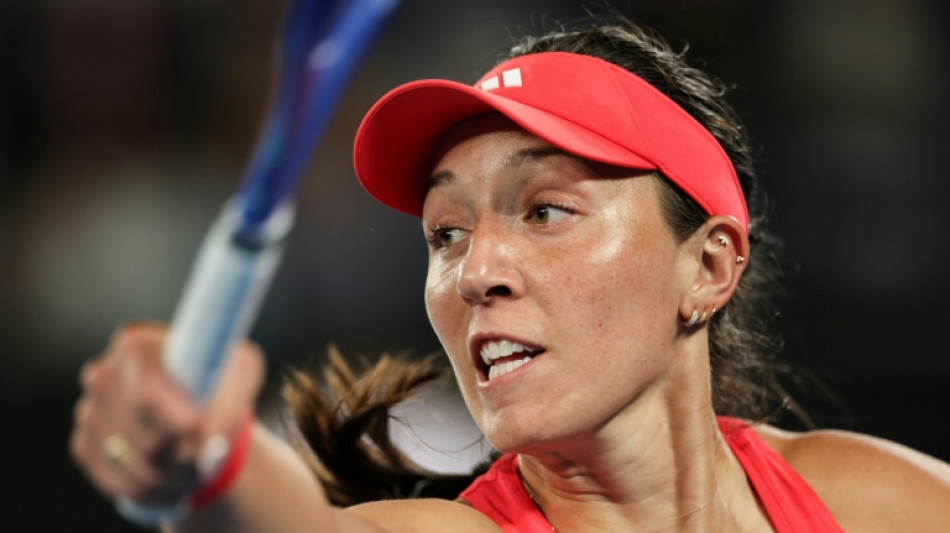
Tennis anti-doping process 'completely broken': Pegula / Photo: Adrian DENNIS - AFP/File

 Malaysia Sues Google for $146m Over Harmful Content

 Black Wind Turbine Blades Reduce Bird Deaths by 74% in Spain Study

 Brazil’s Landless Movement Partners with China to Build Affordable Tractors for Family Farms

 Raheem Sterling Receives Suspended Sentence After Lamborghini Crash

 Luxembourg Pay Rise Delayed as Regional and World Headlines Develop

 Audience to Choose the Set List at Luxembourg's First FAMIL Jukebox Night

 Twickenham Grounds Team Prepares Pitch for Six Matches in Three Days

 Black Friday Discounts Cut Prices on Two Top-Rated Wiper Blades

 Arizona Gun Regulation Battle Intensifies Under New Democratic Legislative Majority

World number five Jessica Pegula believes the handling of high-profile doping cases involving Jannick Sinner and Iga Swiatek has shown that the "process is completely broken".
And top-ranked Aryna Sabalenka admits she cannot trust the tennis anti-doping system and has become "too scared" of it.
Sinner’s long doping saga came to an end on Saturday after he agreed to a three-month ban from tennis, the world number one admitting "partial responsibility" for team mistakes which led to him twice testing positive for traces of clostebol in March last year.
Sinner was facing a potential ban of two years after the World Anti-Doping Agency (WADA) appealed to the Court of Arbitration for Sport (CAS) against his initial exoneration by the International Tennis Integrity Agency (ITIA), announced in August.
In a surprising move, WADA withdrew its appeal and came to an agreement with Sinner to accept a three-month ban.
In a statement, WADA said "Sinner did not intend to cheat" but would serve his suspension as he is responsible for the actions of his entourage.
Swiatek accepted a one-month ban after testing positive for the banned heart drug trimetazidine (TMZ) late last year.
The 23-year-old Pole had pulled out of the WTA's Asian swing in September-October citing "personal matters".
Pegula, last year’s US Open finalist and a member of the WTA Players' Council, said the inconsistencies in the way cases are being processed and judged is creating an unfair environment for all tennis players.
"I think my reaction is that, whether you think he did or you don't, or whatever side you're on, the process just seems to be completely not a process," the American told reporters in Dubai on Sunday.
"It seems to just be whatever decisions and factors they take into consideration, and they just make up their own ruling.
"I don't really understand how that's fair for players when there's just so much inconsistency and you have no idea."
Pegula added that any emails the players have been receiving regarding anti-doping cases contain explanations that are too easy to come up with, and are just ways for anti-doping organisations to justify their inconsistent rulings and processes.
"If you're clean or not, the process is completely broken," she stated.
"I think it needs to be seriously looked at and considered.
"I feel like they have so much power to ruin someone's career, as well. I think there needs to be something done about that because it just seems really unfair.
“I don't think any of the players trust the process at all right now. Zero. It's just a horrible look for the sport."
- 'Too scared': Sabalenka -
Sabalenka refused to comment on the outcome of the Sinner case but says she has become too wary of falling foul to the sport’s strict anti-doping rules.
"You just start to be more careful. For example, before I wouldn't care about leaving my glass of water and go to the bathroom in a restaurant. Now, I’m not going to drink from the same glass of water," said the Belarusian world number one.
"You just become a bit more aware of stuff and this thing gets to your head that, like, if someone used a cream on you and you test positive, they’re going to go for you and they’re not going to believe you or anything.
"You just become too scared of the system. I don’t see how I can trust the system."
American world number three Coco Gauff has not paid much attention to the details of the recent anti-doping cases and is instead sticking to her strategy of avoiding taking any supplements to minimise the risk of testing positive for any banned substance.
"I trust that everyone is doing what they can to protect the sport. As a player, that's all I can hope for," said the former US Open champion.
"I just hope it's more for the protection of the sport and not just out to, like, get players."
C.Cassis--PC