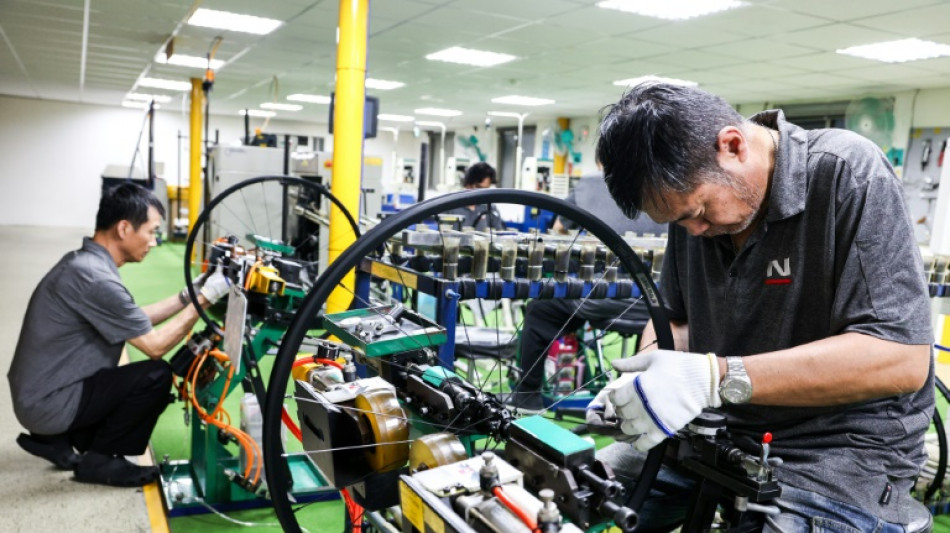
Taiwan bicycle makers in limbo as US tariff threat looms / Photo: I-HWA CHENG - AFP

 Milan-Cortina hailed as 'new kind' of Winter Olympics at closing ceremony

 Strasbourg snap Lyon winning run in Ligue 1

 'One Battle' triumphs at BAFTAs that honour British talent
 Giroud penalty ends Lille's winless run in Ligue 1

 Iran-US talks expected Thursday despite fears of strikes

 Hughes looses teeth then scores Olympic gold-winning goal for USA

 Arsenal's Eze sinks Spurs again, Liverpool late show floors Forest

 'Nothing was good', says Mac Allister despite Liverpool win

 EU 'expects' US to honour trade deal as Trump hikes tariffs

 South Africa thrash India to end 12-match T20 World Cup win streak

 US says trade deals in force despite court ruling on tariffs

 Gu strikes gold, USA beat Canada in men's ice hockey

 Napoli rage at officials after loss at Atalanta

 Rimac Nevera R: Beyond imagination

 Samardzic seals comeback win for Atalanta over Napoli

 Luce: Ferrari's ingenious electric revolution

 Scotland boss 'proud' of comeback Six Nations win over Wales
 US Secret Service kills man trying to access Trump Florida estate

 Cayenne Turbo Electric 2026

 Doris says Six Nations rout of England is sparking Irish 'belief'
 Emotional Gu makes history with Olympic freeski halfpipe gold

 Gu wins triumphant gold of Milan-Cortina Olympics before ice hockey finale

 Underhill tells struggling England to maintain Six Nations 'trust' as Italy await
 BMW 7 Series and i7: facelift in 2026

 Eileen Gu makes history with Olympic halfpipe gold
Weeks after Donald Trump's global tariff bombshell, Jeff Chen's factory in Taiwan is as busy as ever turning out carbon and alloy wheels for high-end bicycles bound for US and European markets.
But he wonders how much longer it will last.
The US president's initial 32 percent tariff on Taiwan stunned the island's bicycle manufacturers, who were racing to meet orders ahead of the northern summer before the new toll was announced.
Some US customers immediately cancelled or postponed shipments, only to reverse their decision when the hefty tariffs on Taiwan and many of America's trading partners were paused for 90 days.
With a global 10 percent levy still in place and no clarity on what happens once the three months are up, Taiwanese bicycle companies and US buyers are in limbo.
"They don't know what to do. There's no time to respond," said Chen, general manager of Joy Group, which makes wheels and hubs in Taichung.
Joy Group, founded by Chen's grandfather in 1971, is one of more than 900 companies assembling bicycles or making components, including wheels, pedals and frames, mostly in central Taiwan, the island's manufacturing heartland.
Some companies have received a surge in orders as US customers rush to import bicycles and components before the end of the 90-day period.
Others, like Joy Group, have seen little change in demand, which Chen put down to inventory leftover from Covid-19, when retailers stocked up to meet surging demand for bicycles.
Chen said US customers had passed on the 10 percent tariff to consumers, but a 32 percent levy could put the brakes on further orders, with inevitable knock-on effects in Taiwan.
- 'Hidden champions' -
"If we are getting affected, then the company would need to think how to cut down... everybody will be facing the same issues," said Chen, whose company also has four factories in China.
Taiwan has long been a key player in the global bicycle industry, but it faced an existential crisis more than two decades ago when an ascendant China drew many of the island's manufacturers to its shores.
Rather than try to compete with China's cheaper, mass-produced two-wheelers, Taiwanese companies collaborated to upgrade their manufacturing techniques and produce quality bikes and components for high-end markets, mainly in Europe and the United States.
While Taiwan's export volume has fallen dramatically from around 10 million in the 1990s to 1.3 million in 2024, exacerbated by the pandemic glut, the average export price of its bicycles has risen sharply.
A traditional bike was valued at US$1,131 last year and an e-bike US$1,848, industry data and analyst reports show.
China, which exported more than 44 million bikes in 2024, had an average price of US$57.
Taiwan bicycle industry expert Michelle Hsieh said the island's success in targeting the high-end market was down to "hidden champions" in the supply chain.
Small and medium-sized companies -- a hallmark of Taiwan's manufacturing sector -- were highly specialised and flexible, Hsieh said, making them "indispensable" in the global market.
"They are making things that other people cannot make so they have that competitive advantage," said Hsieh, a sociologist at Academia Sinica in Taipei.
Trump's hopes that higher tariffs will force firms to move their production to the United States were dismissed by Taiwanese and American bicycle manufacturers as fanciful.
- 'Like a big family' -
It would be "nearly impossible" to set up a factory in the United States in the next three to five years, Taiwanese bicycle company Giant told AFP, citing higher costs, labour challenges and the lack of a "bicycle industry cluster".
"Taichung is the absolute centre of the bicycle industry," said Tim Krueger, industry veteran and chief executive of US-based Esker Cycles, which imports frames and parts from Taiwan for its mountain bikes.
"That's where the expertise in the whole world is on how to properly manufacture bicycles."
Some bike makers in Taiwan look set to benefit from the 145 percent tariff on Chinese products in the short term, with US customers seeking out Taiwanese suppliers, Hsieh said.
But Tsai Po-ming of the Cycling & Health Tech Industry R&D Center, which was set up in 1992 to help Taiwan's industry become more competitive, said there could also be negatives.
Chinese manufacturers might try to offload their lower-end bikes in Europe if Trump's tariffs fuelled inflation, Tsai told AFP.
"Consumers might feel that the prices are too high, and although our products are mid to high-end in quality, they might prefer to buy lower priced models instead," he said.
At Pacific Cycles' factory near Taipei, workers assembled fold-up bicycles mostly destined for Europe and Asia.
While the company has little direct exposure to the US market, president Eva Lin said if one of its suppliers was hurt by the tariffs, then Pacific Cycles would be affected.
"The complete industry is like a big family," she said.
"No one can escape from the impact."
C.Amaral--PC