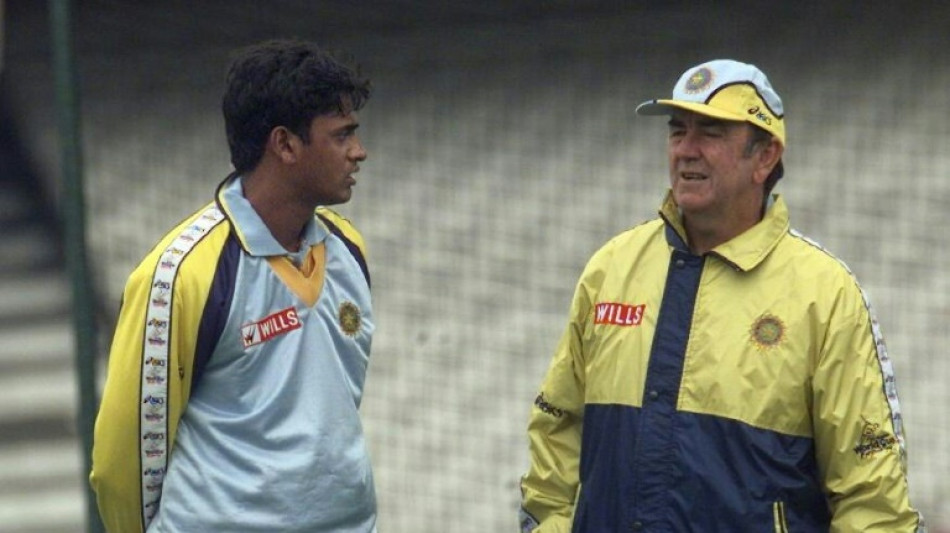
Bob Simpson: Australian cricket captain and influential coach / Photo: MARTIN HAYHOW - AFP/File

 Jovic 'loses sanity five times over' to oust friend Eala in US Open epic

 China's memories of Mao fade to nostalgia 50 years after his death
 US envoys discuss with Putin 'substantive' plans for steps to end Ukraine war

 Zheng stuns Keys as US Open upsets dim American hopes

 Jovic 'loses sanity five times over' to oust Eala and book Gauff clash
 'Like a jewel': Japan's luxury ice revered by bars worldwide
 'The flood is coming': How a Nepal principal saved 900 students
 Kiss's winning run ends as Argentina hold Australia to draw
 Alcaraz excited to face 'dangerous' Paul for US Open quarter-final berth
 Prince William to represent King Charles III at Norway late King Harald's funeral
 Inter and Roma roar back to win thrillers and share top spot

 Don't stop them now: fans party for Freddie Mercury's 80th birthday
 AFP photographer wins top prize for Madagascar protest coverage

 Keys: 'I felt like I couldn't play tennis'
 Simmonds stars as Pau upset Montpellier
 Inter roar back in five-goal thriller with Napoli

 Haaland keeps Man City perfect in Premier League, blunt Spurs held

 Hamilton worried by Ferrari pace while Antonelli prepares for a fight

 Vuelta stage 15 shortened due to extreme heat, Mas consolidates lead

 Putin meets US envoys for Ukraine war talks
 Modric available for Croatia in Nations League
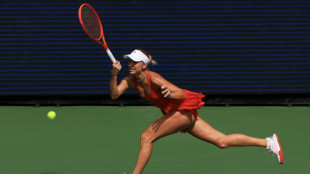 Potapova upsets 2025 US Open runner-up Anisimova
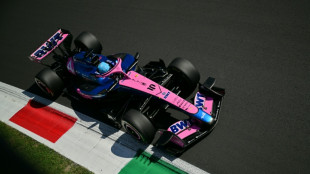 Gasly a 'class act' says Alpine boss after Monza pole
 Athletic Bilbao crush Simeone's flat Atletico

 Stay far from battlefield, warns Japanese director in Vietnam War film
Bob Simpson, who has died at the age of 89, was the archetypal granite-jawed comic-book Australian cricketer who opened the batting, bowled leg-spin and is still cited as the greatest slip catcher the game has seen.
Across four decades, in different roles, he was a key figure in Australian cricket.
Picked for the first time on the 1957-58 tour of South Africa, Simpson took 30 Tests before scoring his first hundred against England at Manchester in 1964, by which time he was also skipper.
He made sure to cash in, going on to post 311 in that Old Trafford innings, the first of his Test centuries - at that time the second highest individual score by an Australian after Don Bradman's 334 against England in 1930.
He is one of only three batsman whose maiden Test centuries were triples, the others being the great West Indian Garry Sobers and India's Karun Nair.
In 62 Tests, which stretched between 1957 and 1978, Simpson racked up 4,869 runs at an average of 46, took 71 wickets and pocketed 110 catches.
He had two spells as captain, first in the 1960s and then again as a 41-year-old recalled to the side a decade later when Kerry Packer's World Series Cricket deprived Australia of its most experienced cricketers.
And in the mid-1980s he took over as coach, working alongside captain Allan Border to rebuild a mediocre Australia team and turning them into the dominant force in world cricket.
- 'Discipline' -
Robert Baddeley Simpson was born in the Sydney suburb of Marrickville on February 3, 1936, the third son of immigrant parents from Scotland whose belief in physical and mental toughness rubbed off on young Bobby.
"I was a naturally ambitious person anyway and never had any doubts I could go further," said Simpson. "It sounds cocky but I always believed in my own talents."
He was still only 16 when he made his debut for New South Wales against Victoria in the 1952/53 season.
It took a move to Western Australia though to get enough cricket to nudge the selectors. Once on the boat to South Africa he was to become a fixture in the side although it was not until he was paired with Bill Lawry at the top of the order in 1961 that he really made his presence felt.
Over a seven-year period they averaged over 60 for the first wicket and posted nine century partnerships, including a monumental 382 against the West Indies in Bridgetown in 1965.
It was the first time that two openers had both scored double-centuries in the same Test and remains a record for Australia's first wicket.
He took over the captaincy from Richie Benaud during the 1964/65 home series against South Africa but retired three years later to find a find a more secure living, initially as a journalist and then in public relations.
When World Series Cricket split the game in 1977, causing most of Australia's leading players to be barred from the national team, Simpson came out of retirement to captain both NSW and Australia.
Leading them in a five-Test series against India he began well with 89 in the first Test and then made 176 in Perth, and 100 and 51 in the final Test in Adelaide as Australia scraped the series 3-2.
He was less successful on the subsequent tour to the West Indies with just one half-century in the 3-1 loss and the selectors drew the curtain for the second time on his playing career.
In 1986 he was appointed coach of an underperforming Australian team with his first priority to improve the quality of the fielding.
"He basically maintained that if you become a really, really solid and high-quality fielding team, even if you have not got the best cricket team, you can stay in the contest for longer, if the other side is better than you," said skipper Border.
"You can win games just on fielding alone."
The result was almost instant as Australia won the 1987 World Cup and then embarked on a period under Border and then Mark Taylor, helped by the burgeoning talents of Shane Warne, Glenn McGrath, Steve Waugh and his twin Mark, when Australia finally overshadowed the West Indies as the best team on the planet.
He wasn't loved by all with some such as Ian Chappell vocal in their disdain but the players he worked with until he stepped back after the World Cup final defeat in 1996 almost universally appreciated his tough manner.
"He was very hard and focused a lot on discipline," said fast bowler Mike Whitney.
"If you didn't have that and if you didn't work within the parameters that he wanted, you were out of the side in a blink of an eye. And everybody knew that."
J.V.Jacinto--PC