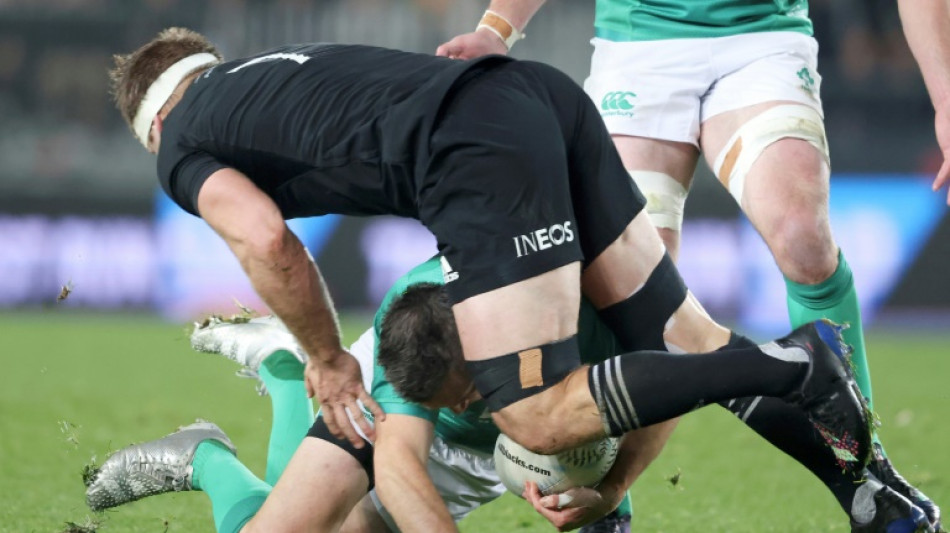
World Rugby clarifies concussion process after Sexton selection / Photo: MICHAEL BRADLEY - AFP

 Google Smart Glasses Privacy: Bystander Face Removal Limits

 Egypt and Vietnam Explore Manufacturing and Technology Transfer Partnerships

 Hilton Phoenix Resort to Open Emberance Restaurant Inspired by Sonoran Desert

 Canva Craft vs ChatGPT: Head-to-Head AI Image Generation Test

 TikTok Security Chief Advises SMBs on Free Cybersecurity Protections

 UCLA Stays Unbeaten With Ty Dieffenbach's Heroic Return Against Illinois

 Marco Rubio Praises Daughter Daniella’s Speech at Federalist Society Convention
World Rugby released a statement Friday clarifying its concussion safety measures after Ireland's selection of captain Johnny Sexton for the second Test against New Zealand drew criticism from a lobby group of rugby's "failing" protocols.
The treatment of fly-half Sexton has been compared unfavourably to that of fellow-veteran Sam Whitelock, the All Blacks lock who has been omitted from Saturday's Test in Dunedin after he suffered delayed concussion symptoms.
All Blacks' coach Ian Foster said Whitelock's welfare took immediate priority and he was left wondering why Ireland would consider picking Sexton, a pivotal player for the tourists.
The 36-year-old suffered a head knock on the half-hour mark of last Saturday's first Test defeat in Auckland and didn't return after failing a sideline Head Injury Assessment (HIA).
He was cleared after passing a second HIA later that night and a third on Monday.
"What I do know from our perspective is the protocols are crystal clear," Foster said.
"If it looks like you've taken a knock and you fail an HIA, you go to a 12-day programme (break) and that's pretty crystal clear to us."
World Rugby's statement said "any player who displays clear signs of concussion during a match such as loss of consciousness, loss of balance and dazed etc, should be permanently removed from play and must not return to play before 12 days."
Sexton wasn't demonstrably struggling after colliding with captaincy counterpart Sam Cane, and Ireland coach Andy Farrell refuted any suggestion his playmaker would be at risk when contesting his 107th Test.
"The only thing that matters here is Johnny. We always, as medics and coaching staff alike, err on the side of caution first and foremost," Farrell said Friday.
"The process was passed and he's fit to play.... It wasn't concussion and we move on with the rules."
- Player welfare -
World Rugby confirmed that failing the pitchside HIA test didn't confirm concussion and, by passing his second and third HIA tests, Sexton was "not required to undertake the return to play protocols".
However, lobby group Progressive Rugby, whose members include medical professionals, issued a statement objecting to the protocol and said Sexton shouldn't have been selected.
"Elite players who fail an in-game HIA have, by definition, displayed cognitive dysfunction requiring their removal," the statement said.
"The fact is there remains no examination by any expert that can demonstrate a brain has healed and is not at risk," it said.
"If player welfare is truly the game's number one priority, the only option must be to err on the side of caution -– otherwise the new elite protocols are failing in their key purpose."
Claims of inadequate concussion treatment have clouded the tour.
Ireland prop Jeremy Loughman was allowed to play for a further 25 minutes after staggering from a head blow early in the tour-opening loss to the Maori All Blacks, prompting an investigation from NZ Rugby, which identified a lapse from the matchday independent medical staff.
M.A.Vaz--PC