First 'dispersed' Winter Olympics a success -- and snow helped / Photo: Fabrice COFFRINI - AFP

 Middletown High School Football Team Ends Legal Battle After Playoff Forfeit

 Canada Signals Openness to Chinese Automakers if US Trade Talks Fail

 US Mortgage Rate Falls for Fourth Week but Remains Above 7%

 US Jobless Claims Rise to 200,000 but Layoffs Remain Historically Low
 Euro-Area Growth Slows to 0.4% While Employment Stalls
 US Wholesale Inflation Eases Monthly but Hits a Four-Year Annual High

 India's Wholesale Inflation Jumps to 12.29% as Fuel Costs Surge
 Japan's Economy Edges Into Contraction as Costly Oil Weighs on Demand

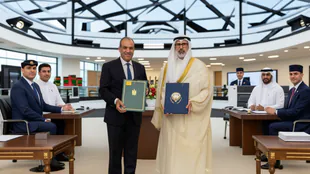 Kuwait and Egypt Sign Eight Agreements to Expand Strategic Partnership

 OBI Pharma Signs Collaboration and License Agreement with Novartis

The Milan-Cortina Games end on Sunday after nearly three weeks of action held over a vast area of northern Italy, with organisers and athletes hailing the most spread-out Winter Olympics in history as a success.
Four competition clusters have hosted captivating stories and world-class performances as the Winter Games returned to one of its traditional heartlands, on the Italian side of the Alps.
The venues also provided a perfect seasonal backdrop thanks to some timely -- and copious -- snowfall, delighting broadcasters.
Kirsty Coventry, the head of the International Olympic Committee (IOC), said that this year's Games "surpassed everyone's expectations" despite huge logistical challenges and some hairy moments getting venues ready in time.
"These Games have been truly successful in a new way of doing things, a sustainable way of doing things in a way that I think many people thought maybe we couldn't do," Coventry said on Friday.
"It's been done extremely well. It surpassed everyone's expectations and that's what we need to take away from the Games."
Coventry was speaking in the press conference at the end of her first Winter Olympics in charge of the IOC after replacing Thomas Bach in June last year.
Her first Games have seen a shift in philosophy on how they should be organised after the colossal investments needed to host the previous three in pioneering locations.
- 'Centre of attention' -
Italian organisers have almost exclusively used existing competition venues that are accustomed to hosting regular season events and world championships.
And the overall budget of 5.2 billion euros ($6.1 billion) -- 1.7 billion euros for the Games themselves and 3.5 billion for the accompanying infrastructure -- is a fraction of what was spent for the three previous editions in Sochi, Russia, Pyeongchang in South Korea and Beijing.
These Olympics were spread over 22,000 square kilometres (8,500 square miles) and that caused concern both for the transportation of fans and athletes and fears that the overall atmosphere would suffer.
But Nils Blairon, a member of the French four-man bobsleigh team, summed up the positive assessment of many of the athletes competing in Italy.
"Everything is great, we're being given a fantastic welcome," he said.
"Everything is being done for us. We're kind of the centre of attention, which is always a very pleasant feeling."
The thorny issues which had plagued the build-up to the Olympics vanished once the action was underway, in particular the main ice hockey arena in Milan which was still unfinished just weeks before the puck dropped on competition.
Although some final details at the arena were unfinished -- and the smell of fresh paint was unmistakeable -- no problems were reported by teams featuring star players from the National Hockey League (NHL), who were appearing at an Olympics for the first time since 2014.
- Smooth operations -
Meanwhile the issues with artificial snow production in Livigno, which led to a pre-Games investigation by the International Ski Federation, have been forgotten as freestyle skiing and snowboarding events have gone off without a hitch.
"There's a general sense of satisfaction," said Christophe Dubi, the IOC's Executive Director for the Olympics.
However Dubi admitted that some parts of the dispersed model, which will be repeated on the French side of the Alps in four years' time, can be improved.
Swiss ski star Marco Odermatt complained that "there's practically no Olympic spirit" in Bormio where the men's alpine events were held, with Dubi admitting that they "felt very isolated" in the tiny resort town.
"Maybe there was something that could have been done better, in particular -- and I would connect this to a second point -- that the medals are given out at the venues and right after events," said Dubi.
"Maybe we should go back to the idea of a single medals plaza (where all athletes are awarded their medal)."
O.Salvador--PC