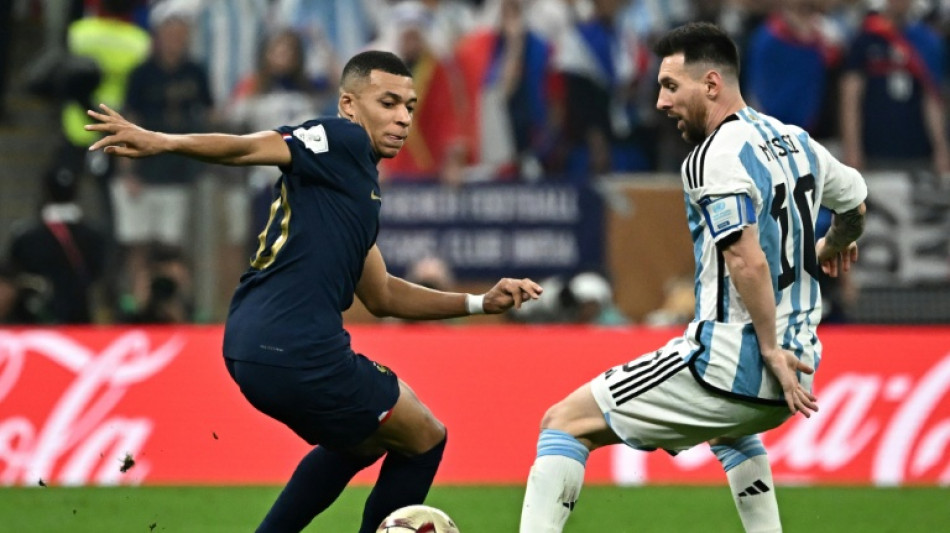
How might this World Cup be won on the pitch? / Photo: Anne-Christine POUJOULAT - AFP/File

 'More confrontational': Iran's new hardline security leadership

 UK summons Israeli envoy over West Bank settlement project
 Trump vows 'tremendous' economic costs on Iran partners

 Germany, France, UN condemn far-right Israeli minister's 'inhumane' Gaza remarks
 Prince Harry and Meghan moving back to UK: British press
 Lee, Baena guide Atletico to opening Liga win over Malaga
 Ecuador intel chief, five Americans killed in Kenya helicopter crash
 Robinson and Tongue share match ball after dismissing Pakistan
 Israel army admits firing on car in death of five-year-old Hind Rajab
 Honduras places 80% of country on El Nino drought alert

 Some of Meta's safety tools were 'designed to fail': witness
 PSG Ligue 1 opener moved over state of Parc des Princes pitch
 UK PM launches bid to help homeless, donating part of his wages
 Golden Shoe winner Kane hopes for Ballon d'Or after 'best season ever'
 Kyiv's ex-defence chief makes risky bet by venturing into electoral grounds
 Coventry have survival inspiration says Lampard

 Reijnders leaves Man City for Saudi's Al Qadsiah
 Trump says will meet North Korea's Kim later this year
 Stocks waver, dollar drops as US Treasury moves to lower bond yields
 France recalls rare disease drug Tavneos after deaths
 Arsenal agree to sign Villa defender Konsa: reports

 Evacuation orders lifted in Belgian wildfire zone
 UK media skewered for 'hounding' black academic
 More than 7,300 excess deaths in France's historically hot summer so far
 US socialists score shock Florida win as Trump picks stumble
The World Cup represents football's pinnacle, the ultimate prize every young player dreams of winning. But whether the tournament is where the very best football is played is a different question entirely.
Elite European clubs with vast revenues concentrate so much of the top talent, and the very best games are often played in the latter stages of the UEFA Champions League -- think of Paris Saint-Germain's recent 5-4 win over Bayern Munich.
It is hard for most international teams to reach the same level -– Luis Enrique himself has taken PSG to greater heights than he managed with Spain at Euro 2020 or the 2022 World Cup.
"I don't think you can compare the international game with elite club football. They each have their own character," insists Andy Roxburgh, the ex-Scotland manager, now technical director of the Asian Football Confederation having previously had the same role with UEFA.
"In international football, there's no transfer market. You select and you use what's available to you."
Therefore, he says, national team coaches usually have to be pragmatic.
"In the international scene, because there's fewer games, and they're usually high-profile games, results are magnified and exaggerated," he tells AFP from Kuala Lumpur.
- High intensity? -
"A national team manager gels the players together, adds his own philosophy, and the national culture is taken into account. But the way the players play at their club has a big, big influence."
An obvious example is the Spain team that won back-to-back Euros either side of lifting the 2010 World Cup, while leaning heavily on the all-conquering Barcelona of the era.
So how exactly might this World Cup be won?
As tactical systems at elite clubs become more advanced, the world's top national teams -– in Europe and South America, plus perhaps Morocco, Senegal and Japan -– may be best suited to borrow elements from their ways of playing.
There is the quick counter-attack, something PSG have demonstrated in devastating fashion in the Champions League and which Argentina used to score their stunning second goal in the 2022 World Cup final against France.
"The key moment in a game of football is the change from defensive phase to attacking phase, when the opposition has no time," said France coach Didier Deschamps a few months after that game.
In order to recover the ball quickly, many of the world's top teams now play with a high press.
Roxburgh, now 82, has followed international football's evolution since managing Scotland at the 1990 World Cup.
"What has changed is the speed of the game. The pressure on the ball is far more intense," he says.
"So collective play at international level today is more sophisticated than previously.
"In the past it depended a lot on individual stars -- today the stars play for the team."
- Set-pieces -
However, the energy required to deploy that high press may come up against one significant problem at this World Cup: the heat of a North American summer.
"I know we're going to have water breaks, but that might not be enough to allow teams to press and play high-intensity," adds Roxburgh.
"We'll see. Jesse Marsch, who's right into high pressing up in Canada, might be able to do that, but I'm not sure that in some parts of the US or even Mexico it will be easy to do."
There is also something more basic, but which has become a defining feature of this Premier League season: the weaponisation of set-pieces and long throws.
"These things will matter... All these patterns are back and crosses are back, as well," said England's Thomas Tuchel earlier this season.
And set-pieces are one aspect of the game coaches can control, while the three-minute hydration breaks FIFA is introducing for midway through each half at the World Cup could well also prove significant for them.
"These could be a big moment for coaches from a tactical viewpoint," said former Arsenal midfielder Gilberto Silva, the 2002 World Cup winner with Brazil who is now part of FIFA's technical study group.
"Now they have two more opportunities, beyond half-time, to make changes. That is a big advantage for them."
A.Seabra--PC