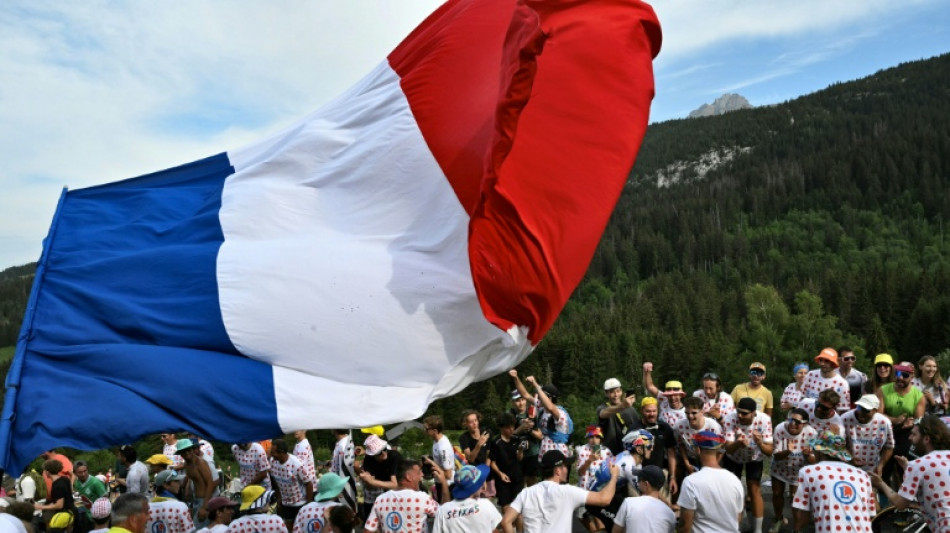
Tour de France hit by new wave of anti-doping tests / Photo: Jeff PACHOUD - AFP/File

 British Couple Spends £3,500 on Gender-Selective IVF in Egypt to Ensure Daughter

 Games Inbox: Reader Debates GTA 6 PC Release, Graphics, and Monster Hunter Choices

 Karbon-X (OTCQB: KARX) Joins IATA CORSIA EEU Supply Alliance as 2027 Aviation Compliance Demand Accelerates
 US Lawmaker and Colombian Ministry Urge X to Suspend Gustavo Petro’s Account

 Firefighters Respond to Blaze at Will Smith and Jada Pinkett Smith's Los Angeles Estate

Several Tour de France teams, including that of Olympic champion Remco Evenepoel, confirmed on Tuesday they had faced anti-doping controls during the race's final rest day.
However, unlike those on Sunday targeting Tour leader Tadej Pogacar and former champion Jonas Vingegaard, these did not happen in the middle of the night.
Pogacar and Evenepoel had beeen amongst a number of riders to blast the night-time controls carried out by the International Testing Agency (ITA) as "inhumane" or disrespectful.
Evenepoel's Red Bull-Bora Hansgrohe, the Decathlon CMA CGM team of French teenage sensation Paul Seixas and French outfit Groupama-FDJ United were amongst the teams targeted on Monday evening -- although in some cases, the riders tested had already gone to bed.
"We were also visited last night, some riders were already asleep," Red Bull manager Ralph Denk told German television channel ZDF.
Their eight riders were tested at 10:00 pm, a spokesperson said.
Decathlon's seven remaining riders in the race were tested at around 8:30 pm.
Picnic-PostNL, Jayco-AlUla and Bahrain Victorious also faced tests.
The ITA is an independent organisation which has been designated by the International Cycling Union (UCI) since 2021 to carry out doping controls.
These tests have become a hot topic at the Tour after Vingegaard and Pogacar were visited by the ITA at 2:00 am and 5:00 am respectively on Sunday, just hours before a major mountain stage.
Vingegaard crashed on that stage after coming down on a bend and broke his collarbone, leading to him quitting the race.
Pogacar speculated afterwards his arch rival's disturbed sleep could have contributed to a lack of concentration which resulted in his fall.
Doping tests are generally done between 5:00 am and 11:00 pm but the ITA had petitioned a Paris judge to get permission to carry out a night-time test.
On Monday, the CPA union which represents professional cyclists blasted the process as counter-productive.
But Jonathan Vaughters, the manager of the EF Education team, who in 2012 admitted to having doped during his cycling career, a part of which was spent in the US Postal team of Lance Armstrong, applauded the controls.
"2am testing is one of the very effective ways to prevent peptide (EPO, hGH) and testosterone micro dosing," he posted on social media.
"If UCI had tested us in 2001 at 2am? We'd all have been suspended and saved the sport 25 years of drama."
Cycling went through a particularly dark and murky period in the 1990s and 2000s when numerous Tour winners either tested positive for doping or later admitted to having done so, amongst them Armstrong.
Nogueira--PC