
New trend of injecting banned peptides to 'optimise' body / Photo: Julie SEBADELHA - AFP/File

 Apple's Cook praises EU over efforts to protect children online

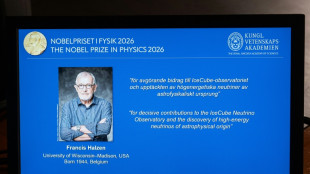 Nobel winner Halzen says years of October 'misery' finally over

 Quebec separatist win rattles Carney's unity push

 'Itching' for change: Shiffrin cuts back slaloms this season

 'Gen Z has risen up': Tens of thousands mass for tense France school protests

 Caribbean tourism hotspot loses men to Russian war machine

 Danish reservists practice war games to respond to 'aggression'

 Bhuvneshwar returns to India's T20 squad for New Zealand tour

 Asos says probing 'unauthorised activity' after phone alerts

 Stocks climb as oil prices retreat under $100 per barrel

 Neutrinos: space particles that change our view of universe

 'Destined' Djokovic wins China Open, extending unbeaten record

 Iceland is 'critical outpost' for security, says Rubio during visit

 Israeli settlers beat AFP photographer covering West Bank

 'Gen Z has risen up': Tens of thousands demand better education in France

 $10 Million and Counting: Hola Prime Hits Major Trader Payout Milestone

 UEFA investigate Ireland-Israel tunnel bustup after spitting claim

 Djokovic wins China Open and keeps unbeaten record after de Minaur retires

 Amsterdam's Rijksmuseum hosts 'homecoming' show for Willem de Kooning

 World Bank forecasts modest growth for Latin America, highlights climate risks

 'Afraid for my future': Tens of thousands demand better education in France

 Pakistan PM urges Imran Khan supporters to end protest march

 Alex Bodi își continuă expansiunea: planuri pentru deschiderea unui showroom ALIX LASERS la București

 STARTRADER Adds 20 Stock and ETF CFDs to Its 24/7 Trading Range

 Bulgaria searches for missing crew after drones hit more Black Sea ships

Thomas's phone alarm buzzes at 9:30 pm -- it's time for the aspiring bodybuilder to start injecting himself in the stomach with several banned peptides.
He takes vials from his refrigerator of GHK-Cu, which he tells AFP will give him "beautiful skin", and Retatrutide, which will help him "feel less hungry".
After adding a liquid to reconstitute the synthetic peptides, he disinfects the syringes and shoots both into his lower abdomen.
Thomas, whose name has been changed, takes GHK-Cu daily and Retatrutide three times a week.
"It takes a little organisation, but it's become a routine," said Thomas, who goes to the gym almost every day.
He is one of a growing number of people attempting to "optimise" themselves by using peptides, a class of substances being widely promoted online by influencers, celebrities and the wellness industry.
Viral social media posts claim peptides can offer a range of seemingly miraculous benefits including glowing skin, stronger muscles, deeper sleep, a more alert mind -- and even provide an avenue to prevent ageing.
However experts warn there is little evidence to support these claims, and that because these peptides have not been studied properly, they can pose serious health risks.
That is why these peptides remain banned in many countries, including in France where Thomas lives.
In the United States, however, a panel recommended loosening restrictions on a range of peptides last month.
The decision outraged many medical experts, who accused Health Secretary Robert F. Kennedy Jr. -- an avowed fan and user of peptides -- of packing the panel with people who have strong ties to the peptide industry.
- 'Very real health risks' -
Peptides are short chains of amino acids that assemble to form proteins, which are the body's building blocks.
They occur naturally in the body, helping dictate processes such as repairing tissue.
Peptides reproduced in a lab are the active ingredients in many common medications including insulin and GLP-1 weight-loss drugs.
However unauthorised forms of synthetic peptides sold online have increasingly been promoted by influencers and gyms promising a more effective workout.
Thomas was already using steroids when he was introduced to peptides six months ago.
Along with GHK-Cu and Retatrutide, he sometimes injects himself with Selank for help with anxiety and BPC-157, which promises to more quickly repair soft tissue such as ligaments.
Because these peptides are not authorised for sale in France, there are no official guidelines for how to use them.
In online discussion forums such as Reddit and Discord, communities of mostly men exchange advice on how much and how often they should inject themselves.
"You read the studies, you look at the lab tests, and you see all the positive effects," said Thomas, who believes that the risks are "rare and not serious".
- Self-experimentation 'worthless' -
However neuroscientist Armelle Rancillac at French research institute INSERM warned that knowledge on how to use these peptides remains limited because they "have often not been tested on humans".
Earlier this year, INSERM said that "no large-scale, randomised controlled clinical trial has confirmed" the promised benefits of peptides, warning that some pose "very real health risks".
"We are not giving research enough time to prove its worth," Rancillac emphasised, adding that" scientifically worthless" accounts of self-experimentation were being given too much credence.
Numerous nations have reported people being hospitalised after using peptides. In June, Australia's government reported six cases of acute liver injury linked to products labelled Retatrutide.
It is difficult to determine how many people are using peptides, but the recent increase to exposure is enough to "raise alarm", Fabien Ohl, a sports sociologist at the University of Lausanne in Switzerland, told AFP.
Ohl criticised the "biological view" being pushed online that the human body is "capital" to be exploited by taking chemical substances to improve one's physical appearance.
For example, one website selling peptides promised to provide "the chemical architecture for those seeking absolute biological optimisation".
Self-proclaimed experts online also sell advice vowing to help men "optimise" their physique.
Ohl criticised this view of masculinity as problematic, warning it normalised an idea of "the biological male who is potentially more violent and aggressive".
R.J.Fidalgo--PC