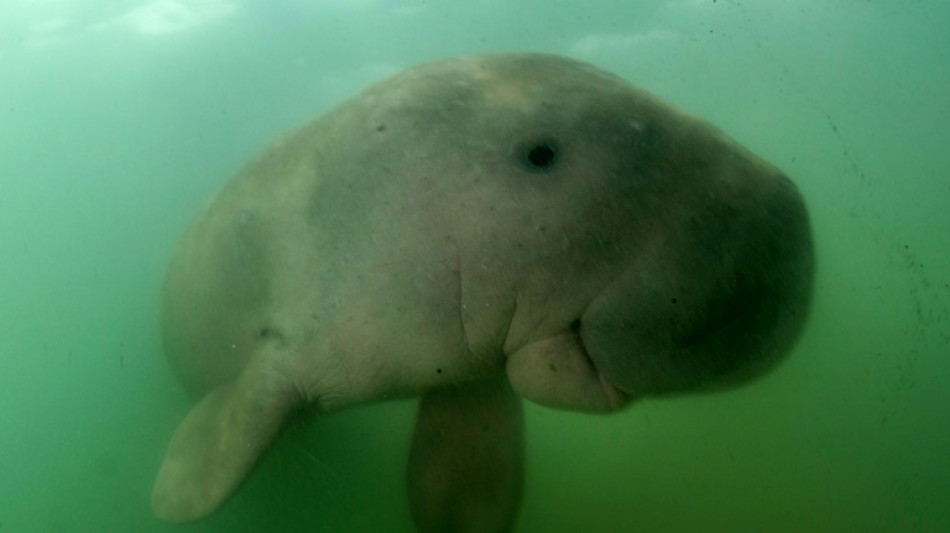
Sea cows threatened with extinction / Photo: Sirachai ARUNRUGSTICHAI - AFP/File

 World No.1 Sinner pulls out of Shanghai Masters to delay return

 Red Bull's Verstappen grabs pole position for Bahrain GP

 India beat Pakistan in blockbuster as golfer Kim wins 'crazy' gold

 India beat arch-rivals Pakistan to win Asian Games cricket gold

 Ethiopia's Tigray rebels abandon regional capital as govt advances: journalist

 Tom Kim powers to Games gold and exemption from military service

 Split loyalties for Indian football fans at Brazil friendly

 India-Pakistan blockbuster brings cricket fever to Japan baseball field

 Wong waiting on Rafa after winning Asian Games tennis gold

 With Russia next door and rising costs, Latvia goes to the polls

 Penalty hero rues empty seats as Games hosts Japan win football gold

 North Korea fires ballistic missile after Seoul's apology demand

 US regulator finds Boeing 737 MAX software bug 'not a safety concern'

 Ohtani 'managing' injuries as Dodgers launch MLB post-season

 Botched US execution leaves murderer unconscious on ventilator: lawyers

 Cornell rape case exposes sexual violence at US colleges

 France held by Italy in Zidane's homecoming after Olise stunner

 Ethiopian pro-government militia claims Tigray airport as regional tensions spike

 Ohtani shaking off injuries as Dodgers launch MLB post-season

 Sea levels to rise in California as coastal wave surges up west coast

 New rallies urged in France as protests disrupt over 730 schools

 Djokovic survives China Open scare, Sabalenka starts strong

 King Charles to evoke colonial 'darkest days' on Caribbean tour

 Tesla shares jump after global car sales top estimates

 DR Congo Ebola outbreak killed more than 4,000: official figures

Dugongs -- large herbivorous marine mammals commonly known as "sea cows" -- are now threatened with extinction, according to an official list updated Friday.
These gentle cousins of the manatee graze on seagrass in shallow coastal waters -- but their populations in East Africa and New Caledonia have now entered the IUCN (International Union for Conservation of Nature) Red List as "critically endangered" and "endangered," respectively.
Globally, the species remains classified as "vulnerable."
Their primary threats are unintentional capture in fishing gear in East Africa and poaching in New Caledonia, as well as boat injuries in both locations.
In East Africa, fossil fuel exploration and production, pollution and unauthorized development are also degrading their seagrass food source, while in New Caledonia seagrass is being damaged by agricultural run-off and pollution from nickel mining, among other sources.
Habitat degradation is compounded by climate change throughout the dugongs' range.
"Today's IUCN Red List update reveals a perfect storm of unsustainable human activity decimating marine life around the globe," said Bruno Oberle, IUCN Director General.
The updated list comes as delegates from across the world meet in Montreal for a UN biodiversity conference to finalize a new framework for "a peace pact with nature," with key goals to preserve Earth's forests, oceans and species.
In other updates to the IUCN list, 44 percent of all abalone shellfish are now threatened with extinction, while pillar coral has moved to "critically endangered."
Abalone species are considered gastronomic delicacies, leading to unsustainable extraction and poaching by international organized crime networks, for example in South Africa.
They are also deeply susceptible to climate change, with a marine heatwave killing 99 percent of Roe's abalones off Western Australia in 2011.
Agricultural and pollution run-off also cause harmful algal blooms, which have eliminated the Omani abalone, a commercial species found in the Arabian Peninsula, across half of its former range.
Twenty of the world's 54 abalone species are now threatened with extinction.
"Abalones reflect humanity's disastrous guardianship of our oceans in microcosm: overfishing, pollution, disease, habitat loss, algal blooms, warming and acidification, to name but a few threats," said Howard Peters of the University of York who led the assessment.
"They really are the canary in the coal mine."
Pillar coral, which are found throughout the Caribbean, moved from "vulnerable" to "critically endangered" after its population shrunk by over 80 percent across most of its range since 1990.
Bleaching caused by sea surface temperature rise -- as well as antibiotics, fertilizers and sewage running into the oceans -- have left them deeply susceptible to Stony coral tissue soss disease, which has ravaged their numbers over the past four years.
Overfishing around coral reefs has piled on more pressure by depleting the number of grazing fish, allowing algae to dominate.
P.L.Madureira--PC



