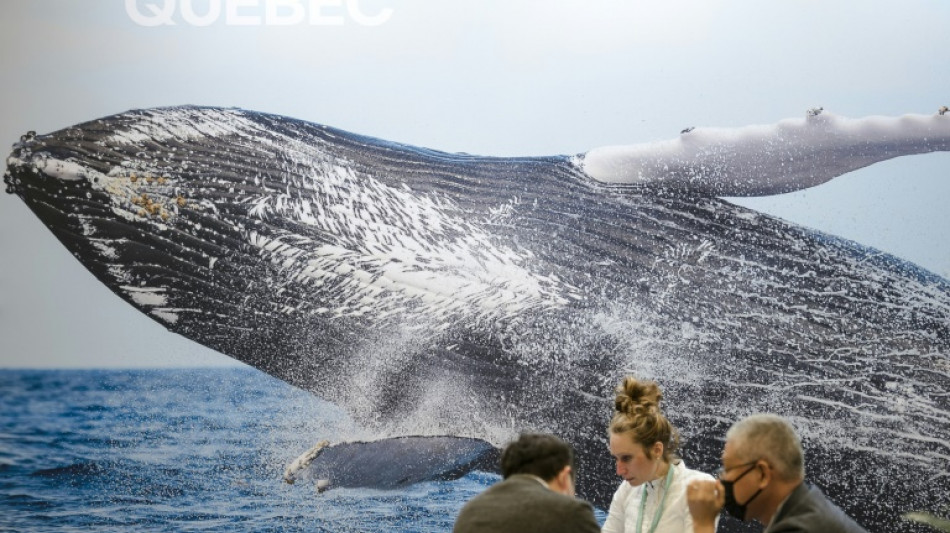
Rich nations oppose new biodiversity fund / Photo: ANDREJ IVANOV - AFP

 Zverev thrashes Shang to set up Djokovic quarter-final at China Open

 Turkey football ref chief jailed pending trial for graft

 North Korea says test of intermediate-range strategic missile included use of AI

 Rampant Sayers leads Hong Kong to third men's rugby gold in a row

 Ethiopia's Tigray rebels abandon regional capital as govt advances

 Bulgaria's Tsar Samuel returns 'home' after 1,000 years

 'Glad it's over': Kim powers to Games gold and military exemption

 After 11 World Cups, football finally comes home for one Indian fan

 Marc Marquez wins sprint at Japan MotoGP, Martin grabs pole
 Alcaraz fends off Arnaldi to reach Japan Open quarters
 Antonelli tops times in final practice at Bahrain GP
 Gauff digs deep to beat Osorio in China Open second round
 Fresh protests to hit Spain after housing measures defeated

 'He's here with me': Japan cycle queen dedicates gold to late brother
 Japan Olympic chief says 'lot more' athletes at Games than expected
 Asian carmakers besting US rivals at home, China poised to strike

 Widgets & Web Offers All-Inclusive Investor Relations Websites for Public Companies, IPOs and SPACs

 Adams named new US captain to 2030 World Cup

 China a better influence in Latin America than US: poll

 Judge pauses construction of border project in Texas national park

 Belgium's De Bruyne fires double to sink Turkey, France held by Italy

 US jobs data boosts stocks as oil prices dip

 US Supreme Court to hear high-stakes climate case
 Trump expected to name intel chief Clayton as AI czar: reports
 Argentina unveils passports-for-investment scheme

Creating a new global fund for biodiversity -- a core demand of developing countries at UN talks in Montreal -- "would take years" and be less effective than reforming existing financial mechanisms, Canada's environment minister said Tuesday.
Ottawa's position reflects the consensus among developed nations on the thorny issue, which has emerged as a key sticking point in negotiations to hammer out a new global pact for nature at the meeting, known as COP15.
Delegates from around the world have gathered for the December 7-19 summit aiming to secure a new deal: a 10-year framework aimed at saving Earth's forests, oceans and species before it's too late.
Draft targets include a cornerstone pledge to protect 30 percent of the world's land and seas by 2030, eliminating harmful fishing and agriculture subsidies and tackling invasive species and reducing pesticides.
Dozens of countries, led by Brazil, India, Indonesia and African nations, are demanding financial subsidies of at least $100 billion a year until 2030, or one percent of global GDP, to protect ecosystems. The current figure is around $10 billion annually.
"The countries of the North understand that ambition must be accompanied by financial resources," Canadian Minister of Environment and Climate Change Steven Guilbeault said at a press conference held halfway through the talks.
But "my concern is that the creation of new funding could take years, and during those years, countries in the South wouldn't be receiving any money from that fund," he added.
He recalled the Global Environment Facility, currently the main multilateral mechanism for biodiversity, took seven years to create. Donors have pledged $5.3 billion to this fund for its current cycle, 2022-2026.
"So I think it would be better to use existing funds" while pursuing reforms that would make money more accessible, he said.
"On the other hand, we have to agree on the fact that it cannot only be public money," said Guilbeault, stressing that private and philanthropic contributions must come into play, as well as multilateral lenders such as the World Bank and IMF.
"We all need to push harder this week," he concluded, after the first week of talks ended in stalemate.
- Yawning funding gap -
The divide between developed and developing nations on the issue of creating a new biodiversity fund mirrors a similar debate during recent UN climate talks in Egypt on creating a "loss and damages" fund for the most climate-vulnerable nations -- though that demand was eventually met.
Given this precedent, Basile van Havre, co-chair of one of COP15's working groups, did not rule out a similar decision for biodiversity.
"The landscape or the context now is a lot more favorable," he told AFP, acknowledging growing political momentum for such a move.
Whatever the final mechanism, the gap in expectations over resource mobilization that would allow lower income nations to hold up their side of the biodiversity deal remains a sore spot.
"The EU says it hears the needs of the Global South and the Africa Group, and recognizes that current finances are not enough. So what is the hold up?" said Greenpeace policy advisory Anna Ogniewska.
A.Aguiar--PC



