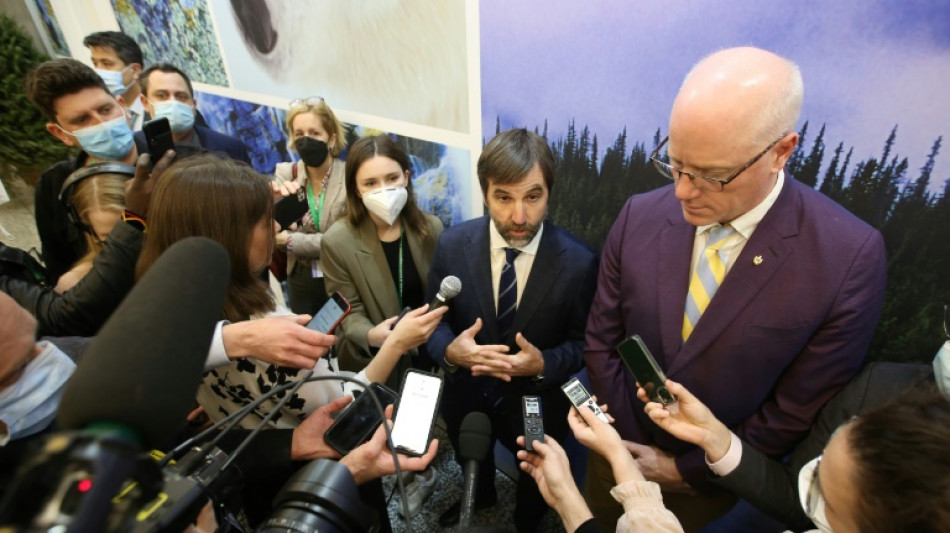
UN nature talks teeter on brink as ministers arrive for home stretch / Photo: Lars Hagberg - AFP

 Zverev thrashes Shang to set up Djokovic quarter-final at China Open

 Turkey football ref chief jailed pending trial for graft

 North Korea says test of intermediate-range strategic missile included use of AI

 Rampant Sayers leads Hong Kong to third men's rugby gold in a row

 Ethiopia's Tigray rebels abandon regional capital as govt advances

 Bulgaria's Tsar Samuel returns 'home' after 1,000 years

 'Glad it's over': Kim powers to Games gold and military exemption

 After 11 World Cups, football finally comes home for one Indian fan

 Marc Marquez wins sprint at Japan MotoGP, Martin grabs pole

 Alcaraz fends off Arnaldi to reach Japan Open quarters

 Antonelli tops times in final practice at Bahrain GP

 Gauff digs deep to beat Osorio in China Open second round

 Fresh protests to hit Spain after housing measures defeated

 'He's here with me': Japan cycle queen dedicates gold to late brother

 Japan Olympic chief says 'lot more' athletes at Games than expected

 Asian carmakers besting US rivals at home, China poised to strike

 Widgets & Web Offers All-Inclusive Investor Relations Websites for Public Companies, IPOs and SPACs

 Adams named new US captain to 2030 World Cup

 China a better influence in Latin America than US: poll

 Judge pauses construction of border project in Texas national park

 Belgium's De Bruyne fires double to sink Turkey, France held by Italy

 US jobs data boosts stocks as oil prices dip

 US Supreme Court to hear high-stakes climate case

 Trump expected to name intel chief Clayton as AI czar: reports

 Argentina unveils passports-for-investment scheme

Hopes of sealing a historic "peace pact with nature" at a United Nations biodiversity summit will soon rest on the world's environment ministers, arriving in Montreal for the final phase of talks beginning Thursday.
Stark divisions remain to be bridged, foremost among them the subject of how much developed countries will pay the developing to help them save ecosystems, and whether there should be a new, dedicated fund for this purpose.
At stake is the future of the planet and whether humanity can roll back habitat destruction, pollution and the climate crisis, which are threatening an estimated million species with extinction.
The draft agreement contains more than 20 targets, including a cornerstone pledge to protect 30 percent of the world's land and seas by 2030, eliminate harmful fishing and agriculture subsidies, tackle invasive species and reduce pesticides.
"I hope what we would have at the end of this... is a Paris moment," said Zakri Abdul Hamid, science advisor for the Campaign for Nature, referencing the landmark climate accord that agreed to hold long-term warming to 1.5 degrees Celsius.
"Decades of study have also clarified what the world must do," he added.
In the absence of heads of state and government, more than a hundred ministers will have to drag the text, three years in the making, over the finish line.
But its success still hangs in the balance after disagreements over the thorny issue of biodiversity financing led to a walkout by negotiators from developing nations overnight Tuesday and a temporary pause in talks.
- New fund sought -
The Global South, home to most of the world's biological diversity, wants a new global biodiversity fund (GBF), something rich countries oppose -- proposing instead making existing financial mechanisms more accessible.
This debate mirrors a similar disagreement during recent UN climate talks in Egypt on creating a "loss and damages" fund for the most climate-vulnerable nations -- though that demand was eventually met.
Dozens of nations, including Brazil, India, Indonesia and many African countries are also seeking funding of $100 billion yearly, or one percent of global GDP, until 2030.
Current financial flows from high-income countries to lower income ones are in the order of $10 billion per year.
A crisis meeting of heads of delegations, organized on Wednesday by China, which is chairing the meeting, brought negotiators back to the table following the breakdown.
A Western negotiator who declined to be named told AFP: "The African group wants to reach an agreement with money in front, other developing countries too, but Brazil is using the financial question to derail the process."
The source said the Brazilian delegation is still following the policies of outgoing far-right president Jair Bolsonaro, who is very close to the agricultural industry, which is hostile to reducing pesticide use.
Nevertheless, developing countries are angered by what they see as a lack of ambition.
"This has led to the negotiations now being on the edge of a full breakdown," said Innocent Maloba of WWF International.
Beyond the moral implications, there is the question of self-interest: $44 trillion of economic value generation -- more than half the world's total GDP -- is dependent on nature and its services.
The summit has failed to garner the same level of attention as the UN climate meeting held in Egypt in November, which brought together more than a hundred world leaders.
This meeting is being held in Canada after China declined to host because of its strict Covid rules, and Canada's Prime Minister Justin Trudeau has been the only leader in attendance.
P.Mira--PC



