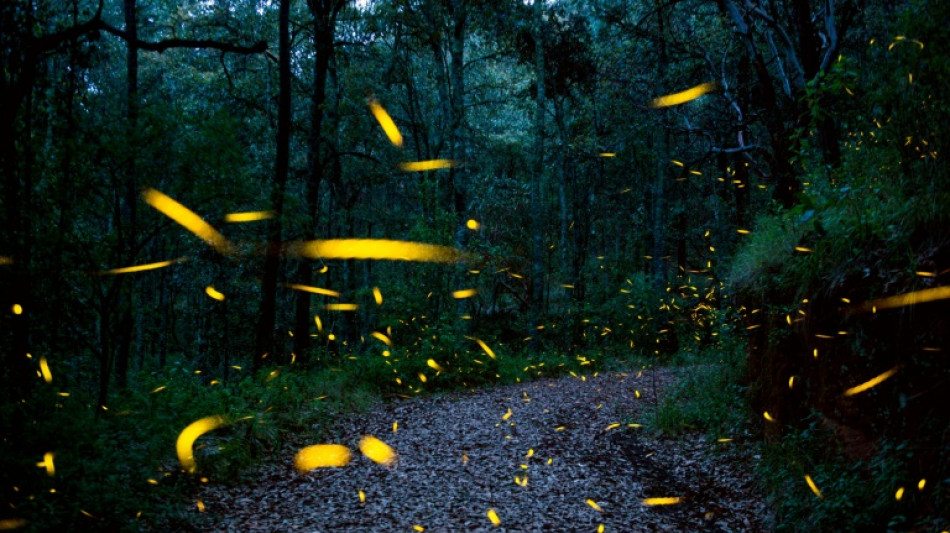
From robot fireflies to okra plasters: 2022's nature-inspired solutions / Photo: Mario Vazquez de la Torre - AFP/File

 Zverev thrashes Shang to set up Djokovic quarter-final at China Open

 Turkey football ref chief jailed pending trial for graft

 North Korea says test of intermediate-range strategic missile included use of AI

 Rampant Sayers leads Hong Kong to third men's rugby gold in a row

 Ethiopia's Tigray rebels abandon regional capital as govt advances

 Bulgaria's Tsar Samuel returns 'home' after 1,000 years

 'Glad it's over': Kim powers to Games gold and military exemption

 After 11 World Cups, football finally comes home for one Indian fan

 Marc Marquez wins sprint at Japan MotoGP, Martin grabs pole

 Alcaraz fends off Arnaldi to reach Japan Open quarters

 Antonelli tops times in final practice at Bahrain GP

 Gauff digs deep to beat Osorio in China Open second round

 Fresh protests to hit Spain after housing measures defeated

 'He's here with me': Japan cycle queen dedicates gold to late brother

 Japan Olympic chief says 'lot more' athletes at Games than expected

 Asian carmakers besting US rivals at home, China poised to strike

 Widgets & Web Offers All-Inclusive Investor Relations Websites for Public Companies, IPOs and SPACs

 Adams named new US captain to 2030 World Cup

 China a better influence in Latin America than US: poll

 Judge pauses construction of border project in Texas national park

 Belgium's De Bruyne fires double to sink Turkey, France held by Italy

 US jobs data boosts stocks as oil prices dip

 US Supreme Court to hear high-stakes climate case

 Trump expected to name intel chief Clayton as AI czar: reports

 Argentina unveils passports-for-investment scheme

Even as animals and plants face widespread extinction from human-driven causes like climate change, the natural world continues to inspire scientific discovery in unexpected ways.
"Nature has spent hundreds of millions of years optimising elegant solutions to extremely complicated problems," said Alon Gorodetsky, a biomedical engineer at the University of California, Irvine.
"So if we look to nature, we can shortcut our development process and get to a valuable solution right away," he told AFP.
From squid-skin food warmers to a lubricant made of cow mucus, here is a selection of this year's scientific work inspired by nature.
- Okra plasters stop bleeding hearts -
Stopping the bleeding hearts and livers of dogs and rabbits without stitches may now be possible with a biodegradable plaster made of sticky okra gel.
Okra is a fuzzy green vegetable with a slimy texture that inspired Malcolm Xing from Canada's University of Manitoba to turn it into a medical adhesive.
"Okra is a fantastic material," said Xing.
In the July study published in Advanced Healthcare Materials, researchers discovered that refining okra in a juicer and then drying it into a powder creates an effective bioadhesive that quickly creates a physical barrier and starts the blood clotting process.
The researchers plan to test this plaster on humans in the coming years.
- Cow mucus lubricant -
Snot may invoke feelings of disgust, but laboratory tests found that a lubricant made of cow mucus showed promise at curtailing the spread of certain sexually transmitted infections.
The study, published in Advanced Science in September, is very preliminary, however. It has not yet been tested on humans and should not replace other forms of protection, like condoms.
Researchers extracted the mucus from the salivary glands of cows and turned it into a gel that binds to and constrains viruses. Mucus is made of a protein called mucin that might have antiviral properties.
It is also both a solid and a liquid.
"Being a solid, it can trap bacteria or viruses in the body. Being a liquid, it can clear those pathogens from the body," said study co-author Hongji Yan from Sweden's KTH Royal Institute of Technology in Stockholm.
- Robot fireflies -
Fireflies that light up the night sky inspired scientists at the Massachusetts Institute of Technology to create tiny, bug-sized robots that emit light when they fly.
The glowing artificial muscles help the honey bee-sized robots communicate with each other, which may make them useful for search and rescue missions some day.
Though the robots can only operate in a laboratory environment so far, the researchers are excited at their potential future uses.
- Cancer-sniffing ants -
There are an estimated 20 quadrillion ants in the world, and researchers have discovered that one species might be able to sniff out cancer in human breasts.
In a study conducted at Sorbonne Paris Nord University and published on the preprint server bioRxiv, which has not yet been peer-reviewed, scientists used a sugar-water reward to train ants to smell the difference between mouse urine implanted with, and without, human tumours.
While dogs can be trained to use their super noses to detect cancer, this is expensive and takes time.
Ants might provide a cheaper, albeit less cute, alternative.
- Squid-skin tea cosies -
The strange skin of squids has inspired a packaging material that can keep coffee and food warm for as long, or as little, as wanted, according to a March study published in Nature Sustainability.
Squids have miniature organs called chromatophores that can drastically change size, and also help them change colour.
To mimic "these pigment-filled organs", study co-author Alon Gorodetsky, from the University of California, Irvine, said they developed "little metal islands that you could move apart" and contract.
The heat level can then be controlled by how much the material is stretched.
"If you put it around a warm object -- for example, a coffee-filled cup or a hot sandwich -- you can control the rate at which it cools down," he said.
"Nature really is the epitome of innovation and engineering," Gorodetsky added.
A.F.Rosado--PC



