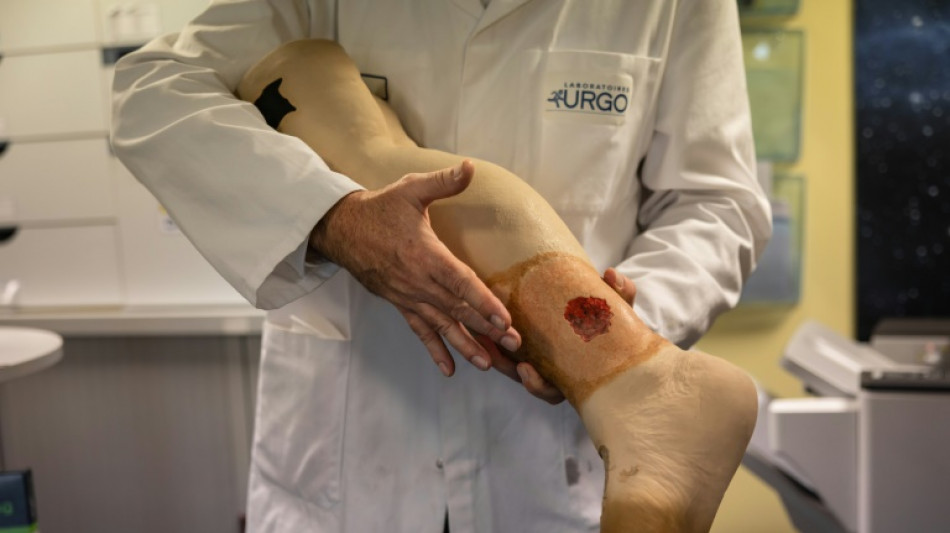
Dressing 'revolution' seeks artificial skin for burn victims / Photo: ARNAUD FINISTRE - AFP

 Zverev thrashes Shang to set up Djokovic quarter-final at China Open

 Turkey football ref chief jailed pending trial for graft

 North Korea says test of intermediate-range strategic missile included use of AI

 Rampant Sayers leads Hong Kong to third men's rugby gold in a row

 Ethiopia's Tigray rebels abandon regional capital as govt advances

 Bulgaria's Tsar Samuel returns 'home' after 1,000 years

 'Glad it's over': Kim powers to Games gold and military exemption

 After 11 World Cups, football finally comes home for one Indian fan
 Marc Marquez wins sprint at Japan MotoGP, Martin grabs pole

 Alcaraz fends off Arnaldi to reach Japan Open quarters

 Antonelli tops times in final practice at Bahrain GP

 Gauff digs deep to beat Osorio in China Open second round

 Fresh protests to hit Spain after housing measures defeated

 'He's here with me': Japan cycle queen dedicates gold to late brother

 Japan Olympic chief says 'lot more' athletes at Games than expected

 Asian carmakers besting US rivals at home, China poised to strike

 Widgets & Web Offers All-Inclusive Investor Relations Websites for Public Companies, IPOs and SPACs

 Adams named new US captain to 2030 World Cup

 China a better influence in Latin America than US: poll

 Judge pauses construction of border project in Texas national park

 Belgium's De Bruyne fires double to sink Turkey, France held by Italy

 US jobs data boosts stocks as oil prices dip

 US Supreme Court to hear high-stakes climate case

 Trump expected to name intel chief Clayton as AI czar: reports

 Argentina unveils passports-for-investment scheme

Far from the humble sticking plaster, medical firms and researchers are seeking to create the "ultimate dressing" -- artificial skin they hope will revolutionise the treatment of severe burns.
For the last 18 months, researchers from the French firm Urgo have been working towards achieving this Holy Grail of wound treatment, which would save serious burn victims from the painful and repeated skin grafts they currently endure.
The 100-million-euro ($106,000-million) "Genesis" project hopes to have a product ready by 2030.
Guirec Le Lous, the president of Urgo's medical arm, told AFP that it is a "crazy" project.
"Are we capable of designing artificial skin in a laboratory? No one in the world has succeeded," he said.
Inside Urgo's laboratory in Chenove, near the eastern French city of Dijon, living cells are being chilled before they can be cultivated.
"You have to be able to recreate all the functions of skin," including protecting against external threats and regulating the temperature, Le Lous said.
It must also be relatively easy to make, because artificial skin must be "available for all and at the right price," he said, without revealing the exact technology or type of cells Urgo is using.
Urgo, a family-owned business since 1880, has long made dressings for chronic wounds such as diabetic foot ulcers and venous leg ulcers.
"Since the 2000s, we have worked on materials that will correct healing problems: dressings have become intelligent, interactive with wounds, allowing them to perform better," Urgo's research director Laurent Apert said.
He called the change "a revolution".
- Silver bullet -
Urgo is far from alone in pushing the boundaries of what dressings can do.
Researchers at the University of South Australia have developed a new kind of dressing that knows when to release nanoparticles of silver, which can break down antibiotic-resistant bacteria.
"Our treatment is unique in that it capitalises on the anti-bacterial properties of silver, but avoids over-exposure, by only activating when infection in present," lead researcher Zlatko Kopecki said in a statement.
This makes the dressing "a much safer and effective treatment for children," he added.
Children suffer almost half of burn injuries worldwide, most of them aged between one to five years old, according to research using the World Health Organization's Global Burn Registry.
- 'Night and day' -
Another new technique does away with the idea of dressing altogether.
For a product from French startup VistaCare Medical, patients put their affected leg into a large device which never touches their wound.
Instead the chamber controls the humidity, temperature and other aspects important to healing.
"There is no more dressing. The idea is to put the wound in an enclosure, in a sterile air, VistaCare Medical president Francois Dufay said.
"With this system, we provide the wound with what it needs, at the right time."
VistaCare Medical's device is currently used in around 20 French hospitals, but next year the firm plans to apply for approval in the United States for a product to be used in the home.
The new developments have shaken up the world of wound healing, long a neglected area of medical research.
Isabelle Fromantin, who heads the wounds and healing research unit at the Curie Institute in Paris, said that "compared to 20 years ago, it's night and day in terms of wound care".
Along with her team, Fromantin has developed dressings that reduce the odours from necrotic wounds seen in some cancers.
However she said that not everything can be achieved by new technologies -- healing is a process that varies from person to person, depending on their age and health.
"Believing that a dressing will heal you all by itself is utopian," she said.
P.Cavaco--PC



