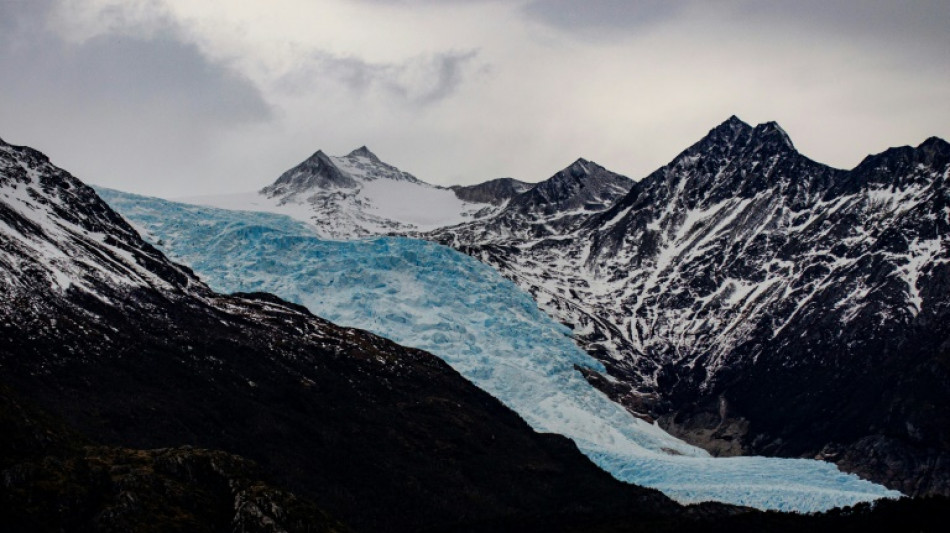
Half of world's glaciers expected to vanish by 2100: study / Photo: Alberto PEÑA - AFP/File

 Zverev thrashes Shang to set up Djokovic quarter-final at China Open

 Turkey football ref chief jailed pending trial for graft

 North Korea says test of intermediate-range strategic missile included use of AI

 Rampant Sayers leads Hong Kong to third men's rugby gold in a row

 Ethiopia's Tigray rebels abandon regional capital as govt advances

 Bulgaria's Tsar Samuel returns 'home' after 1,000 years

 'Glad it's over': Kim powers to Games gold and military exemption

 After 11 World Cups, football finally comes home for one Indian fan

 Marc Marquez wins sprint at Japan MotoGP, Martin grabs pole

 Alcaraz fends off Arnaldi to reach Japan Open quarters

 Antonelli tops times in final practice at Bahrain GP

 Gauff digs deep to beat Osorio in China Open second round

 Fresh protests to hit Spain after housing measures defeated

 'He's here with me': Japan cycle queen dedicates gold to late brother

 Japan Olympic chief says 'lot more' athletes at Games than expected
 Asian carmakers besting US rivals at home, China poised to strike

 Widgets & Web Offers All-Inclusive Investor Relations Websites for Public Companies, IPOs and SPACs

 Adams named new US captain to 2030 World Cup

 China a better influence in Latin America than US: poll

 Judge pauses construction of border project in Texas national park

 Belgium's De Bruyne fires double to sink Turkey, France held by Italy

 US jobs data boosts stocks as oil prices dip

 US Supreme Court to hear high-stakes climate case
 Trump expected to name intel chief Clayton as AI czar: reports

 Argentina unveils passports-for-investment scheme

Half of the Earth's glaciers, notably smaller ones, are destined to disappear by the end of the century because of climate change, but limiting global warming could save others, according to a new study.
The findings, published in the journal Science on Thursday, provide the most comprehensive look so far at the future of the world's 215,000 glaciers.
The authors emphasized the importance of restricting greenhouse gas emissions to limit the consequences from glacier melt such as sea level rise and depletion of water resources.
To help orient policy makers, the study looked at the impact of four scenarios on glaciers, where global mean temperature change is 1.5 degrees Celsius (2.7 degrees Fahrenheit), 2.0C, 3.0C and 4.0C.
"Every degree increase produces more melt and loss," said Regine Hock of the University of Oslo and University of Alaska Fairbanks, a co-author of the study.
"But that also means if you reduce the temperature increase, you can also reduce that mass loss," Hock told AFP. "So in that sense, there is also a little bit of hope."
Even if global temperature rise is limited to 1.5C above pre-industrial levels -- the most ambitious goal of the Paris Agreement -- the researchers estimated that 49 percent of the world's glaciers would vanish by the year 2100.
That would represent about 26 percent of the world's glacier mass because the smallest glaciers would be those first impacted.
Global mean temperature is currently estimated to be increasing by 2.7C which would result in a near-complete loss of glaciers in Central Europe, Western Canada and the continental United States and New Zealand.
"Regions with relatively little ice like the European Alps, the Caucasus, the Andes, or the western US, they lose almost all the ice by the end of the century almost no matter what the emission scenario is," Hock said. "So those glaciers, they're more or less doomed."
- 'Up to the policy makers' -
Under the worst-case scenario -- global temperature rise of 4.0C -- giant glaciers such as those in Alaska would be more affected and 83 percent of glaciers would disappear by the end of the century.
Glacier loss would also exacerbate sea level rise.
"The glaciers that we are studying are only one percent of all ice on Earth," said Hock, "much less than the Greenland ice sheet and the Antarctic ice sheet.
"But they have contributed to sea level rise almost just as much as the Greenland and Antarctic ice sheet together in the last three decades," she said.
Warming of 1.5C would lead to an increase in average sea levels of nine centimeters while temperatures 4.0C higher would cause 15 centimeters of sea level rise.
"It doesn't sound very much, nine centimeters up to 15 centimeters," Hock said, "but it's not global sea level that is that much of a concern.
"It's mostly associated storm surges," she said, which have the potential to cause "a lot more damage."
The disappearance of glaciers will also have an impact on water resources because they provide freshwater for some two billion people.
"The glaciers compensate for the loss of water in summer when it's not raining much and it's hot," Hock said.
The study's projections, which are more pessimistic than those of UN climate experts, were reached through observations of the mass of each glacier through the decades and computer simulations.
Despite the alarming findings, Hock said "it is possible to reduce the mass loss by human action.
"If it happens is of course a different question," she said. "If that happens is of course up to the policy makers."
P.Mira--PC



