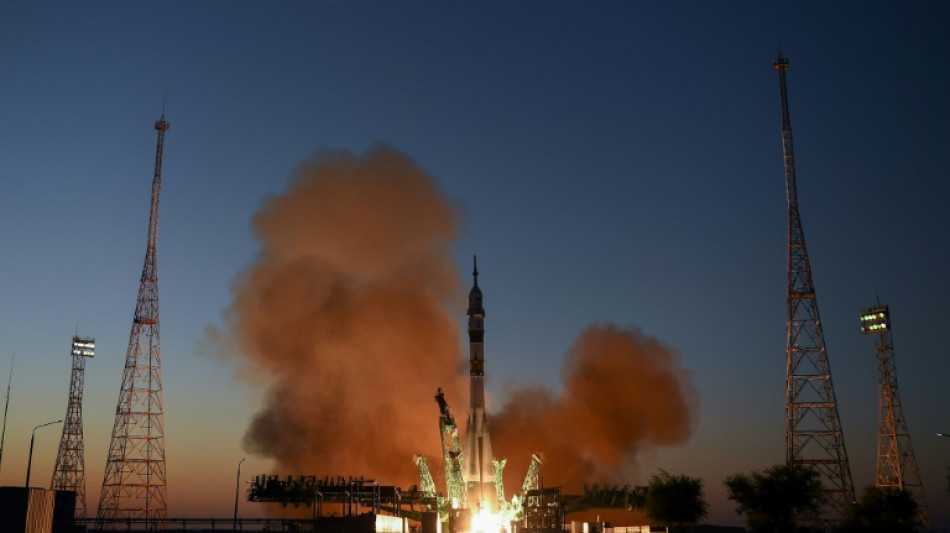
Russia to send spacecraft to ISS to bring home crew of damaged capsule / Photo: NATALIA KOLESNIKOVA - AFP/File

 Zverev thrashes Shang to set up Djokovic quarter-final at China Open

 Turkey football ref chief jailed pending trial for graft

 North Korea says test of intermediate-range strategic missile included use of AI

 Rampant Sayers leads Hong Kong to third men's rugby gold in a row

 Ethiopia's Tigray rebels abandon regional capital as govt advances

 Bulgaria's Tsar Samuel returns 'home' after 1,000 years

 'Glad it's over': Kim powers to Games gold and military exemption

 After 11 World Cups, football finally comes home for one Indian fan

 Marc Marquez wins sprint at Japan MotoGP, Martin grabs pole

 Alcaraz fends off Arnaldi to reach Japan Open quarters

 Antonelli tops times in final practice at Bahrain GP

 Gauff digs deep to beat Osorio in China Open second round

 Fresh protests to hit Spain after housing measures defeated

 'He's here with me': Japan cycle queen dedicates gold to late brother

 Japan Olympic chief says 'lot more' athletes at Games than expected
 Asian carmakers besting US rivals at home, China poised to strike

 Widgets & Web Offers All-Inclusive Investor Relations Websites for Public Companies, IPOs and SPACs

 Adams named new US captain to 2030 World Cup

 China a better influence in Latin America than US: poll

 Judge pauses construction of border project in Texas national park

 Belgium's De Bruyne fires double to sink Turkey, France held by Italy
 US jobs data boosts stocks as oil prices dip

 US Supreme Court to hear high-stakes climate case

 Trump expected to name intel chief Clayton as AI czar: reports

 Argentina unveils passports-for-investment scheme

Russia said Wednesday that it will send an empty spacecraft to the International Space Station (ISS) next month to bring home three astronauts whose planned return vehicle was damaged by a strike from a tiny meteorite.
The Russian space agency, Roscosmos, made the announcement after examining the flight worthiness of the Soyuz MS-22 crew capsule docked with the ISS that sprang a radiator coolant leak in December.
Roscosmos and NASA officials said at a joint press briefing that an uncrewed Soyuz spacecraft, MS-23, would be sent to the ISS on February 20 to bring Russian cosmonauts Dmitry Petelin and Sergei Prokopyev and NASA astronaut Frank Rubio back to Earth.
"We're not calling it a rescue Soyuz," said Joel Montalbano, the ISS program manager at NASA's Johnson Space Center in Houston. "I'm calling it a replacement Soyuz.
"Right now the crew is safe onboard the space station."
MS-22 flew Petelin, Prokopyev and Rubio to the ISS in September. They were scheduled to return home in the same spacecraft in mid-March.
But MS-22 began leaking coolant on December 14 after being hit by what US and Russian space officials said they believe was a micrometeorite.
"Everything does point to a micrometeorite," Montalbano said.
Sergei Krikalev, executive director of Human Space Flight Programs at Roscosmos, said the "current theory is that this damage was caused by a small particle about one millimetre in diameter".
Krikalev said the decision to use MS-23 to fly the crew home was made because of concern over high temperatures in MS-22 during re-entry.
"The main problem to land the current Soyuz with crew would be thermal conditions because we lost heat rejection capability," he said.
"We may have a high temperature situation on Soyuz in the equipment compartment and in the crew compartment."
- SpaceX Crew Dragon -
Montalbano said discussions were also underway with SpaceX officials about potentially returning one or more crew members on the SpaceX Crew Dragon capsule currently docked with the ISS.
Four astronauts were flown to the ISS by a SpaceX rocket in October for a mission expected to last about six months.
"We could safely secure the crew members in the area that the cargo normally returns on the Dragon," Montalbano said.
"All that is only for an emergency, only if we have to evacuate ISS," he stressed. "That's not the nominal plan or anything like that."
Krikalev said MS-22 would return to Earth after the two cosmonauts and the NASA astronaut leave on MS-23. It would bring back equipment and experiments that are not "temperature sensitive", he said.
Soyuz MS-23 had been initially scheduled to fly Russian cosmonauts Oleg Kononenko and Nikolai Chub and NASA's Loral O'Hara to the ISS on March 16.
Space has remained a rare venue of cooperation between Moscow and Washington since the start of the Russian offensive in Ukraine and ensuing Western sanctions on Russia.
The ISS was launched in 1998 at a time of increased US-Russia cooperation following the Cold War "Space Race".
Russia has been using the ageing but reliable Soyuz capsules to ferry astronauts into space since the 1960s.
V.Fontes--PC



