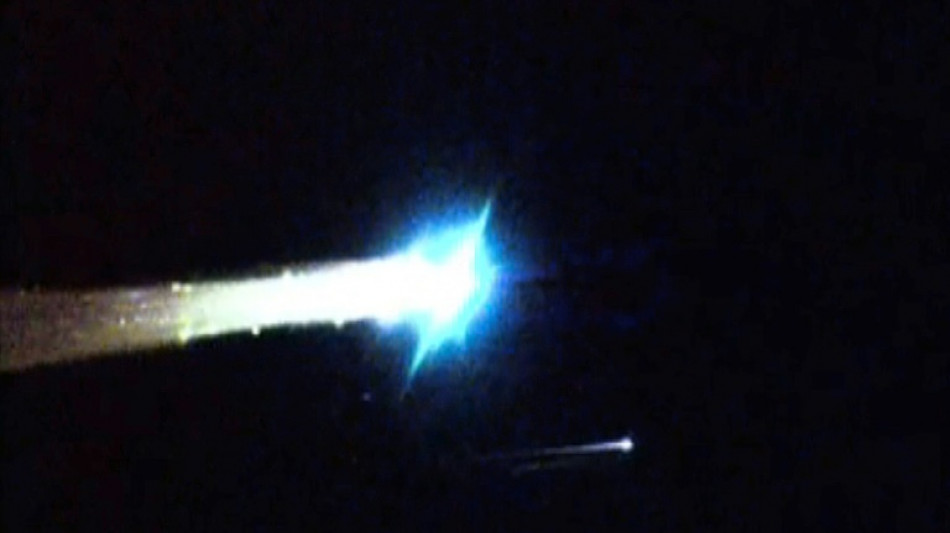
How three dust specks reveal an asteroid's secrets / Photo: NASA - NASA/AFP/File

 Zverev thrashes Shang to set up Djokovic quarter-final at China Open

 Turkey football ref chief jailed pending trial for graft

 North Korea says test of intermediate-range strategic missile included use of AI

 Rampant Sayers leads Hong Kong to third men's rugby gold in a row

 Ethiopia's Tigray rebels abandon regional capital as govt advances

 Bulgaria's Tsar Samuel returns 'home' after 1,000 years

 'Glad it's over': Kim powers to Games gold and military exemption

 After 11 World Cups, football finally comes home for one Indian fan

 Marc Marquez wins sprint at Japan MotoGP, Martin grabs pole

 Alcaraz fends off Arnaldi to reach Japan Open quarters

 Antonelli tops times in final practice at Bahrain GP

 Gauff digs deep to beat Osorio in China Open second round

 Fresh protests to hit Spain after housing measures defeated

 'He's here with me': Japan cycle queen dedicates gold to late brother

 Japan Olympic chief says 'lot more' athletes at Games than expected

 Asian carmakers besting US rivals at home, China poised to strike

 Widgets & Web Offers All-Inclusive Investor Relations Websites for Public Companies, IPOs and SPACs

 Adams named new US captain to 2030 World Cup

 China a better influence in Latin America than US: poll

 Judge pauses construction of border project in Texas national park

 Belgium's De Bruyne fires double to sink Turkey, France held by Italy

 US jobs data boosts stocks as oil prices dip

 US Supreme Court to hear high-stakes climate case

 Trump expected to name intel chief Clayton as AI czar: reports

 Argentina unveils passports-for-investment scheme

The specks are tiny. No, really tiny. Smaller than the diameter of a hair. But they hold billions of years of history that reveal some of the secrets of asteroids.
The three minute particles from an asteroid called Itokawa show some of these space rocks are vastly older than was thought, and are much tougher.
And that could mean we need bolder ways to prevent catastrophic collisions with Earth, according to research published Tuesday.
The three samples were collected in 2005 from the peanut-shaped Itokawa, some 300 million kilometres (186 million miles) from Earth.
It took the Japanese spacecraft Hayabusa five years to return them to Earth, along with hundreds of other particles from Itokawa, and scientists have been analysing them for clues ever since.
Fred Jourdan, professor at Curtin University's School of Earth and Planetary Sciences, wanted to see what the specks could reveal about the age of rubble-pile asteroids like Itokawa.
These form when solid asteroids collide and the resulting fragments assemble into new structures.
Solid asteroids are thought to have a lifespan of several hundred million years, and are gradually ground down by constant collisions.
But rubble-pile asteroids have a very different structure, composed of rocks, dust, pebbles and a void, and held together by the gravitational pull of their various components.
"It's like a giant space cushion, and cushions are good at absorbing shock," Jourdan said.
To find out just how good, the team analysed crystal structures in the samples, looking for deformations caused by the impact that created Itokawa.
And they dated the samples by measuring the decay of potassium into argon.
The methods suggest Itokawa was formed by an asteroid collision at least 4.2 billion years ago, ten times older than solid asteroids of similar size are predicted to be.
"We were really surprised," said Jourdan.
"I mean that's really, really old, and I'm sure some of my colleagues are not even going to believe it."
Rubble-pile asteroids are so resilient to the constant battering they face that they are likely to be much more abundant than previously assumed, the research published in the journal Proceedings of the National Academy of Sciences concludes.
That might mean we need new ways to tackle such asteroids on a collision course with Earth, Jourdan said.
NASA's recent DART test showed asteroids like Itokawa can be nudged off course, but that would likely require a lead time of several years.
An asteroid just weeks from colliding with Earth would require a different approach, and Jourdan argues a nuclear blast might be needed.
"It's not 'Armageddon'-style," blowing it up, he hastens to add, referring to the 1998 sci-fi movie.
"The shockwave should push the asteroid out of the way."
It is a far-reaching conclusion to draw from such tiny specks of dust, but each particle is analysed at the atomic level.
"We can get big stories like that out of (something) very, very small, because those machines, what they're doing, is the measuring and counting of atoms," Jourdan said.
"Every grain has its own story to tell."
X.M.Francisco--PC



