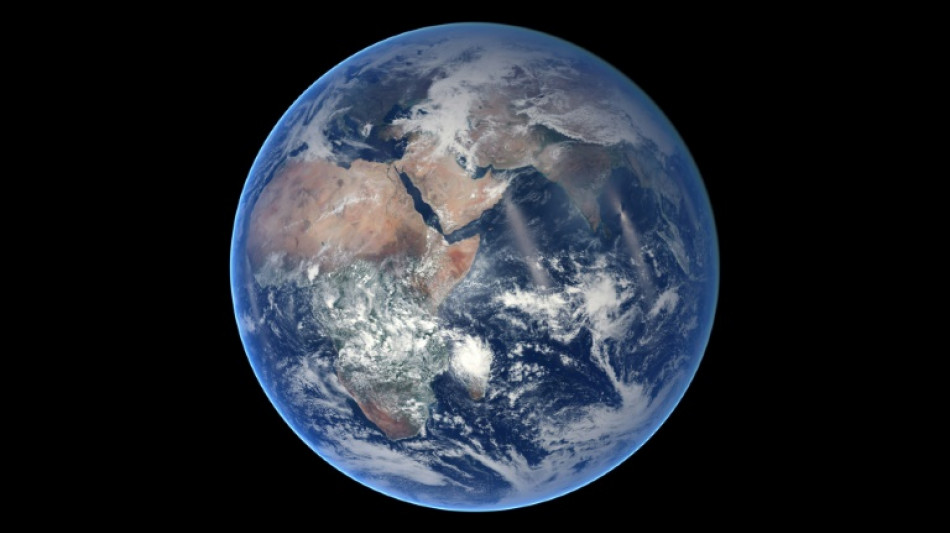
Earth's inner core rotating slower than surface, study suggests / Photo: HANDOUT - NASA/AFP/File

 Zverev thrashes Shang to set up Djokovic quarter-final at China Open

 Turkey football ref chief jailed pending trial for graft
 North Korea says test of intermediate-range strategic missile included use of AI

 Rampant Sayers leads Hong Kong to third men's rugby gold in a row

 Ethiopia's Tigray rebels abandon regional capital as govt advances
 Bulgaria's Tsar Samuel returns 'home' after 1,000 years

 'Glad it's over': Kim powers to Games gold and military exemption

 After 11 World Cups, football finally comes home for one Indian fan
 Marc Marquez wins sprint at Japan MotoGP, Martin grabs pole

 Alcaraz fends off Arnaldi to reach Japan Open quarters

 Antonelli tops times in final practice at Bahrain GP

 Gauff digs deep to beat Osorio in China Open second round

 Fresh protests to hit Spain after housing measures defeated

 'He's here with me': Japan cycle queen dedicates gold to late brother
 Japan Olympic chief says 'lot more' athletes at Games than expected
 Asian carmakers besting US rivals at home, China poised to strike

 Widgets & Web Offers All-Inclusive Investor Relations Websites for Public Companies, IPOs and SPACs

 Adams named new US captain to 2030 World Cup

 China a better influence in Latin America than US: poll

 Judge pauses construction of border project in Texas national park

 Belgium's De Bruyne fires double to sink Turkey, France held by Italy

 US jobs data boosts stocks as oil prices dip

 US Supreme Court to hear high-stakes climate case
 Trump expected to name intel chief Clayton as AI czar: reports
 Argentina unveils passports-for-investment scheme

Earth's inner core, a hot iron ball the size of Pluto, has stopped spinning faster than the planet's surface and might now be rotating slower than it, research suggested on Monday.
Roughly 5,000 kilometres (3,100 miles) below the surface we live on, this "planet within the planet" can spin independently because it floats in the liquid metal outer core.
Exactly how the inner core rotates has been a matter of debate between scientists -- and the latest research is expected to prove controversial.
What little is known about the inner core comes from measuring the tiny differences in seismic waves -- created by earthquakes or sometimes nuclear explosions -- as they pass through the middle of the Earth.
Seeking to track the inner core's movements, new research published in the journal Nature Geoscience analysed seismic waves from repeating earthquakes over the last six decades.
"We believe the inner core rotates, relative to the Earth's surface, back and forth, like a swing," the study's authors, Xiaodong Song and Yi Yang of China's Peking University, told AFP.
"One cycle of the swing is about seven decades," the authors said.
The inner core started rotating slightly faster than the rest of the planet in the early 1970s, the study said.
But it had been slowing down before coming in sync with Earth's rotation around 2009, it added.
There has been a "negative trend" since, the study said, meaning the inner core is now rotating slower than the surface.
The researchers predicted the next change would occur in the mid-2040s.
They said this rotation timeline roughly lines up with changes in what is called the "length of day" -- small variations in the exact time it takes Earth to rotate on its axis.
- Stuck in the middle -
So far there is little to indicate that what the inner core does has much effect on surface dwellers.
But the researchers said they believed there were physical links between all Earth's layers, from the inner core to the surface.
"We hope our study can motivate some researchers to build and test models which treat the whole Earth as an integrated dynamic system," they said.
Experts not involved in the study expressed caution about its findings, pointing to several other theories and warning that many mysteries remain about the centre of the Earth.
"This is a very careful study by excellent scientists putting in a lot of data," said John Vidale, a seismologist at the University of Southern California.
"(But) none of the models explain all the data very well in my opinion," he added.
Vidale published research last year suggesting that the inner core oscillates far more quickly, swinging around every six years or so.
His work was based on seismic waves from two nuclear explosions in the late 1960s and early 1970s.
That timeframe is around the point when Monday's research says the inner core was last in sync with Earth's rotation -- which Vidale called "kind of a coincidence".
- Geophysicists 'divided' -
Another theory -- which Vidale said has some good evidence supporting it -- is that the inner core only moved significantly between 2001 to 2013 and has stayed put since.
Hrvoje Tkalcic, a geophysicist at the Australian National University, has published research suggesting that the inner core's cycle is every 20 to 30 years, rather than the 70 proposed in the latest study.
"These mathematical models are most likely all incorrect because they explain the observed data but are not required by the data," Tkalcic said.
"Therefore, the geophysical community will be divided about this finding and the topic will remain controversial."
He compared seismologists to doctors "who study the internal organs of patients' bodies using imperfect or limited equipment".
Lacking something like a CT scan, "our image of the inner Earth is still blurry", he said, predicting more surprises ahead.
That could include more about a theory that the inner core might have yet another iron ball inside it -- like a Russian doll.
"Something's happening and I think we're gonna figure it out," Vidale said. "But it may take a decade."
P.Cavaco--PC



