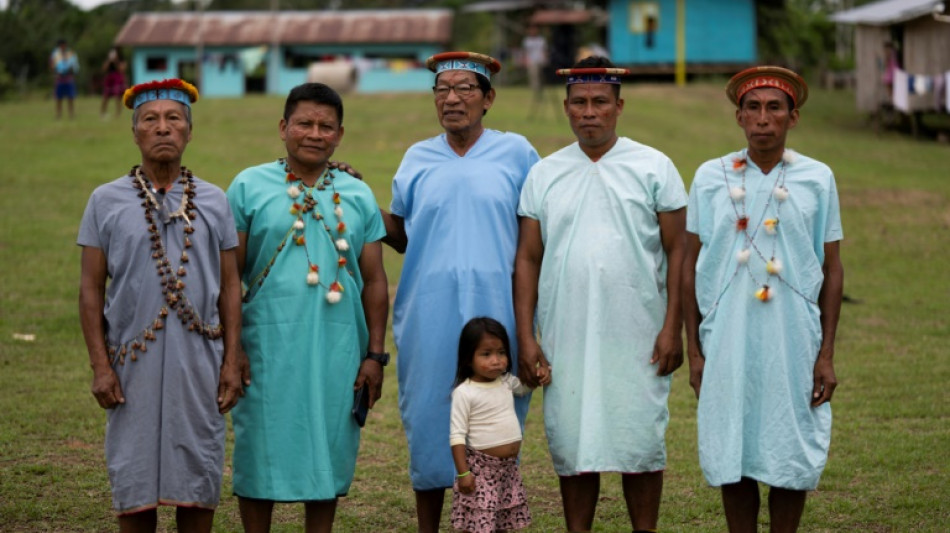
Uprooted: Amazonian Siekopai people battle for return to ancestral land / Photo: Pedro PARDO - AFP

 Lula, Bolsonaro in final push for votes ahead of knife-edge election

 Boisterous fashion week barnstorms 'sleepy' Nigerian capital

 UAE investigators say flydubai co-pilot was planning 'terrorist act'

 Rahul smacks century in India v Windies ODI

 Daryz seeks to join exclusive club of dual Arc winners

 Russia warns diplomats to leave Kyiv over new strikes threat

 Olympic champ Zheng rebukes rowdy home crowd at China Open

 World No.1 Sinner pulls out of Shanghai Masters to delay return

 Red Bull's Verstappen grabs pole position for Bahrain GP

 India beat Pakistan in blockbuster as golfer Kim wins 'crazy' gold

 India beat arch-rivals Pakistan to win Asian Games cricket gold

 Ethiopia's Tigray rebels abandon regional capital as govt advances: journalist

 Tom Kim powers to Games gold and exemption from military service

 Split loyalties for Indian football fans at Brazil friendly

 India-Pakistan blockbuster brings cricket fever to Japan baseball field

 Wong waiting on Rafa after winning Asian Games tennis gold

 With Russia next door and rising costs, Latvia goes to the polls

 Penalty hero rues empty seats as Games hosts Japan win football gold

 North Korea fires ballistic missile after Seoul's apology demand

 US regulator finds Boeing 737 MAX software bug 'not a safety concern'

 Ohtani 'managing' injuries as Dodgers launch MLB post-season

 Botched US execution leaves murderer unconscious on ventilator: lawyers

 Cornell rape case exposes sexual violence at US colleges

 France held by Italy in Zidane's homecoming after Olise stunner

 Ethiopian pro-government militia claims Tigray airport as regional tensions spike

They call themselves "the multicolored people," or Siekopai, after the eye-catching traditional body paint and adornments they used to wear in their ancestral home in the heart of the Amazon rainforest.
But the feathered crowns and animal tooth necklaces are now stored away for special occasions as the Siekopai live scattered between villages straddling the Ecuador-Peru border, far from their hunter-gatherer way of life and ancestral territory, which they are fighting to reclaim.
Displaced by decades of war as well as commercial and cultural intrusions, the Siekopai eke out a living doing odd jobs in rural towns bordered by oil fields, palm plantations and a network of busy roads.
The children wear jeans, T-shirts and sneakers, listen to reggaeton and -- instead of learning to fish, hunt and make traditional plant brews when not in school -- stare transfixed at cell phone or tablet screens just like teenagers anywhere else.
With the Siekopai teetering on the brink of cultural extinction, their leaders say it is a matter of survival to reclaim their ancestral land -- still largely untouched in the remote heart of the Amazon.
They call the homeland Pe'keya in the Paicoca language.
"Our big dream is to rebuild our territory -- to reunite our nation, our families along these rivers that are home to the spirits and creatures my grandfather used to tell me about," community leader Justino Piaguaje told AFP at a recent, rare Siekopai reunion in Pe'keya.
The Siekopai are one of 14 recognized Indigenous groups in Ecuador, a country where seven percent of the population identifies as such.
There are not many of them: an estimated 1,200 Siekopai are divided between Ecuador and Peru.
During the war between the neighbors from 1941 to 1998, intense fighting drove them from Pe'keya -- which the Siekopai claim once stretched some three million hectares (7.4 million acres) along the Lagartococha River, which forms part of the Ecuador-Peru border.
On the Ecuadoran side, most of the displaced ended up some 160 kilometers (99 miles) west of their homeland in the rural settlement of San Pablo de Kantesiya, a riverside village that subsists mainly on palm oil and petroleum.
"Since the war, we have never really been able to return to our territory. Brothers and families were separated... and we were cut off from our nourishing roots," said Piaguaje.
- 'Everything comes from here' -
In January, some 200 Siekopai from San Pablo and elsewhere congregated in the village of Manoko on the Peruvian side of the border in Pe'keya, where a handful of their people dwell in wooden houses poised on stilts near the sacred burial grounds of their revered shamans.
It is about a 12-hour journey by motorized boat from San Pablo to Manoko, which is located on the banks of the Lagartococha River.
Lagartococha means Caiman in Paicoca — the river is named after the feared reptiles that dwell in its depths.
Along the journey, the unseen antics of mystery fish and unknown beasts ripple the surface of the dark waters, as colorful birds fly overhead and monkeys howl from giant trees whose roots cling to muddy banks.
Once in Manoko, the Siekopai disembark and erect tents among the hamlet's few houses before falling in line at a community kitchen for a meal of rice, lentils and fish freshly caught from the river.
Over the next days, groups meet on the rudimentary football field or in the school's sole classroom to listen to the stories of elders decked out for the occasion in colorful traditional tunics and feathered headgear, with necklaces of pearls, seeds and animal teeth.
Using plant-based paints, men and women decorate their faces with motifs inspired by jungle animals -- snakes, panthers and spiders.
Everyone speaks Paicoca, but Spanish is heard too.
"This return to Pe'keya is to rediscover ourselves. For the Siekopai, everything comes from here," said community leader Elias Piyahuaje -- a common family name in the area that comes in a variety of spellings.
"New generations do not know this place, its history, its special energy. This meeting aims to strengthen the bonds between the elders and the young," added Piyahuaje, his forehead adorned with a shimmering band of red and yellow feathers.
Among those who made the journey were teens such as 18-year-old Milena, who said she came from San Pedro to "learn about the medicinal herbs and listen to the stories of the elders."
Proud to be Siekopai but tired of "discrimination at school," she told AFP she would like to return to the ancestral homeland with her family.
"I am happy here, among my family and my community. These are my roots," she said.
The Siekopai youth, said Sophie Pinchetti of the non-governmental organization Amazon Frontlines, "live in a complex reality: one foot in the modern, Western world and the other in their territory."
- 'Violation of rights' -
With a 1998 peace agreement between Peru and Ecuador, the Siekopai regained hope of finally returning to their land.
In 2017, a demand was sent to the environment ministry for title to a 42,000-hectare portion of Pe'keya.
Since then, "we had discussions with four successive ministers, without any results," said Justino Piaguaje.
And in 2021, the community launched a court case demanding recognition of its territorial rights.
The legal action, still pending, seeks title deeds, an apology from the Ecuadoran state for "violations of rights" of the Siekopai, and guarantees for a safe return to the land.
There is a major complication, however: Pe'keya lies in the heart of a vast protected area -- the Cuyabeno Wildlife Reserve -- that was created in 1979 and covers nearly 600,000 hectares.
The reserve is part of a complex ecosystem with hundreds of rivers, lakes and pools, that was listed by the Ecuadoran government in 2017 as a Wetland of International Importance under the global Ramsar Convention.
It hosts more than 200 species of reptiles and amphibians, some 600 types of birds and 167 mammal types. Many are threatened species, including the Amazon river dolphin, the giant otter, the manatee and the arapaima, one of the world's largest freshwater fish.
In 2007, Indigenous groups signed an agreement with the government that granted the Siekopai rights to use, but not own, 8,000 hectares of the reserve in an area that overlaps with Pe'keya.
Members of the Kichwa, Shuar, Cofan, Zabalo and Siona Indigenous groups were given rights to other land nearby.
Observers say the government and oil and mining companies stoke rivalries between the groups to thwart their land claims and maintain access to territory containing natural resources such as oil that may yet be found in the Amazon.
"The state doesn't want to protect us. It just wants to exploit the wealth of our territories," charged Piaguaje.
The government did not respond to AFP's requests for comment on the matter.
- 'Cannot abandon the struggle' -
The meeting in Manoko offered a glimpse into the past -- and a look at a culture in peril.
"We are people of the rivers... with knowledge of plants and lagoons," said Piaguaje, who like many Siekopai dreams of returning to the earlier life of fishing, hunting and itinerant farming.
At Manoko, elders hosted informal workshops explaining traditional fishing techniques using ant eggs, fruit and seeds to a younger generation.
Youngsters are also schooled in the hunting of caimans -- at night and with harpoons -- a hazardous endeavor as the meters-long reptiles are known to attack small boats.
Monkeys, too, are a favored meat source -- hunted no longer with a blowpipe and poison darts as in the old days, but with shotguns.
The Siekopai boast knowledge of more than 1,000 plants, including the "yage" hallucinogenic vine used in shamanic rites that create a bridge to the spirit world.
"Yage is vital to us," said Piaguaje. "If we lose the yage, we lose our spirituality. We will fall into ignorance, we will lose the wisdom of the elders. We will no longer listen to the animals and spirits of the jungle and the rivers."
To retain this knowledge, he insisted, the Siekopai must return to their territory.
"We cannot abandon the struggle... or the Siekopai will disappear like some jungle animals disappeared overnight," added Elias Piyahuaje.
P.Cavaco--PC



