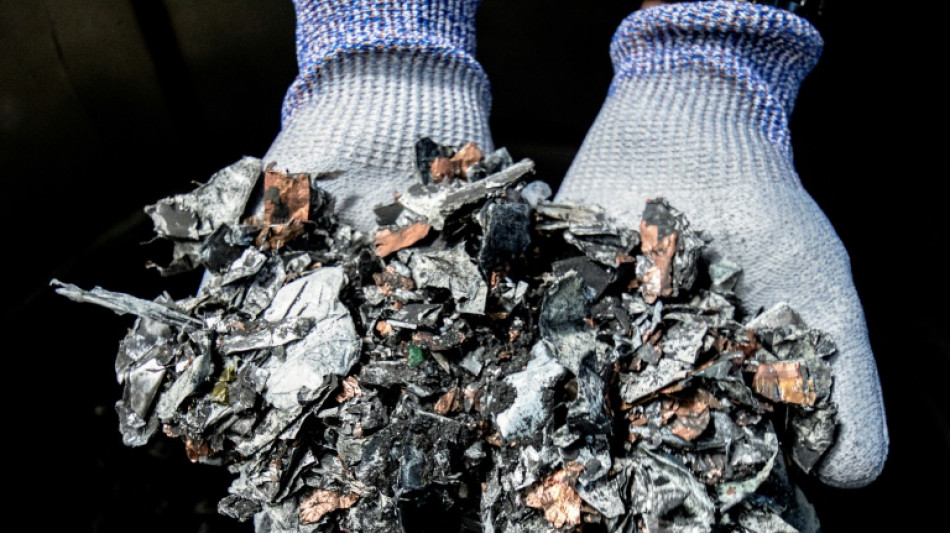
Costa Rica's 'urban mine' for planet-friendlier lithium
/ Photo: Ezequiel BECERRA - AFP

 Lula, Bolsonaro in final push for votes ahead of knife-edge election

 Boisterous fashion week barnstorms 'sleepy' Nigerian capital

 UAE investigators say flydubai co-pilot was planning 'terrorist act'

 Rahul smacks century in India v Windies ODI

 Daryz seeks to join exclusive club of dual Arc winners

 Russia warns diplomats to leave Kyiv over new strikes threat

 Olympic champ Zheng rebukes rowdy home crowd at China Open

 World No.1 Sinner pulls out of Shanghai Masters to delay return

 Red Bull's Verstappen grabs pole position for Bahrain GP

 India beat Pakistan in blockbuster as golfer Kim wins 'crazy' gold

 India beat arch-rivals Pakistan to win Asian Games cricket gold

 Ethiopia's Tigray rebels abandon regional capital as govt advances: journalist

 Tom Kim powers to Games gold and exemption from military service

 Split loyalties for Indian football fans at Brazil friendly

 India-Pakistan blockbuster brings cricket fever to Japan baseball field

 Wong waiting on Rafa after winning Asian Games tennis gold

 With Russia next door and rising costs, Latvia goes to the polls

 Penalty hero rues empty seats as Games hosts Japan win football gold

 North Korea fires ballistic missile after Seoul's apology demand

 US regulator finds Boeing 737 MAX software bug 'not a safety concern'

 Ohtani 'managing' injuries as Dodgers launch MLB post-season

 Botched US execution leaves murderer unconscious on ventilator: lawyers

 Cornell rape case exposes sexual violence at US colleges

 France held by Italy in Zidane's homecoming after Olise stunner

 Ethiopian pro-government militia claims Tigray airport as regional tensions spike

Costa Rica, a country where open pit mining is banned, has become a leader in the extraction of heavy metals such as lithium -- not from the Earth, but old batteries.
The Fortech recycling factory which opened nearly three decades ago in Cartago about 27 kilometers (17 miles) from the capital San Jose, is referred to by its staff as an "urban mine."
For the last six years, it has focused on extracting lithium contained in rechargeable batteries used in everything from mobile phones and laptops to electric cars and solar panels.
Millions of batteries are discarded every year.
While the battery casings take about 100 years to decompose, the often toxic heavy metals inside never do.
For Fortech, this presents a proverbial gold mine, and for our planet, perhaps a lifeboat.
"We now know that waste does not exist. We know it is a resource that can be used again," Fortech managing director Guillermo Pereira told AFP.
"It’s important to break paradigms," added the 54-year-old, who with his son Francisco, 25, created a new method for extracting metals from used batteries.
"The world needs a circular economy" that recycles precious primary materials rather than sourcing new ones, said Pereira.
- 'White gold' -
Unlike lithium mined elsewhere in conditions often harmful to the environment, workers and local populations, Fortech's metals are taken from 1,500 tons of used batteries discarded every year in Costa Rica alone, according to his son, the company's project manager.
They are collected in malls, electronics stores or electric vehicle sales points.
Lithium, dubbed "white gold" or the "oil of the 21st century," has seen its price explode on the global market from $5,700 per ton in November 2020 to 60,500 dollars in September 2022 due to electric cars replacing their polluting, gas-guzzling forerunners.
But lithium production plants consume millions of liters of water and can be harmful to the environment.
Obtaining lithium from recycling batteries expels only a quarter of the planet-warming CO2 that comes with mining it, according to Fortech chemist Henry Prado.
Recycling also saves the planet of the environment pollution caused by the "usual disposal method" of lithium batteries, which is often simply to dump them, he added.
According to the American Chemical Society, as little as five percent of the world’s lithium-ion batteries are thought to be recycled.
- 'Pioneer' -
At Fortech, collected spent batteries are placed on a conveyor belt that feeds them into a crusher.
The waste extracted in this way is then transformed into a mix of cobalt, nickel, manganese and lithium known as "black mass."
These metals comprise about 57 percent of each battery -- the rest is copper, aluminum, plastic and iron, all of which can also be recycled.
Fortech does not have the technology to further separate the individual metals in the "black mass," which it sells instead to factories in Europe to complete the process and manufacture new batteries.
According to the German development agency GIZ, Fortech has turned Costa Rica into "a pioneer in Latin America in the valorization of used lithium batteries."
V.F.Barreira--PC



