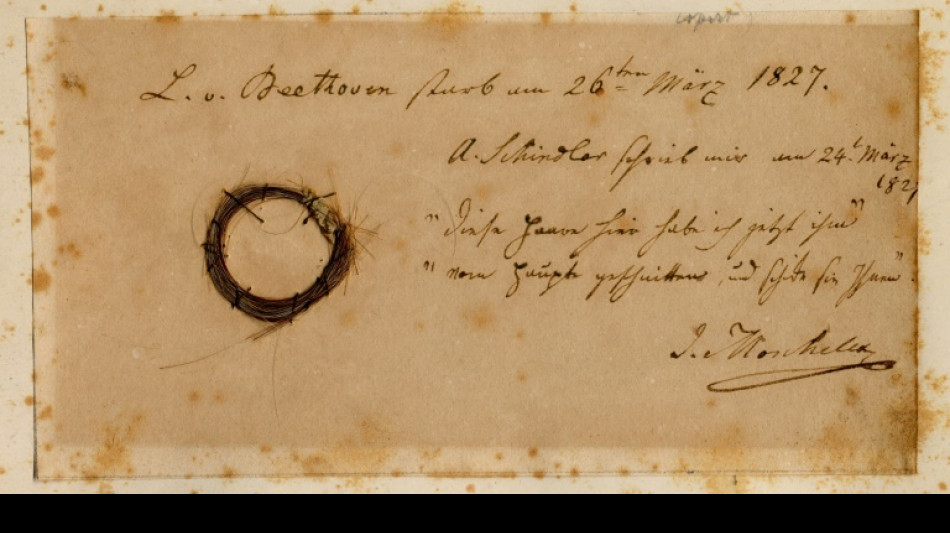
DNA analysis of Beethoven's hair provides clues to his death / Photo: Ira F. Brilliant - Center for Beethoven Studies, San Jose State University/AFP

 Lula, Bolsonaro in final push for votes ahead of knife-edge election

 Boisterous fashion week barnstorms 'sleepy' Nigerian capital

 UAE investigators say flydubai co-pilot was planning 'terrorist act'

 Rahul smacks century in India v Windies ODI

 Daryz seeks to join exclusive club of dual Arc winners

 Russia warns diplomats to leave Kyiv over new strikes threat

 Olympic champ Zheng rebukes rowdy home crowd at China Open

 World No.1 Sinner pulls out of Shanghai Masters to delay return

 Red Bull's Verstappen grabs pole position for Bahrain GP

 India beat Pakistan in blockbuster as golfer Kim wins 'crazy' gold

 India beat arch-rivals Pakistan to win Asian Games cricket gold

 Ethiopia's Tigray rebels abandon regional capital as govt advances: journalist

 Tom Kim powers to Games gold and exemption from military service

 Split loyalties for Indian football fans at Brazil friendly

 India-Pakistan blockbuster brings cricket fever to Japan baseball field

 Wong waiting on Rafa after winning Asian Games tennis gold

 With Russia next door and rising costs, Latvia goes to the polls

 Penalty hero rues empty seats as Games hosts Japan win football gold

 North Korea fires ballistic missile after Seoul's apology demand

 US regulator finds Boeing 737 MAX software bug 'not a safety concern'

 Ohtani 'managing' injuries as Dodgers launch MLB post-season

 Botched US execution leaves murderer unconscious on ventilator: lawyers

 Cornell rape case exposes sexual violence at US colleges

 France held by Italy in Zidane's homecoming after Olise stunner

 Ethiopian pro-government militia claims Tigray airport as regional tensions spike

Ludwig van Beethoven died in Vienna nearly 200 years ago after a lifetime of composing some of the most influential works in classical music.
Ever since, biographers have sought to explain the causes of the German composer's death at the age of 56, his progressive hearing loss and his well-documented struggles with chronic illness.
A team of researchers who sequenced Beethoven's genome using locks of the German composer's hair may now have some answers.
Liver failure, or cirrhosis, was the likely cause of Beethoven's death brought about by a number of factors, including his alcohol consumption, they said.
"We looked at possible genetic causes of his three main symptom complexes -- the progressive hearing loss, the gastrointestinal symptoms and the liver disease ultimately leading to his death due to liver failure," said Markus Nothen of the Institute of Human Genetics at the University Hospital of Bonn, one of the co-authors.
Beethoven, Nothen said, had "a strong genetic disposition to liver disease" and sequences of the hepatitis B virus were detected in his hair.
"We believe the disease arose from an interplay of genetic disposition, well documented chronic alcohol consumption and hepatitis B infection," Nothen said.
Johannes Krause of the Max Planck Institute for Evolutionary Anthropology said hepatitis B "was probably quite common at that time in the early 19th century."
"At least in the last few months before his death he was infected with hepatitis B virus," Krause said.
The authors of the study, published in the Cell Press journal Current Biology on Wednesday, were unable to determine the cause of the hearing loss that eventually left Beethoven profoundly deaf.
The researchers analyzed eight locks of hair said to be from Beethoven and determined that five of them were "almost certainly authentic," said Tristan Begg, a PhD student at the University of Cambridge and the lead author of the study.
"Because we reconstructed the genome from ultra-short DNA fragments, we only confidently mapped about two-thirds of it," he said.
- 'Acute illness' -
Beethoven, who was born in Bonn in 1770 and died in 1827, battled gastrointestinal problems at various times of his life as well as jaundice.
"There were periods of acute illness where he was unable to work, for example, his month-long period of acute illness in the spring of 1825," Begg said.
The researchers, by studying Beethoven's DNA data and archival documents, also uncovered a discrepancy in his legal and biological genealogy.
They found an "extra-pair paternity event" -- a child resulting from an extramarital relationship -- in Beethoven's direct paternal line, said Toomas Kivisild of the Institute of Genomics at the University of Tartu.
Kivisild said it occurred some time within seven generations that separate a common ancestor, Aert van Beethoven, at the end of the 16th century and Beethoven's birth in 1770.
Begg said it was no surprise it was not recorded.
"You wouldn't necessarily expect an extra-pair paternity event to be documented," he said, being "probably clandestine in nature."
"You cannot rule out that Beethoven himself may have been illegitimate," Begg said.
"I'm not advocating that," he stressed. "I'm simply saying that's a possibility and you have to consider it."
Beethoven had asked in an 1802 letter that his health problems, particularly his hearing loss, be described after his death.
"He had the wish to be studied post-mortem," Krause said.
"And it is kind of, basically, his wish that we are fulfilling to some degree with this project."
N.Esteves--PC



