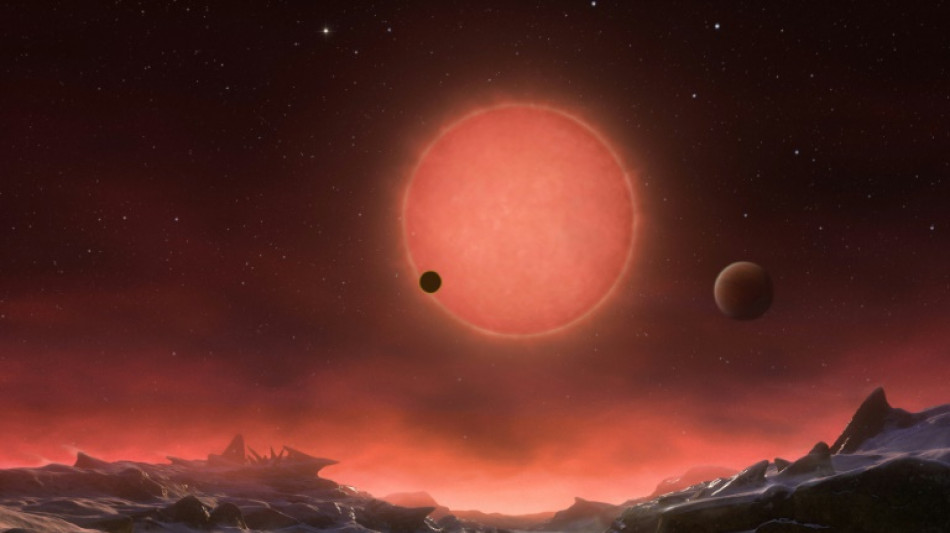
Webb measures temperature of rocky exoplanet for first time / Photo: HO - European Southern Observatory/AFP/File

 Lula, Bolsonaro in final push for votes ahead of knife-edge election

 Boisterous fashion week barnstorms 'sleepy' Nigerian capital

 UAE investigators say flydubai co-pilot was planning 'terrorist act'

 Rahul smacks century in India v Windies ODI

 Daryz seeks to join exclusive club of dual Arc winners

 Russia warns diplomats to leave Kyiv over new strikes threat

 Olympic champ Zheng rebukes rowdy home crowd at China Open

 World No.1 Sinner pulls out of Shanghai Masters to delay return

 Red Bull's Verstappen grabs pole position for Bahrain GP

 India beat Pakistan in blockbuster as golfer Kim wins 'crazy' gold

 India beat arch-rivals Pakistan to win Asian Games cricket gold

 Ethiopia's Tigray rebels abandon regional capital as govt advances: journalist

 Tom Kim powers to Games gold and exemption from military service

 Split loyalties for Indian football fans at Brazil friendly

 India-Pakistan blockbuster brings cricket fever to Japan baseball field

 Wong waiting on Rafa after winning Asian Games tennis gold

 With Russia next door and rising costs, Latvia goes to the polls

 Penalty hero rues empty seats as Games hosts Japan win football gold

 North Korea fires ballistic missile after Seoul's apology demand

 US regulator finds Boeing 737 MAX software bug 'not a safety concern'

 Ohtani 'managing' injuries as Dodgers launch MLB post-season

 Botched US execution leaves murderer unconscious on ventilator: lawyers

 Cornell rape case exposes sexual violence at US colleges

 France held by Italy in Zidane's homecoming after Olise stunner

 Ethiopian pro-government militia claims Tigray airport as regional tensions spike

The James Webb Space Telescope has measured the temperature of a rocky exoplanet for the first time, finding that a "cousin" of Earth most likely lacks an atmosphere, researchers said Monday.
When the Trappist-1 system was discovered in 2017, astronomers were excited at the prospect that some of its seven rocky planets -- which are roughly similar to Earth in size and mass -- could be habitable.
Just 40 light years from Earth, the planets orbit much closer to their ultracool red dwarf star than the rocky planets in our Solar System. But their star gives off far less energy than our Sun.
The system made an obvious target for the piercing gaze of the Webb telescope, which has unleashed a torrent of scientific discovery since releasing its first observations in July last year.
Astronomers focused on Trappist-1b, the closest planet to the red dwarf, because it was the easiest to spot.
Webb's Mid-Infrared Instrument (MIRI) measured the change in brightness when the planet moved behind its star, in what is known as a secondary eclipse.
"Just before disappearing behind the star, the planet gives off the most light because it almost exclusively shows its 'day' side," Elsa Ducrot, a co-author of a new study published in the journal Nature, told AFP.
By subtracting the brightness of the star, the researchers calculated how much infrared light the planet was giving off.
The MIRI instrument was therefore able to act like "a giant touch-free thermometer," NASA said in a statement.
- 'Perfect for baking pizza' -
The planet's dayside temperature was determined to be 230 degrees Celsius (450 Fahrenheit) -- "just about perfect for baking pizza," NASA added.
France's Atomic Energy Commission (CEA) said that the heat was not redistributed throughout this "cousin" of Earth, a role normally provided by an atmosphere.
The scientists therefore concluded that Trappist-1b "has little or no atmosphere," said Ducrot, a CEA astrophysicist. She emphasised that other wavelengths would need to be analysed to confirm the result.
But it was certain that the atmosphere did not contain carbon dioxide, because that would have absorbed some of the light, she added.
The Spitzer Space Telescope was not able to rule out an atmosphere on Trappist-1b despite observing 28 secondary eclipses, Ducrot said.
"The James Webb saw it in a single eclipse!"
The ability to analyse the potential atmospheres of such rocky exoplanets opens "a new era" in the study of planets outside our Solar System, she added.
It was already known that Trappist-1b was uninhabitable, as it is too close to its star.
But Trappist-1e, Trappist-1f and Trappist-1g are all thought to be in what is called the "goldilocks zone".
Planets in this zone have a moderate temperature which could support liquid water -- considered essential for life anywhere.
O.Gaspar--PC



