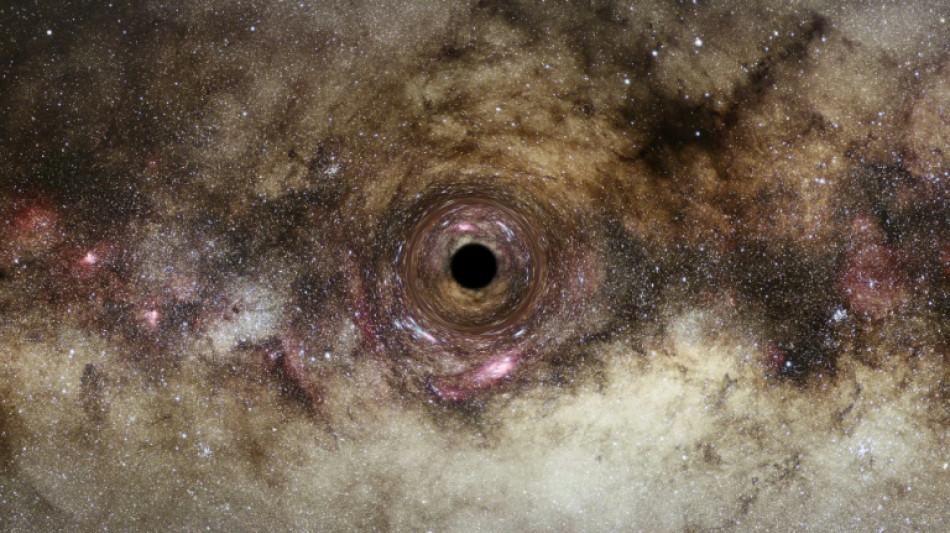
Astronomers discover one of biggest black holes ever recorded / Photo: Handout - ESA/HUBBLE/AFP

 #IAmJaneDoe: online support campaign in US university rape case

 Brazil shine on Selecao's first visit to India

 Zverev sets up Djokovic quarter-final at China Open, Rybakina out

 Happier at home, Bordeaux hammer Lyon in Top 14

 Lula, Bolsonaro in final push for votes ahead of knife-edge election

 Boisterous fashion week barnstorms 'sleepy' Nigerian capital

 UAE investigators say flydubai co-pilot was planning 'terrorist act'

 Rahul smacks century in India v Windies ODI

 Daryz seeks to join exclusive club of dual Arc winners

 Russia warns diplomats to leave Kyiv over new strikes threat

 Olympic champ Zheng rebukes rowdy home crowd at China Open

 World No.1 Sinner pulls out of Shanghai Masters to delay return
 Red Bull's Verstappen grabs pole position for Bahrain GP

 India beat Pakistan in blockbuster as golfer Kim wins 'crazy' gold

 India beat arch-rivals Pakistan to win Asian Games cricket gold

 Ethiopia's Tigray rebels abandon regional capital as govt advances: journalist

 Tom Kim powers to Games gold and exemption from military service

 Split loyalties for Indian football fans at Brazil friendly

 India-Pakistan blockbuster brings cricket fever to Japan baseball field

 Wong waiting on Rafa after winning Asian Games tennis gold

 With Russia next door and rising costs, Latvia goes to the polls

 Penalty hero rues empty seats as Games hosts Japan win football gold

 North Korea fires ballistic missile after Seoul's apology demand

 US regulator finds Boeing 737 MAX software bug 'not a safety concern'

 Ohtani 'managing' injuries as Dodgers launch MLB post-season

One of the largest black holes ever recorded has been discovered using a new technique that could spot thousands more of the insatiable celestial monsters in the coming years, according to astronomers.
The ultramassive black hole, one of just four ever observed, is more than 30 billion times the mass of the Sun, a new study said.
It is the first black hole ever observed using a phenomenon called gravitational lensing, in which light travelling towards us from a distant galaxy appears to magnify and bend inwards, giving away the presence of a dark giant.
James Nightingale, an astronomer at the UK's Durham University and the study's lead author, told AFP the process was "similar to shining light through the base of a wine glass".
He said it was "very fortuitous" that the light of a galaxy in the distant universe travelled extremely close to this black hole, which is roughly two billion light years from Earth.
It could even be the biggest black hole ever recorded, but it was difficult to say for sure given the varying techniques and uncertainties involved, he added.
Supermassive black holes sit at the centre of galaxies using their vast gravitational pull to gobble up stars like specks of dust, not even allowing light to escape.
Previous black holes of this size have been observed when their voracious devouring gives off huge amounts light at the margins -- or by measuring the orbit of stars that speed up as they pass by.
But these techniques only work for galaxies relatively close to Earth.
- Landscape to 'dramatically change' -
Gravitational lensing allows astronomers to "discover black holes in the other 99 percent of galaxies that are currently inaccessible," Nightingale said.
There are currently around 500 known gravitational lenses -- at least one of which we now know is a supermassive black hole.
But "the landscape is about to dramatically change," Nightingale said.
The European Space Agency's Euclid mission, planned to launch into space in July, will open a "big data era" for black hole hunters by creating a huge high resolution map of the universe, he said.
In the next six years Euclid could find 100,000 new gravitational lenses, which would potentially point towards thousands of previously hidden black holes, Nightingale added.
For the latest discovery, the researchers used computer simulations and images from the Hubble Space Telescope to confirm their findings, as well as eliminating other possibilities such as an overconcentration of dark matter.
The huge size is also consistent with what would be expected for a black hole at the centre of its giant host galaxy, Nightingale said.
The mass of all the stars in the galaxy, dubbed Abell 1201, is more than a trillion times that of our Sun, meaning it would be expected to have a particularly large black hole at its centre.
The study was published in the journal Monthly Notices of the Royal Astronomical Society on Tuesday.
F.Ferraz--PC



