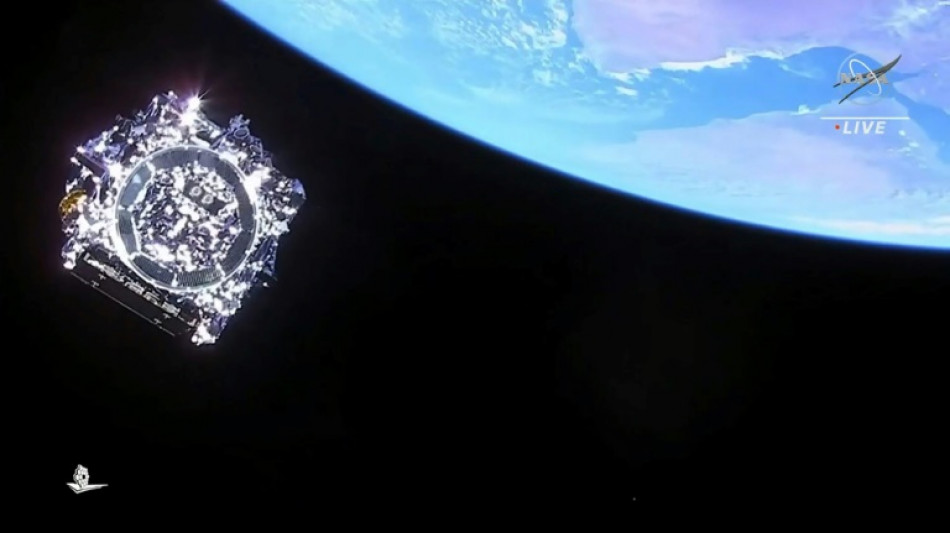
Webb telescope discovers oldest galaxies ever observed / Photo: - - NASA TV/AFP/File

 #IAmJaneDoe: online support campaign in US university rape case

 Brazil shine on Selecao's first visit to India

 Zverev sets up Djokovic quarter-final at China Open, Rybakina out

 Happier at home, Bordeaux hammer Lyon in Top 14

 Lula, Bolsonaro in final push for votes ahead of knife-edge election

 Boisterous fashion week barnstorms 'sleepy' Nigerian capital

 UAE investigators say flydubai co-pilot was planning 'terrorist act'

 Rahul smacks century in India v Windies ODI

 Daryz seeks to join exclusive club of dual Arc winners

 Russia warns diplomats to leave Kyiv over new strikes threat

 Olympic champ Zheng rebukes rowdy home crowd at China Open

 World No.1 Sinner pulls out of Shanghai Masters to delay return

 Red Bull's Verstappen grabs pole position for Bahrain GP

 India beat Pakistan in blockbuster as golfer Kim wins 'crazy' gold

 India beat arch-rivals Pakistan to win Asian Games cricket gold

 Ethiopia's Tigray rebels abandon regional capital as govt advances: journalist

 Tom Kim powers to Games gold and exemption from military service

 Split loyalties for Indian football fans at Brazil friendly

 India-Pakistan blockbuster brings cricket fever to Japan baseball field

 Wong waiting on Rafa after winning Asian Games tennis gold

 With Russia next door and rising costs, Latvia goes to the polls

 Penalty hero rues empty seats as Games hosts Japan win football gold

 North Korea fires ballistic missile after Seoul's apology demand

 US regulator finds Boeing 737 MAX software bug 'not a safety concern'

 Ohtani 'managing' injuries as Dodgers launch MLB post-season

The James Webb Space Telescope has discovered the four most distant galaxies ever observed, one of which formed just 320 million years after the Big Bang when the universe was still in its infancy, new research said on Tuesday.
The Webb telescope has unleashed a torrent of scientific discovery since becoming operational last year, peering farther than ever before into the universe's distant reaches -- which also means it is looking back in time.
By the time light from the most distant galaxies reaches Earth, it has been stretched by the expansion of the universe and shifted to the infrared region of the light spectrum.
The Webb telescope's NIRCam instrument has an unprecedented ability to detect this infrared light, allowing it to quickly spot a range of never-before-seen galaxies -- some of which could reshape astronomers' understanding of the early universe.
In two studies published in the Nature Astronomy journal, astronomers revealed they have "unambiguously detected" the four most distant galaxies ever observed.
The galaxies date from 300 to 500 million years after the Big Bang more than 13 billion years ago, when the universe was just two percent of its current age.
That means the galaxies are from what is called "the epoch of reionisation," a period when the first stars are believed to have emerged. The epoch came directly after the cosmic dark ages brought about by the Big Bang.
- 'Surprising' -
Stephane Charlot, a researcher at the Astrophysics Institute of Paris and co-author of the two new studies, told AFP that the farthest galaxy -- called JADES-GS-z13-0 -- formed 320 million years after the Big Bang.
That is the greatest distance ever observed by astronomers, he said.
The Webb telescope also confirmed the existence of JADES-GS-z10-0, which dates from 450 million years after the Big Bang and had previously been spotted by the Hubble Space Telescope.
All four galaxies are "very low in mass," weighing roughly a hundred million solar masses, Charlot said. The Milky Way, in comparison, weighs 1.5 trillion solar masses by some estimations.
But the galaxies are "very active in star formation in proportion to their mass," Charlot said.
Those stars were forming "at around the same rate as the Milky Way," a speed that was "surprising so early in the Universe," he added.
The galaxies were also "very poor in metals," he added.
This is consistent with the standard model of cosmology, science's best understanding of how the universe works, which says that the closer to the Big Bang, the less time there is for such metals to form.
- Technical tour de force' -
However in February, the discovery of six massive galaxies from 500-700 million years after the Big Bang led some astronomers to question the standard model.
Those galaxies, also observed by the Webb telescope, were bigger than thought possible so soon after the birth of the universe -- if confirmed, the standard model could need updating.
Pieter van Dokkum, an astronomer at Yale University not involved in the latest research, hailed the confirmation of the four newly-discovered distant galaxies as a "technical tour de force".
"The frontier is moving almost every month," van Dokkum commented in Nature, adding that there was now "only 300 million years of unexplored history of the universe between these galaxies and the Big Bang".
The Webb telescope has observed possible galaxies even closer to the Big Bang, but they have yet to be confirmed, he said.
A.S.Diogo--PC



