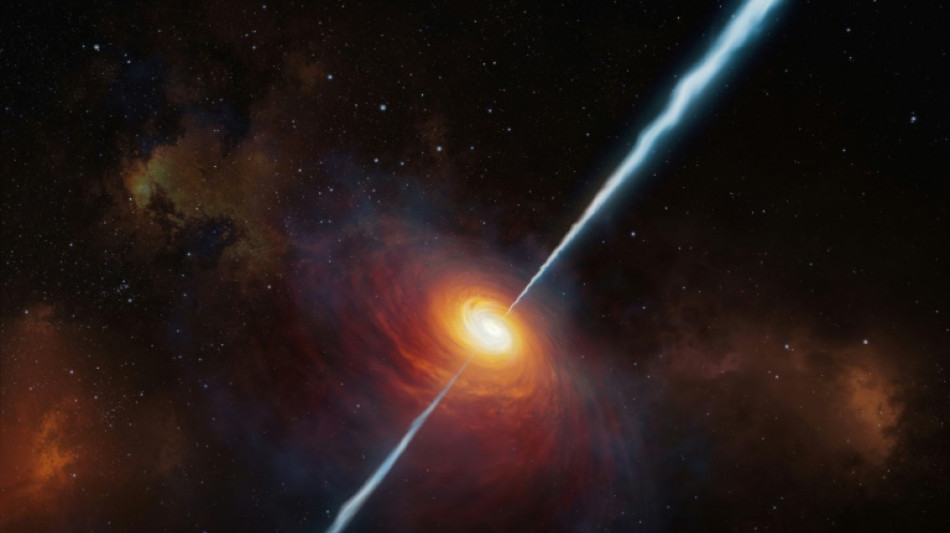
Milky Way's fate? Astronomers reveal what ignites quasars / Photo: M. KORNMESSER - European Southern Observatory/AFP

 Tuchel hails 'complete' England after Croatia demolition

 Fury to invite Trump to lead ring walk before Joshua showdown

 Fashion industry in 'precarious moment', says Vivienne Westwood supremo

 Seventh heaven for England in Nations League rout of Croatia

 Storms, flooding cause chaos on Greek holiday island of Crete

 #IAmJaneDoe: online support campaign in US university rape case

 Brazil shine on Selecao's first visit to India

 Zverev sets up Djokovic quarter-final at China Open, Rybakina out

 Happier at home, Bordeaux hammer Lyon in Top 14

 Lula, Bolsonaro in final push for votes ahead of knife-edge election

 Boisterous fashion week barnstorms 'sleepy' Nigerian capital

 UAE investigators say flydubai co-pilot was planning 'terrorist act'

 Rahul smacks century in India v Windies ODI

 Daryz seeks to join exclusive club of dual Arc winners

 Russia warns diplomats to leave Kyiv over new strikes threat

 Olympic champ Zheng rebukes rowdy home crowd at China Open

 World No.1 Sinner pulls out of Shanghai Masters to delay return

 Red Bull's Verstappen grabs pole position for Bahrain GP

 India beat Pakistan in blockbuster as golfer Kim wins 'crazy' gold

 India beat arch-rivals Pakistan to win Asian Games cricket gold

 Ethiopia's Tigray rebels abandon regional capital as govt advances: journalist

 Tom Kim powers to Games gold and exemption from military service

 Split loyalties for Indian football fans at Brazil friendly

 India-Pakistan blockbuster brings cricket fever to Japan baseball field

 Wong waiting on Rafa after winning Asian Games tennis gold

Astronomers said Wednesday that for the first time they have confirmed what ignites quasars, the brightest and most powerful objects in the universe, which put galaxies in their "death throes".
These celestial behemoths form when two galaxies smash into each other, the astronomers said, warning that this could be the Milky Way's fate in a few billion years.
Quasars are one of the most extreme objects in the universe, some shining with the brightness of a trillion stars despite being packed into the space of our Solar System.
They sit in the heart of galaxies, powered by supermassive black holes, requiring a huge amount of gas to be so staggeringly bright.
But exactly what creates quasars has been a matter of debate since their discovery in the 1950s.
In a new study, an international team of researchers said they have "clear evidence" that quasars are triggered by two galaxies colliding, which releases the vast amounts of energy needed.
Clive Tadhunter, an astrophysicist at the University of Sheffield in the UK and one of the study's authors, told AFP that this could be the fate of the Milky Way one day.
The nearby Andromeda Galaxy is "coming directly towards us at about 200 kilometres (125 miles) a second," he said.
It will collide with the Milky War in roughly five billion years, and "we could get a quasar" as a result, he said.
Quasars push out all the gas from a galaxy, preventing any new stars from forming, he added.
- 'Beacons to the distant universe' -
The researchers compared observations of 48 galaxies with quasars at their centre to 100 without them.
Galaxies hosting quasars were three times as likely to have had collisions with other galaxies, the study said.
While the theory that such collisions ignited quasars has been around for decades, it was difficult to prove.
Tadhunter said this was because observations had often been carried out with telescopes that were optimised to look at objects in the centre of galaxies, but were less effective at spotting the distorted features at their edges that indicate past collisions.
For example, these diffuse structures "get washed out" when observed by the Hubble Space Telescope, he said.
So the team used land-based observatories, such as the Isaac Newton Telescope on the Spanish island of La Palma.
The new study, published in the Monthly Notices of the Royal Astronomical Society, also reviewed previous research to show how it may have missed the tell-tale signs of collisions.
Tadhunter said that quasars "act like beacons to the distant universe" because of their incredible brightness.
The James Webb Space Telescope, which has a much bigger aperture than Hubble, could help reveal more about quasars in this distant universe, when the universe was in its infancy, he said.
S.Caetano--PC



