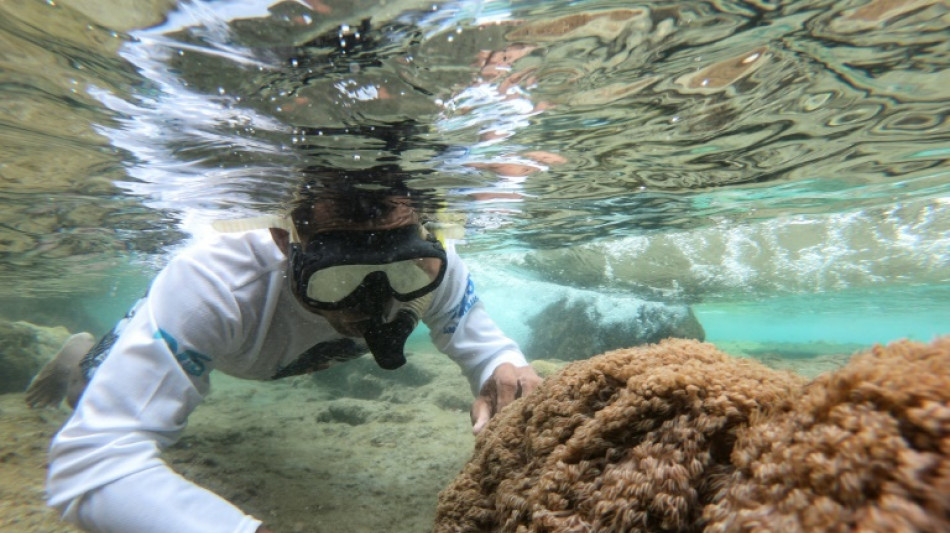
Deadly invader devastating Venezuelan coral reefs / Photo: Yuri CORTEZ - AFP

 Tuchel hails 'complete' England after Croatia demolition

 Fury to invite Trump to lead ring walk before Joshua showdown

 Fashion industry in 'precarious moment', says Vivienne Westwood supremo

 Seventh heaven for England in Nations League rout of Croatia

 Storms, flooding cause chaos on Greek holiday island of Crete

 #IAmJaneDoe: online support campaign in US university rape case

 Brazil shine on Selecao's first visit to India

 Zverev sets up Djokovic quarter-final at China Open, Rybakina out

 Happier at home, Bordeaux hammer Lyon in Top 14

 Lula, Bolsonaro in final push for votes ahead of knife-edge election

 Boisterous fashion week barnstorms 'sleepy' Nigerian capital

 UAE investigators say flydubai co-pilot was planning 'terrorist act'

 Rahul smacks century in India v Windies ODI

 Daryz seeks to join exclusive club of dual Arc winners

 Russia warns diplomats to leave Kyiv over new strikes threat

 Olympic champ Zheng rebukes rowdy home crowd at China Open

 World No.1 Sinner pulls out of Shanghai Masters to delay return

 Red Bull's Verstappen grabs pole position for Bahrain GP

 India beat Pakistan in blockbuster as golfer Kim wins 'crazy' gold

 India beat arch-rivals Pakistan to win Asian Games cricket gold

 Ethiopia's Tigray rebels abandon regional capital as govt advances: journalist

 Tom Kim powers to Games gold and exemption from military service

 Split loyalties for Indian football fans at Brazil friendly

 India-Pakistan blockbuster brings cricket fever to Japan baseball field

 Wong waiting on Rafa after winning Asian Games tennis gold

An ominous shadow in the turquoise Caribbean waters off Venezuela comes from a deadly intruder -- a soft coral that experts say has caused one of the most destructive habitat invasions on record anywhere.
The Unomia stolonifera, native to Indonesia and the Indo-Pacific, is a pinkish type of pulse coral so called for its dance-like movements in the ocean currents.
It is a popular aquarium ornament -- pretty to look at and hardy -- with a single polyp fetching as much as $80 to $120.
But it is also a killer -- settling on native hard corals, rocks and even seagrass which it suffocates and replaces, ultimately destroying entire ecosystems.
Off Venezuela's north coast, Unomia dominates the ocean floor landscape after being introduced through the illegal aquarium trade around 20 years ago.
"This is an ecological catastrophe," said marine biologist Juan Pedro Ruiz-Allais, director of Project Unomia, named after the invader he has spent years investigating.
Fish stocks are drastically decreasing in the waters off Venezuela as native reefs, which serve as nurseries and feeding grounds, die off, he told AFP.
"When the reef dies, when it is covered by the Unomia stolonifera, a disruption of the food chain occurs," said the biologist.
"It is a social, food security, and economic problem because the livelihood of fishermen is compromised."
- 'Nobody knew' -
When Ruiz-Allais first came across the invader in 2007, it was an unknown species in the Caribbean and even the Atlantic, he recalled. "Nobody knew what it was."
It was first spotted in the Mochima National Park, a gorgeous archipelago covering more than 94,000 hectares, and has since been found to have colonized most of those islands.
The first scientific report was published in 2014, and the coral was initially classified as a member of the broad Xeniidae family before it was finally categorized in 2021 as Unomia stolonifera.
From Mochima, it has spread west and east in the Caribbean Sea.
Off the northern state of Anzoategui, it has taken over the equivalent of 300 football stadiums.
The coral is spread by fishing nets, anchors, and ship ballast water.
"It is a great colonizer," Gustavo Carrasquel, director of the Azul Ambientalistas, an environmental NGO, told AFP.
- 'Unprecedented' -
The threat extends beyond Venezuela's borders: officials say Unomia traces have been found near the islands of Aruba and Curacao, and in waters off Colombia and Brazil -- where it became attached to an oil rig but was controlled.
"It is a problem that will affect the rest of the Caribbean," said Ruiz-Allais.
But nowhere has it been more destructive than in Venezuela.
"It is an unprecedented case," said Project Unomia coordinator Mariano Onoro.
Fishermen and tour operators, concerned about the invasive coral's rapid propagation, have resorted to manual extraction.
But experts say this is not advised, because broken-off fragments are transported by the tides, settling to create yet more colonies.
The privately funded Project Unomia has developed an extraction machine with a group of engineers that is awaiting government approval for testing.
Venezuela's Institute for Scientific Research and the ministry of eco-socialism have launched an investigation into the coral's rapid spread but have yet to come up with a solution.
For now, the magnitude of the problem is such that the invader's elimination appears impossible.
"What we can do is recover some areas and control it," said Onoro.
G.Teles--PC



