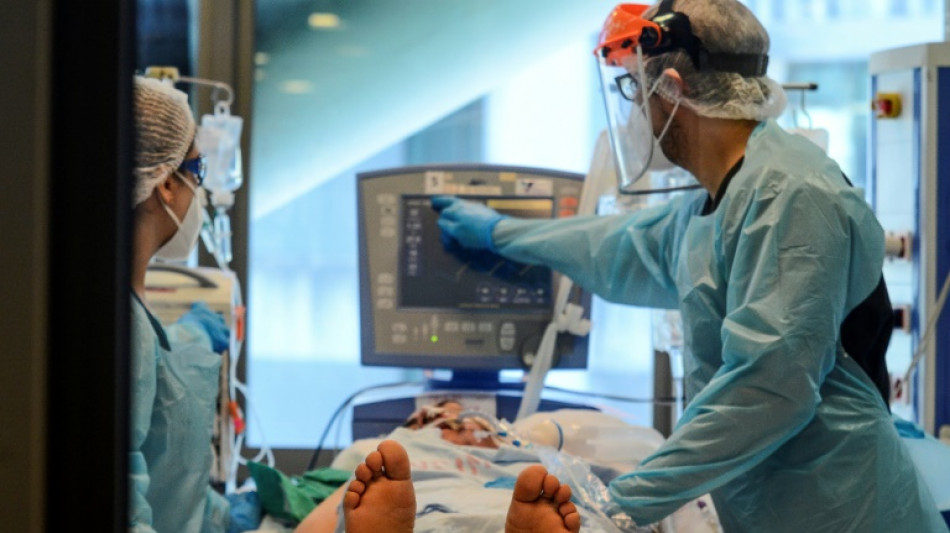
Why does your life flash before your eyes near death? / Photo: GUILLERMO SALGADO SANCHEZ - AFP/File

 Tuchel hails 'complete' England after Croatia demolition

 Fury to invite Trump to lead ring walk before Joshua showdown

 Fashion industry in 'precarious moment', says Vivienne Westwood supremo

 Seventh heaven for England in Nations League rout of Croatia

 Storms, flooding cause chaos on Greek holiday island of Crete

 #IAmJaneDoe: online support campaign in US university rape case

 Brazil shine on Selecao's first visit to India

 Zverev sets up Djokovic quarter-final at China Open, Rybakina out

 Happier at home, Bordeaux hammer Lyon in Top 14

 Lula, Bolsonaro in final push for votes ahead of knife-edge election

 Boisterous fashion week barnstorms 'sleepy' Nigerian capital

 UAE investigators say flydubai co-pilot was planning 'terrorist act'

 Rahul smacks century in India v Windies ODI

 Daryz seeks to join exclusive club of dual Arc winners

 Russia warns diplomats to leave Kyiv over new strikes threat

 Olympic champ Zheng rebukes rowdy home crowd at China Open

 World No.1 Sinner pulls out of Shanghai Masters to delay return

 Red Bull's Verstappen grabs pole position for Bahrain GP

 India beat Pakistan in blockbuster as golfer Kim wins 'crazy' gold

 India beat arch-rivals Pakistan to win Asian Games cricket gold

 Ethiopia's Tigray rebels abandon regional capital as govt advances: journalist

 Tom Kim powers to Games gold and exemption from military service

 Split loyalties for Indian football fans at Brazil friendly

 India-Pakistan blockbuster brings cricket fever to Japan baseball field

 Wong waiting on Rafa after winning Asian Games tennis gold

Survivors of close calls with death often recall extraordinary experiences: seeing light at the end of a tunnel, floating outside their own bodies, encountering deceased loved ones or recapping major life events in an instant.
The fact that these stories share so many elements in common and come from people from diverse cultural backgrounds points to a possible biological mechanism -- one that has yet to be de-mystified by scientists.
In a new paper published Monday in the Proceedings of the National Academy of Science (PNAS), researchers at the University of Michigan found evidence of surges in brain activity associated with consciousness in two dying patients.
While not the first study of its kind, what sets the new research apart is that it's detailed in a way "that's never been done before," senior author Jimo Borjigin, whose lab is devoted to understanding the neurological basis of consciousness, told AFP.
The team looked back at the records of four patients who died from cardiac arrest while on electroencephalogram (EEG) monitoring.
All four fell into comas and were removed from life support after it was determined they were beyond medical help.
When taken off their ventilators, two of the four patients -- a 24-year-old woman and a 77-year-old woman -- saw increases in their heart rates as well as surges of brain waves in the gamma frequency -- the fastest such brain activity, which is associated with consciousness.
Earlier studies -- including a prominent paper published in 2022 about an 87-year-old man who died from a fall -- have also found spikes in gamma waves in some people near the point of death.
The University of Michigan paper went further by examining in greater depth which parts of the brain lit up, with the activity detected in the "posterior cortical hot zone" -- comprised of the temporal, parietal and occipital lobes, which are associated with changes in consciousness.
"If this part of the brain lights up, that means the patient is seeing something, can hear something, and they might feel sensations out of the body," said Borjigin, adding that the region was "on fire."
Brain and heart activity were monitored, second by second, for the last few hours of the patients' life, contributing to the strength of the analysis, she added.
It's not clear why two of the patients experienced these potential signs of "covert consciousness" while two did not, though Borjigin speculated their history of seizures might have primed their brains in some way.
Owing to the small sample size, the authors cautioned against making wide-ranging inferences.
What's more, it's not possible to confirm that the patients really had any visions as they did not live to tell the tale.
Borjigin hopes in the future to collect data on hundreds more people -- increasing the chances that some will actually survive.
One way to do so might be to create an experiment that simulates a near-death experience while the patient is being monitored under lab conditions.
E.Borba--PC



