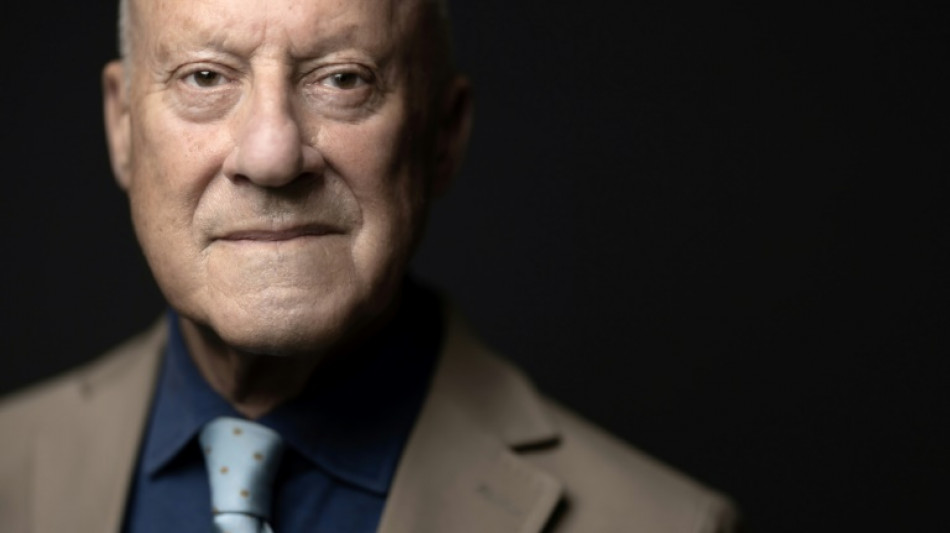
Architects don't need AI, says high-tech pioneer Norman Foster / Photo: JOEL SAGET - AFP

 Tuchel hails 'complete' England after Croatia demolition

 Fury to invite Trump to lead ring walk before Joshua showdown

 Fashion industry in 'precarious moment', says Vivienne Westwood supremo

 Seventh heaven for England in Nations League rout of Croatia

 Storms, flooding cause chaos on Greek holiday island of Crete
 #IAmJaneDoe: online support campaign in US university rape case
 Brazil shine on Selecao's first visit to India
 Zverev sets up Djokovic quarter-final at China Open, Rybakina out

 Happier at home, Bordeaux hammer Lyon in Top 14
 Lula, Bolsonaro in final push for votes ahead of knife-edge election

 Boisterous fashion week barnstorms 'sleepy' Nigerian capital
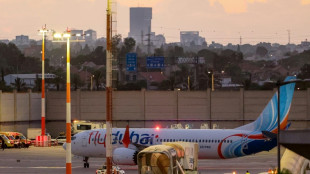 UAE investigators say flydubai co-pilot was planning 'terrorist act'
 Rahul smacks century in India v Windies ODI

 Daryz seeks to join exclusive club of dual Arc winners

 Russia warns diplomats to leave Kyiv over new strikes threat
 Olympic champ Zheng rebukes rowdy home crowd at China Open

 World No.1 Sinner pulls out of Shanghai Masters to delay return

 Red Bull's Verstappen grabs pole position for Bahrain GP

 India beat Pakistan in blockbuster as golfer Kim wins 'crazy' gold

 India beat arch-rivals Pakistan to win Asian Games cricket gold

 Ethiopia's Tigray rebels abandon regional capital as govt advances: journalist
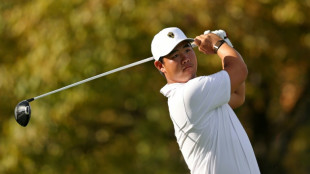 Tom Kim powers to Games gold and exemption from military service
 Split loyalties for Indian football fans at Brazil friendly
 India-Pakistan blockbuster brings cricket fever to Japan baseball field

 Wong waiting on Rafa after winning Asian Games tennis gold
British architect Norman Foster has spent six decades pushing the boundaries of technology with awe-inspiring modernist structures from California to Hong Kong, but he is yet to be convinced by the craze for artificial intelligence.
"Artificial intelligence at the moment has the ability to cheat, to invent," he told AFP in a recent interview in Paris, which is hosting a retrospective of his work.
"We live in a world which is physical, we inhabit buildings, streets, squares. That physicality, you can't replicate by artificial intelligence."
Foster has been shaping urban landscapes since the 1960s and won the Pritzker Prize, the equivalent of the Nobel Prize in architecture, in 1999.
His statement projects include Apple's giant ring-shaped headquarters in California, London's Wembley Stadium and Millennium Bridge, and Berlin's Reichstag.
Experts describe his practice, Foster and Partners, as possibly the most prolific in history, and the most adept at navigating changing trends and technologies.
"He conceives architecture almost as an organism balancing itself with the air, the sun, life," said Frederic Migayrou, curator of the Norman Foster exhibition at the Pompidou Centre in the French capital.
Yet he has not swerved controversy, irking climate campaigners with his keenness to build airports and his views on the environment.
- 'Hard facts' -
He is a champion of urban living -- "people live longer in cities" -- but his vision for sustaining urban lifestyles has courted some criticism.
He supports nuclear power, saying it had not caused a single death and the world would only be able to tackle climate change "with hard facts, not emotion".
He sees it as a vital part of the solution to the deprivation and poverty seen in megacities and overpopulated slums across the world.
"Many people gravitated to those cities because there are more opportunities," he said.
"The answer has to be an abundance of clean energy, and the cleanest, safest form of energy is nuclear."
Hong Kong's Chek Lap Kok airport, opened in 1998, made a huge splash for his firm, and he has worked on several airports since -- much to the annoyance of climate activists, who see air travel as part of the problem.
Yet when he talks of his broader philosophy, the 87-year-old could easily make common cause with climate activists.
- End of the sprawl -
Surrounded by models of his greatest creations, he talked breezily about the development of cleaner, greener cities.
The pandemic accelerated a growing need for people to have access to outdoor spaces for eating and strolling, and for services within walking distance of their homes, he argued.
"The cities which are most popular... they fit that model, essentially it's a European model born before the ascendency of the automobile," he said.
And the transformation of our relationship with cars is central to the reshaping of modern cities, he said.
"You have younger generations who are less interested in ownership, who will move towards ride-sharing and mobility more as a service," he said.
This was pushing us away from sprawling car-centric cities with rigid work-home zones to ones where buildings were multipurpose, reducing the need for commuting.
Despite his storied history, Foster, still a central figure in all these threads of modern design, is not keen to dwell on his achievements.
The Pompidou exhibition, which displays models of his buildings alongside exhibits that inspired their design, has allowed him to see hidden connections.
But understandably for someone who forged the "high-tech" architectural movement in the 1960s with fellow Briton Richard Rogers, what comes next is always more important than what has already gone.
"Overall, I'm more excited by the future than I am by the past."
L.Carrico--PC



