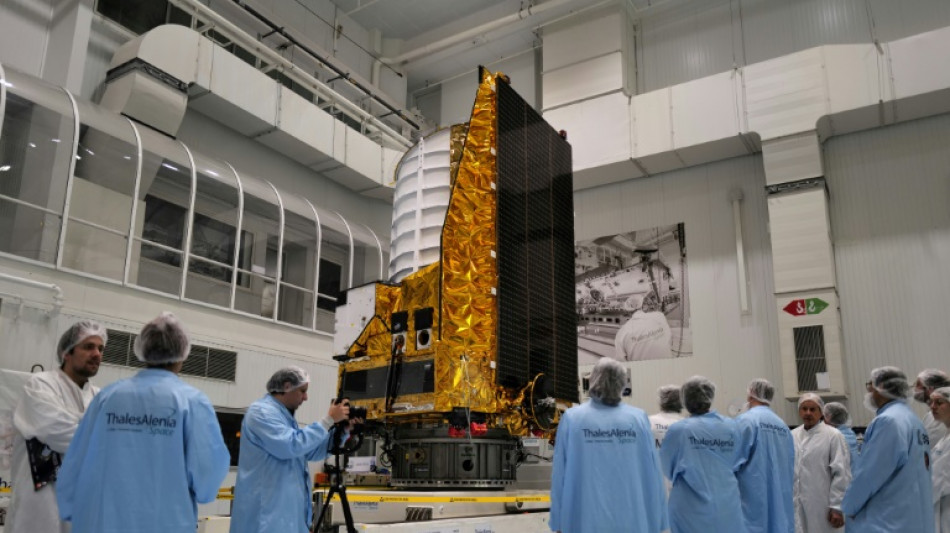
Europe's Euclid space telescope to launch on July 1 / Photo: Valery HACHE - AFP/File

 Yamal on target as Spain hold off Czech Republic

 Latvian exit polls suggest pro-European choice

 Lula, Bolsonaro wrap up campaigns ahead of knife-edge election

 Tuchel hails 'complete' England after Croatia demolition

 Fury to invite Trump to lead ring walk before Joshua showdown

 Fashion industry in 'precarious moment', says Vivienne Westwood supremo

 Seventh heaven for England in Nations League rout of Croatia

 Storms, flooding cause chaos on Greek holiday island of Crete

 #IAmJaneDoe: online support campaign in US university rape case

 Brazil shine on Selecao's first visit to India

 Zverev sets up Djokovic quarter-final at China Open, Rybakina out

 Happier at home, Bordeaux hammer Lyon in Top 14

 Lula, Bolsonaro in final push for votes ahead of knife-edge election

 Boisterous fashion week barnstorms 'sleepy' Nigerian capital

 UAE investigators say flydubai co-pilot was planning 'terrorist act'

 Rahul smacks century in India v Windies ODI

 Daryz seeks to join exclusive club of dual Arc winners

 Russia warns diplomats to leave Kyiv over new strikes threat

 Olympic champ Zheng rebukes rowdy home crowd at China Open

 World No.1 Sinner pulls out of Shanghai Masters to delay return

 Red Bull's Verstappen grabs pole position for Bahrain GP

 India beat Pakistan in blockbuster as golfer Kim wins 'crazy' gold

 India beat arch-rivals Pakistan to win Asian Games cricket gold

 Ethiopia's Tigray rebels abandon regional capital as govt advances: journalist

 Tom Kim powers to Games gold and exemption from military service

The European Space Agency said on Wednesday its space telescope Euclid is scheduled to launch on July 1, blasting off on a mission to shed light on the mysteries of dark matter and dark energy.
The mission will launch on a SpaceX Falcon 9 rocket from Cape Canaveral in Florida, with the broadcast beginning at 1430 GMT, the ESA said in a tweet.
Euclid was originally planned to ride into space on a Russian Soyuz rocket, but last year Moscow withdrew its launchers in response to sanctions over the invasion of Ukraine.
The ESA was forced to turn to its rival SpaceX, the US company of billionaire Elon Musk, to launch the 1.4-billion-euro ($1.5 billion) mission.
The two-tonne Euclid, which is 4.7 metres (15 feet) tall and 3.5 metres (11 feet) wide, will join fellow space telescope James Webb at a stable hovering spot 1.5 million kilometres from Earth called the second Lagrangian Point.
From there, Euclid will chart a 3D map of the universe encompassing two billion galaxies across more than a third of the sky.
Euclid's gaze will stretch out to 10 billion light years away. Because of how long it takes the light from distant stars to reach Earth, that means it will peer back 10 billion years into the cosmic past.
The mission will allow scientists to reconstruct the history of the 13.8-billion-year-old universe via "slices of time," astrophysicist Yannick Mellier told the Euclid consortium earlier this month.
Euclid's main objective is to better understand dark matter and dark energy, which together make up 95 percent of the universe.
The existence of both remains entirely theoretical -- although also necessary for scientists to construct a working understanding of the universe.
Dark matter is invisible, its existence inferred from the motion of objects affected by its gravitational pull.
Dark energy is the name given to the unknown force causing the expansion of the universe to accelerate.
Euclid is not expected to identify the true nature of these dark mysteries, but astronomers hope its unprecedented view of the universe will shed light on how they act and evolve over time.
Euclid's first images are expected to roll in quickly once scientific operations start in October, but it will take scientists longer to sift through the massive amount of data.
X.Matos--PC



