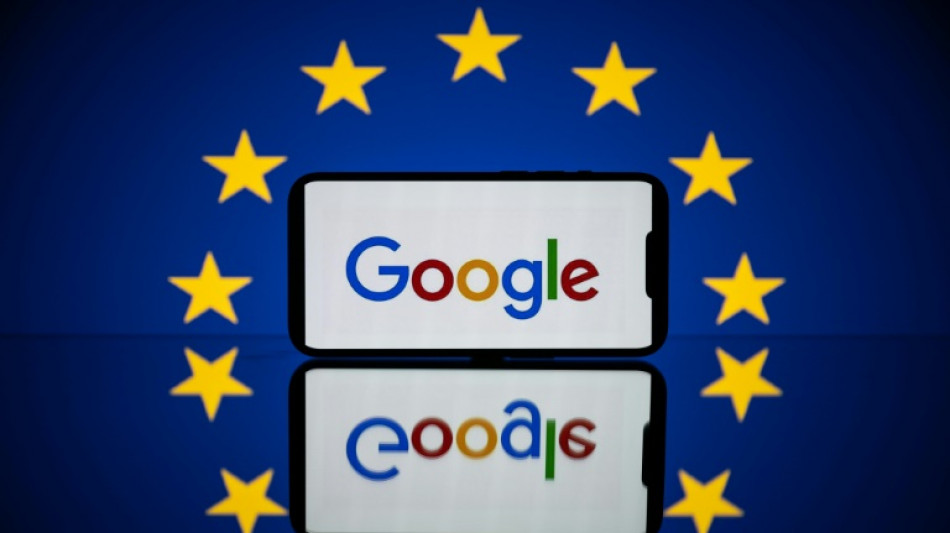
Google launches ChatGPT rival Bard in EU, Brazil / Photo: Lionel BONAVENTURE - AFP/File

 Yamal on target as Spain hold off Czech Republic

 Latvian exit polls suggest pro-European choice

 Lula, Bolsonaro wrap up campaigns ahead of knife-edge election

 Tuchel hails 'complete' England after Croatia demolition

 Fury to invite Trump to lead ring walk before Joshua showdown

 Fashion industry in 'precarious moment', says Vivienne Westwood supremo

 Seventh heaven for England in Nations League rout of Croatia

 Storms, flooding cause chaos on Greek holiday island of Crete

 #IAmJaneDoe: online support campaign in US university rape case

 Brazil shine on Selecao's first visit to India

 Zverev sets up Djokovic quarter-final at China Open, Rybakina out

 Happier at home, Bordeaux hammer Lyon in Top 14

 Lula, Bolsonaro in final push for votes ahead of knife-edge election

 Boisterous fashion week barnstorms 'sleepy' Nigerian capital

 UAE investigators say flydubai co-pilot was planning 'terrorist act'

 Rahul smacks century in India v Windies ODI
 Daryz seeks to join exclusive club of dual Arc winners
 Russia warns diplomats to leave Kyiv over new strikes threat

 Olympic champ Zheng rebukes rowdy home crowd at China Open

 World No.1 Sinner pulls out of Shanghai Masters to delay return

 Red Bull's Verstappen grabs pole position for Bahrain GP

 India beat Pakistan in blockbuster as golfer Kim wins 'crazy' gold

 India beat arch-rivals Pakistan to win Asian Games cricket gold

 Ethiopia's Tigray rebels abandon regional capital as govt advances: journalist

 Tom Kim powers to Games gold and exemption from military service

Google launched its AI chatbot Bard in the European Union, Brazil and a dozen other countries on Thursday and unveiled new features as it expands access to its answer to Microsoft-backed ChatGPT.
The US tech giant unveiled Bard in February but delayed its release in the European Union as the bloc plans to regulate artificial intelligence amid concerns about risks associated with the rapidly growing technology.
Google has raced to catch up with rival Microsoft, which has rushed to integrate ChatGPT-like powers in a wide array of its products, including the Bing search engine.
Bard is "now available in most of the world, and in the most widely spoken languages," Bard's product lead Jack Krawczyk and vice president Amarnag Subramanya wrote in a blog.
"As part of our bold and responsible approach to AI, we've proactively engaged with experts, policymakers and privacy regulators on this expansion," they said.
The company said it would incorporate user feedback and take steps to protect people's privacy and data as it broadens access to Bard.
The AI tool can now be used in over 40 languages including Arabic, Chinese, German, Hindi and Spanish. It was previously available in three languages -- English, Japanese and Korean.
Google also announced new features, including receiving audio responses from Bard or answers in five different styles: simple, long, short, professional or casual.
Another new feature allows users to upload photos that Bard can analyse for information.
The rise of AI has raised both excitement and concerns about its potential to improve or replace tasks done by humans.
AI tools have shown in recent months the ability to generate essays, create realistic images, mimic voices of famous singers and even pass medical exams, among a slew of uses.
Common worries include the possibility that chatbots could flood the web with disinformation, that biased algorithms will churn out racist material, or that AI-powered automation could lay waste to entire industries.
- 'Extinction' fears -
Experts -- even the founder of ChatGPT-maker OpenAI, Sam Altman -- have warned about the potential existential risks that the technology poses to humanity.
Altman and dozens of other specialists signed a statement in May urging global leaders to reduce "the risk of extinction" from AI.
But the warnings have not stopped the rapid development of AI.
Tesla and Twitter owner Elon Musk, who has issued his own warnings about the risks, launched an AI company named xAI on Wednesday.
The xAI website said Musk would run the company separately from his other companies but that the technology developed would benefit those businesses, including Twitter.
Last month, the European Parliament backed a draft law that will be the basis for the world's first comprehensive rules for AI.
It includes specific provisions for generative AI systems, such as ChatGPT and Dall-E, capable of producing text, images and other media.
The parliament and the EU's member states will negotiate on the regulation before it is approved and the bloc wants to strike a deal by the end of the year.
The rules stipulate that AI-generated content must be declared as such and bans some AI including real-time facial recognition systems.
N.Esteves--PC



