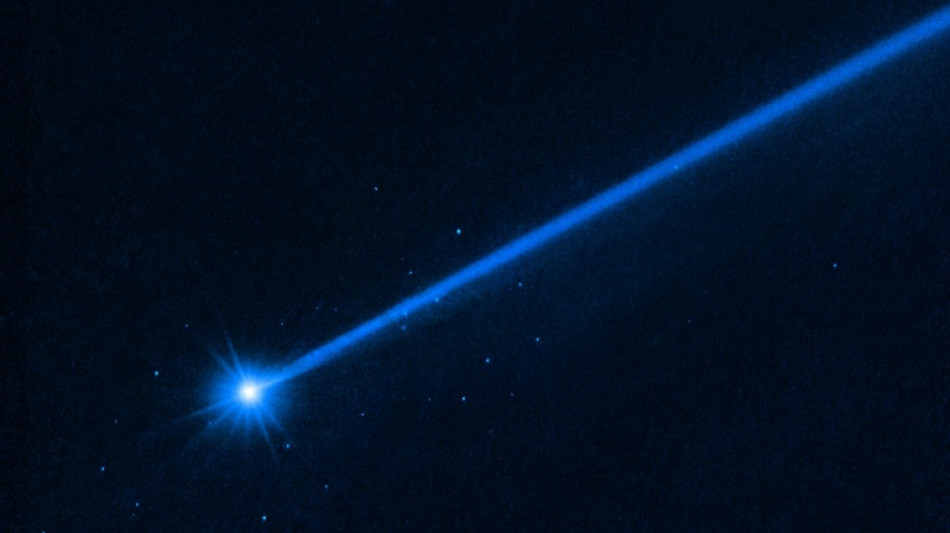
Asteroid-smashing NASA probe sent boulders into space / Photo: Handout - Space Telescope Science Institute/AFP

 Yamal on target as Spain hold off Czech Republic

 Latvian exit polls suggest pro-European choice

 Lula, Bolsonaro wrap up campaigns ahead of knife-edge election

 Tuchel hails 'complete' England after Croatia demolition

 Fury to invite Trump to lead ring walk before Joshua showdown

 Fashion industry in 'precarious moment', says Vivienne Westwood supremo

 Seventh heaven for England in Nations League rout of Croatia

 Storms, flooding cause chaos on Greek holiday island of Crete

 #IAmJaneDoe: online support campaign in US university rape case

 Brazil shine on Selecao's first visit to India

 Zverev sets up Djokovic quarter-final at China Open, Rybakina out

 Happier at home, Bordeaux hammer Lyon in Top 14

 Lula, Bolsonaro in final push for votes ahead of knife-edge election

 Boisterous fashion week barnstorms 'sleepy' Nigerian capital

 UAE investigators say flydubai co-pilot was planning 'terrorist act'

 Rahul smacks century in India v Windies ODI

 Daryz seeks to join exclusive club of dual Arc winners

 Russia warns diplomats to leave Kyiv over new strikes threat

 Olympic champ Zheng rebukes rowdy home crowd at China Open

 World No.1 Sinner pulls out of Shanghai Masters to delay return

 Red Bull's Verstappen grabs pole position for Bahrain GP

 India beat Pakistan in blockbuster as golfer Kim wins 'crazy' gold

 India beat arch-rivals Pakistan to win Asian Games cricket gold

 Ethiopia's Tigray rebels abandon regional capital as govt advances: journalist

 Tom Kim powers to Games gold and exemption from military service

When a NASA spacecraft successfully knocked an asteroid off course last year it sent dozens of boulders skittering into space, images from the Hubble telescope showed on Thursday.
NASA's fridge-sized DART probe smashed into the pyramid-sized, rugby ball-shaped asteroid Dimorphos roughly 11 million kilometres (6.8 million miles) from Earth in September last year.
The spacecraft knocked the asteroid significantly off course in the first-ever such test of Earth's planetary defences.
New images taken by the Hubble Space Telescope show that the collision also sent 37 boulders -- ranging from one metre (three feet) to seven metres (22 feet) across -- floating into the cosmos.
They represent around two percent of the boulders that were already scattered across the surface of the loosely-held-together asteroid, scientists estimated in a new study.
The finding suggests that possible future missions to divert life-threatening asteroids heading towards Earth could also spray off boulders in our direction.
But these particular rocks do not pose any threat to Earth -- indeed they have barely gone anywhere.
They are drifting away from Dimorphos at around a kilometre (half a mile) per hour -- roughly the speed a giant tortoise walks, Hubble said in a statement.
The boulders are moving so slowly that the European Space Agency's Hera mission -- which is due to arrive at the asteroid in late 2026 to inspect the damage -- will even be able to take a look at them.
"The boulder cloud will still be dispersing when Hera arrives," said David Jewitt, a planetary scientist at the University of California at Los Angeles and lead author of the new study.
"It's like a very slowly expanding swarm of bees," he said.
The "spectacular observation" by Hubble "tells us for the first time what happens when you hit an asteroid and see material coming out," he added.
"The boulders are some of the faintest things ever imaged inside our solar system."
The dispersal of the boulders indicates that DART left a crater roughly 50 metres (160 feet) wide on Dimorphos, according to Jewitt. The whole asteroid is 170 metres across.
The scientists plan to continue following the boulders to work out their trajectory and determine how exactly they launched off the surface.
The study was published in the Astrophysical Journal Letters.
P.L.Madureira--PC



