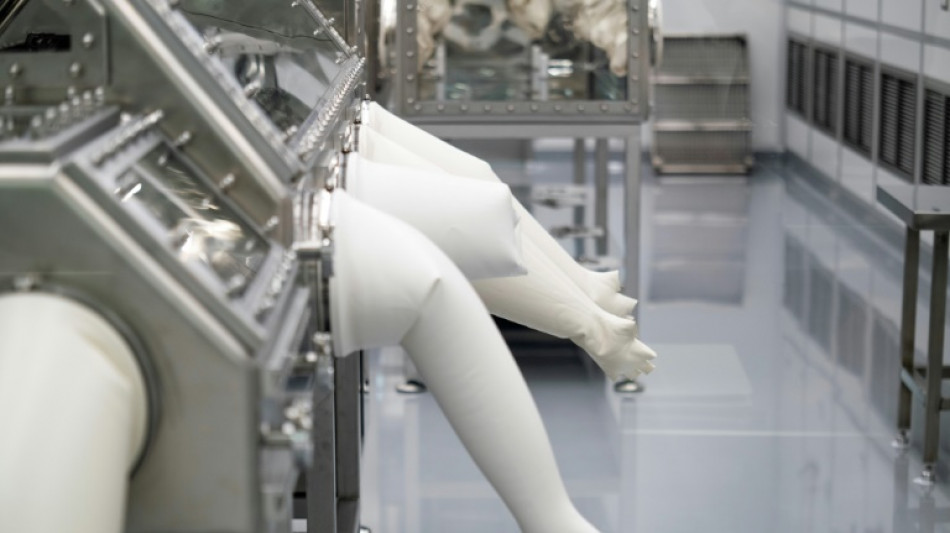
NASA lab hopes to find life's building blocks in asteroid sample / Photo: Mark Felix - AFP

 Yamal on target as Spain hold off Czech Republic

 Latvian exit polls suggest pro-European choice

 Lula, Bolsonaro wrap up campaigns ahead of knife-edge election

 Tuchel hails 'complete' England after Croatia demolition

 Fury to invite Trump to lead ring walk before Joshua showdown

 Fashion industry in 'precarious moment', says Vivienne Westwood supremo

 Seventh heaven for England in Nations League rout of Croatia

 Storms, flooding cause chaos on Greek holiday island of Crete

 #IAmJaneDoe: online support campaign in US university rape case

 Brazil shine on Selecao's first visit to India

 Zverev sets up Djokovic quarter-final at China Open, Rybakina out

 Happier at home, Bordeaux hammer Lyon in Top 14

 Lula, Bolsonaro in final push for votes ahead of knife-edge election

 Boisterous fashion week barnstorms 'sleepy' Nigerian capital

 UAE investigators say flydubai co-pilot was planning 'terrorist act'

 Rahul smacks century in India v Windies ODI

 Daryz seeks to join exclusive club of dual Arc winners

 Russia warns diplomats to leave Kyiv over new strikes threat

 Olympic champ Zheng rebukes rowdy home crowd at China Open

 World No.1 Sinner pulls out of Shanghai Masters to delay return

 Red Bull's Verstappen grabs pole position for Bahrain GP

 India beat Pakistan in blockbuster as golfer Kim wins 'crazy' gold

 India beat arch-rivals Pakistan to win Asian Games cricket gold

 Ethiopia's Tigray rebels abandon regional capital as govt advances: journalist

 Tom Kim powers to Games gold and exemption from military service

Eager scientists and a gleaming lab awaits.
A sample from the asteroid Bennu, which could be key to understanding the formation of the solar system and our own planet, is set to be analyzed at NASA's Johnson Space Center in Houston after it reaches Earth in late September.
The precious cargo is currently aboard OSIRIS-REx, a US space probe launched in 2016 to Bennu, which orbits the Sun at an average distance of about 105 million miles (168 million kilometers).
Long white sleeves hang from the huge metal and glass box in which the sample will be handled.
Scientists will separate pieces of the rock and dust for study now, while carefully storing away the rest for future generations equipped with better technology -- a practice first started during the Apollo missions to the Moon.
"We don't expect there to be anything living but (rather) the building blocks of life," Nicole Lunning, lead OSIRIS-Rex sample curator, told AFP.
"That's really what motivated going to this type of asteroid, to understand what the precursors were that may have fostered life in our solar system and on Earth."
Once the return vessel arrives at the Texas "cleanroom," Lunning's job will be to carefully disassemble it and separate the contents, all while keeping the material pure and uncontaminated.
- Origins of life -
The spacecraft is scheduled to land in the Utah desert on September 24, carrying an estimated 8.8 ounces, or 250 grams of material -- just over a cupful.
Obtaining it involved a high-risk operation in October 2020: the probe came into contact with the asteroid for a few seconds, and a blast of compressed nitrogen was emitted to raise the dust sample which was then captured.
The whole mission was imperiled when NASA realized a few days later that the valve of the collection compartment was failing to close, letting fragments escape into space.
But the precious cargo was finally secured after being transferred to a capsule fixed in the spacecraft's center.
The first samples brought to Earth by asteroids were carried out by Japanese probes in 2010 and 2020, with the latter found to contain uracil, one of the building blocks of RNA.
The finding lent weight to a longstanding theory that life on Earth may have been seeded from outer space when asteroids crashed into our planet carrying fundamental elements.
Cosmochemist Eve Berger can't wait to get to work on the Bennu material.
"These samples haven't hit the Earth. They haven't been exposed to our atmosphere. They haven't been exposed to really anything except harsh space for billions of years," she said.
Ultimately they "will help us to determine whether what we really think is true, is true," said Berger.
Not only might the Bennu sample add to our knowledge of the ingredients that brought life to our world, but "if we can figure out what happened here on the Earth, that helps us to extrapolate to other bodies where we might look or how we might interpret what we're seeing," she added.
Could Bennu bring back something that's never been seen before? "You never know," said Berger.
"Bennu is a trickster, so we'll know more in a few months when the sample comes back -- that would be exciting!"
J.V.Jacinto--PC



