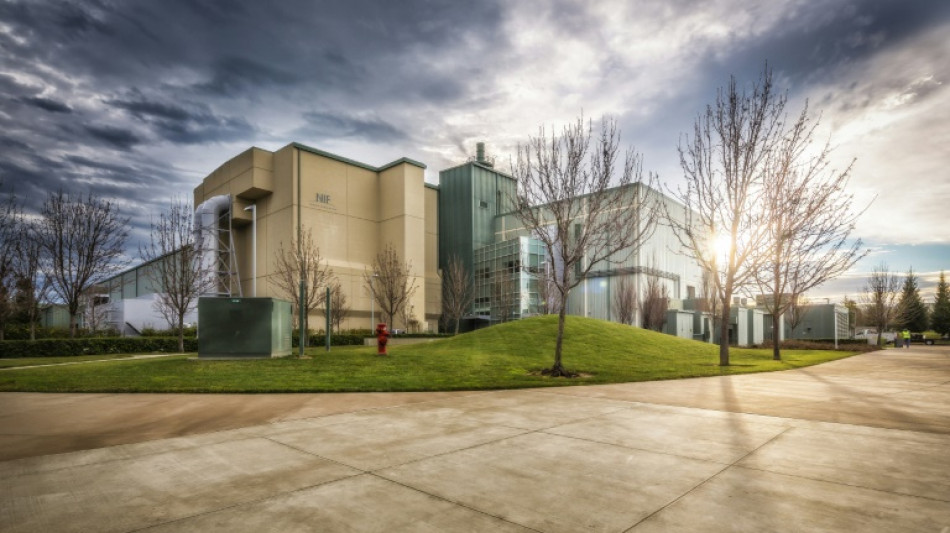
US lab repeats nuclear fusion feat, with higher yield / Photo: Handout - Lawrence Livermore National Laboratory/AFP/File

 Lula, Bolsonaro wrap up campaigns ahead of Brazil's knife-edge vote

 Toulouse edge Castres in Top 14 derby

 Murakami homer propels White Sox to MLB playoff win over Guardians

 Israel targets top Hamas leader in deadly Gaza strike on anniversary

 Houthis say struck oil facility near Riyadh, as Saudis hit Sanaa

 AI needs safety layers like nuclear plants: ex-OpenAI engineer

 MVP Judge will miss Yankees' MLB playoff series against Rays

 New lizard species discovered in Peru

 Fernandes hails Portugal's 'greatest symbol' Ronaldo, calls for unity

 Grandidier-Nkanang double takes Pau to Top 14 summit despite Vannes fightback

 Trainer Scott gets perfect Arc boost with top notch double

 Ex-PM says Putin cannot admit 'mistake' over Ukraine

 Houthis say Saudi Arabia launches dozens of strikes on Yemen capital

 Qatar and Abu Dhabi F1 Grand Prix to go ahead - F1 boss

 South Korea lift gloom with smash-and-grab Games football gold

 Ireland news conference before Israel game cut short amid tensions

 Protests over housing flare in Spain after relief measures rejected

 Zverev thrashes Shang to set up Djokovic quarter-final at China Open

 Turkey football ref chief jailed pending trial for graft
 North Korea says test of intermediate-range strategic missile included use of AI

 Rampant Sayers leads Hong Kong to third men's rugby gold in a row

 Ethiopia's Tigray rebels abandon regional capital as govt advances

 Bulgaria's Tsar Samuel returns 'home' after 1,000 years

 'Glad it's over': Kim powers to Games gold and military exemption

 After 11 World Cups, football finally comes home for one Indian fan

US scientists responsible for a historic nuclear fusion breakthrough say they have repeated the feat -- this time achieving a greater yield of energy.
The Lawrence Livermore National Laboratory stunned the world in December when it announced it had carried out an experimental nuclear reaction that put out more energy than was put into it, a holy grail of science in the quest for unlimited, clean power to end the era of fossil fuels.
"We can confirm the experiment produced a higher yield than the December 2022 experiment," public information officer Paul Rhien said Monday in an emailed statement, without disclosing specific figures.
He added the California lab planned to report the results at upcoming scientific conferences and in peer-reviewed publications.
The new development was first reported by the Financial Times.
Nuclear fusion has been touted by its supporters as a clean, abundant and safe source of energy that could eventually allow humanity to break its dependence on coal, crude oil, natural gas and other hydrocarbons driving a global climate crisis.
However, there is still a long way to go before fusion is viable on an industrial scale, providing power to homes and businesses.
Nuclear power plants around the world currently use fission -- the splitting of a heavy atom's nucleus -- to produce energy.
Fusion on the other hand combines two light hydrogen atoms to form one heavier helium atom, releasing a large amount of energy in the process.
That is what occurs inside stars, including our Sun.
On Earth, fusion reactions can be provoked by heating hydrogen to extreme temperatures inside specialized devices.
Like fission, fusion is carbon-free during operation, and has additional critical advantages: it poses no risk of nuclear disaster and produces much less radioactive waste.
During December's experiment, the lab used 192 ultra-powerful lasers to deliver 2.05 megajoules of energy to a tiny capsule smaller than a pea containing isotopes of hydrogen. It produced 3.15 megajoules of fusion energy output.
While the result was a net energy gain, 300 megajoules of energy was needed from the electrical grid to power the lasers.
N.Esteves--PC



