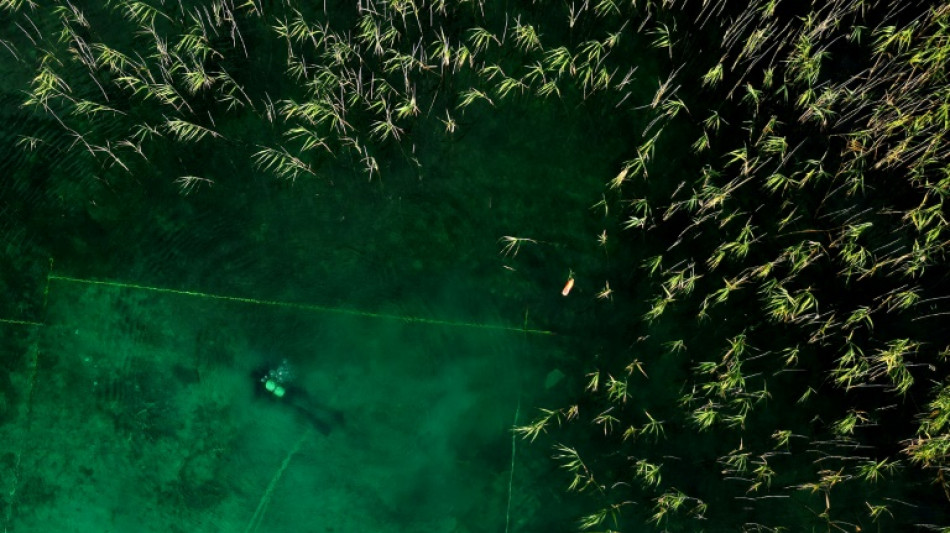
Archaeologists uncover Europe's oldest stilt village
/ Photo: Adnan Beci - AFP

 Lula, Bolsonaro wrap up campaigns ahead of Brazil's knife-edge vote

 Toulouse edge Castres in Top 14 derby

 Murakami homer propels White Sox to MLB playoff win over Guardians

 Israel targets top Hamas leader in deadly Gaza strike on anniversary

 Houthis say struck oil facility near Riyadh, as Saudis hit Sanaa

 AI needs safety layers like nuclear plants: ex-OpenAI engineer

 MVP Judge will miss Yankees' MLB playoff series against Rays

 New lizard species discovered in Peru

 Fernandes hails Portugal's 'greatest symbol' Ronaldo, calls for unity

 Grandidier-Nkanang double takes Pau to Top 14 summit despite Vannes fightback

 Trainer Scott gets perfect Arc boost with top notch double

 Ex-PM says Putin cannot admit 'mistake' over Ukraine

 Houthis say Saudi Arabia launches dozens of strikes on Yemen capital

 Qatar and Abu Dhabi F1 Grand Prix to go ahead - F1 boss

 South Korea lift gloom with smash-and-grab Games football gold

 Ireland news conference before Israel game cut short amid tensions

 Protests over housing flare in Spain after relief measures rejected

 Zverev thrashes Shang to set up Djokovic quarter-final at China Open

 Turkey football ref chief jailed pending trial for graft
 North Korea says test of intermediate-range strategic missile included use of AI

 Rampant Sayers leads Hong Kong to third men's rugby gold in a row

 Ethiopia's Tigray rebels abandon regional capital as govt advances

 Bulgaria's Tsar Samuel returns 'home' after 1,000 years

 'Glad it's over': Kim powers to Games gold and military exemption

 After 11 World Cups, football finally comes home for one Indian fan

Beneath the turquoise waters of Lake Ohrid, the "Pearl of the Balkans", scientists have uncovered what may be one of Europe's earliest sedentary communities, and are trying to solve the mystery of why it sheltered behind a fortress of defensive spikes.
A stretch of the Albanian shore of the lake once hosted a settlement of stilt houses some 8,000 years ago, archaeologists believe, making it the oldest lakeside village in Europe discovered to date.
Radiocarbon dating from the site puts it at between 6000 and 5800 BC.
"It is several hundred years older than previously known lake-dwelling sites in the Mediterranean and Alpine regions," said Albert Hafner, a professor of archaeology from Switzerland's University of Bern.
"To our knowledge, it is the oldest in Europe," he told AFP.
The most ancient other such villages were discovered in the Italian Alps and date to around 5000 BC, said the expert in European Neolithic lake dwellings.
Hafner and his team of Swiss and Albanian archaeologists have spent the past four years carrying out excavations at Lin on the Albanian side of Lake Ohrid, which straddles the mountainous border of North Macedonia and Albania.
The settlement is believed to have been home to between 200 and 500, with houses built on stilts above the lake's surface or in areas regularly flooded by rising waters.
- Fortress of spikes -
And it is slowly revealing some astonishing secrets.
During a recent dive, archaeologists uncovered evidence suggesting the settlement was fortified with thousands of spiked planks used as defensive barricades.
"To protect themselves in this way, they had to cut down a forest," said Hafner.
But why did the villagers need to build such extensive fortifications to defend themselves? Archaeologists are still searching for an answer to the elusive question.
Researchers estimate that roughly 100,000 spikes were driven into the bottom of the lake off Lin, with Hafner calling the discovery "a real treasure trove for research".
Lake Ohrid is one of the oldest lakes in the world and has been around for more than a million years.
Assisted by professional divers, archaeologists have been picking through the bottom of the lake often uncovering fossilised fragments of wood and prized pieces of oak.
- 'Like a Swiss watch' -
Analysis of the tree rings helps the team reconstruct the daily life of the area's inhabitants -- providing "valuable insights into the climatic and environmental conditions" from the period, said Albanian archaeologist Adrian Anastasi.
"Oak is like a Swiss watch, very precise, like a calendar," said Hafner.
"In order to understand the structure of this prehistoric site without damaging it, we are conducting very meticulous research, moving very slowly and very carefully," added Anastasi, who heads the team of Albanian researchers.
The lush vegetation at the site makes the work painstaking slow at times.
"Building their village on stilts was a complex task, very complicated, very difficult, and it's important to understand why these people made this choice," said Anastasi.
For the time being, scientists say it is possible to assume that the village relied on agriculture and domesticated livestock for food.
"We found various seeds, plants and the bones of wild and domesticated animals," said Ilir Gjepali, an Albanian archaeology professor working at the site.
But it will take another two decades for site to be fully explored and studied and for final conclusions to be drawn.
According to Anastasi, each excavation trip yields valuable information, enabling the team to piece together a picture of life along Lake Ohrid's shores thousands of years ago -- from the architecture of the dwellings to the structure of their community.
"These are key prehistoric sites that are of interest not only to the region but to the whole of southwest Europe," said Hafner.
N.Esteves--PC



