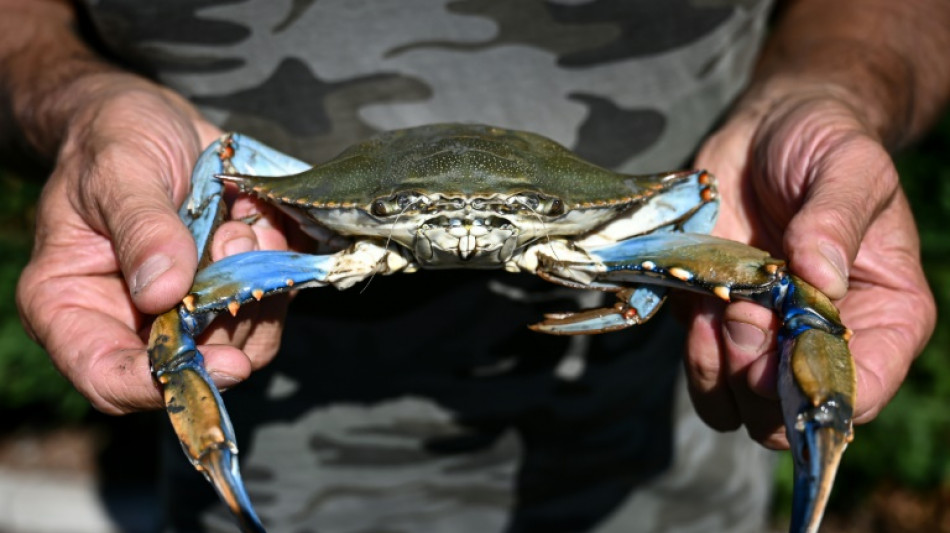
Invasive species a growing and costly threat, key report to find / Photo: Piero CRUCIATTI - AFP/File

 Lula, Bolsonaro wrap up campaigns ahead of Brazil's knife-edge vote

 Toulouse edge Castres in Top 14 derby

 Murakami homer propels White Sox to MLB playoff win over Guardians

 Israel targets top Hamas leader in deadly Gaza strike on anniversary

 Houthis say struck oil facility near Riyadh, as Saudis hit Sanaa

 AI needs safety layers like nuclear plants: ex-OpenAI engineer

 MVP Judge will miss Yankees' MLB playoff series against Rays

 New lizard species discovered in Peru

 Fernandes hails Portugal's 'greatest symbol' Ronaldo, calls for unity

 Grandidier-Nkanang double takes Pau to Top 14 summit despite Vannes fightback

 Trainer Scott gets perfect Arc boost with top notch double

 Ex-PM says Putin cannot admit 'mistake' over Ukraine

 Houthis say Saudi Arabia launches dozens of strikes on Yemen capital

 Qatar and Abu Dhabi F1 Grand Prix to go ahead - F1 boss

 South Korea lift gloom with smash-and-grab Games football gold

 Ireland news conference before Israel game cut short amid tensions

 Protests over housing flare in Spain after relief measures rejected

 Zverev thrashes Shang to set up Djokovic quarter-final at China Open

 Turkey football ref chief jailed pending trial for graft
 North Korea says test of intermediate-range strategic missile included use of AI

 Rampant Sayers leads Hong Kong to third men's rugby gold in a row

 Ethiopia's Tigray rebels abandon regional capital as govt advances

 Bulgaria's Tsar Samuel returns 'home' after 1,000 years

 'Glad it's over': Kim powers to Games gold and military exemption

 After 11 World Cups, football finally comes home for one Indian fan

Invasive species that destroy forests, ravage crops and cause extinctions are a major and growing threat worldwide, a landmark UN-backed assessment is poised to report.
From water hyacinth choking Lake Victoria in East Africa, to rats and brown snakes wiping out bird species in the Pacific, to mosquitoes exposing new regions to Zika, yellow fever, dengue and other diseases, tens of thousand of aliens species have taken root -- often literally -- far from their place of origin.
The science advisory panel for the UN Convention on Biodiversity, known by its acronym IPBES, will release on Monday the most comprehensive assessment of so-called "alien species" ever assembled.
Humans are to blame when non-native species wind up on the other side of the world, whether by accident or on purpose.
Scientists point to the pervasive spread of these species as hard evidence that rapid expansion of human activity has so radically altered natural systems as to tip Earth into a new geological epoch called the Anthropocene, or the "era of humans".
Some invasive species are accidental arrivals, hitching rides in the ballast water of cargo ships, the containers in their holds, or in a tourist's suitcase.
Others were introduced deliberately.
The hyacinth which at one point covered 90 percent of Lake Victoria -- crippling transport and fishing, smothering aquatic life, blocking hydroelectric dam intake, and breeding mosquitoes -- is thought to have been introduced by Belgian colonial officials in Rwanda as an ornamental garden flower before making its way down the Kagera River in the 1980s.
The Everglades wetlands preserve in Florida is teeming with the destructive offspring of erstwhile pets and house plants, from five-metre (16-foot) Burmese pythons and walking catfish to Old World climbing fern and Brazilian pepper.
Invasive species are a significant cause of extinctions, along with habitat loss, global warming, pollution and direct exploitation for food or body parts.
Small islands with endemic species not found anywhere else on Earth are especially vulnerable.
Rats, snakes and mosquitoes transported by Western explorers or, later, tourists have wiped out dozens of bird species in the last two centuries.
The deadly fire that reduced the Hawaiian town of Lahaina to ashes last month was fuelled in part by bone-dry guinea, molasses and buffel grasses -- imported as livestock feed -- that have spread across abandoned sugar plantations.
A global treaty to protect biodiversity hammered out in the Canadian city of Montreal last December sets a target of reducing the rate at which invasive alien species spread by 50 percent compared to current levels.
G.Machado--PC



