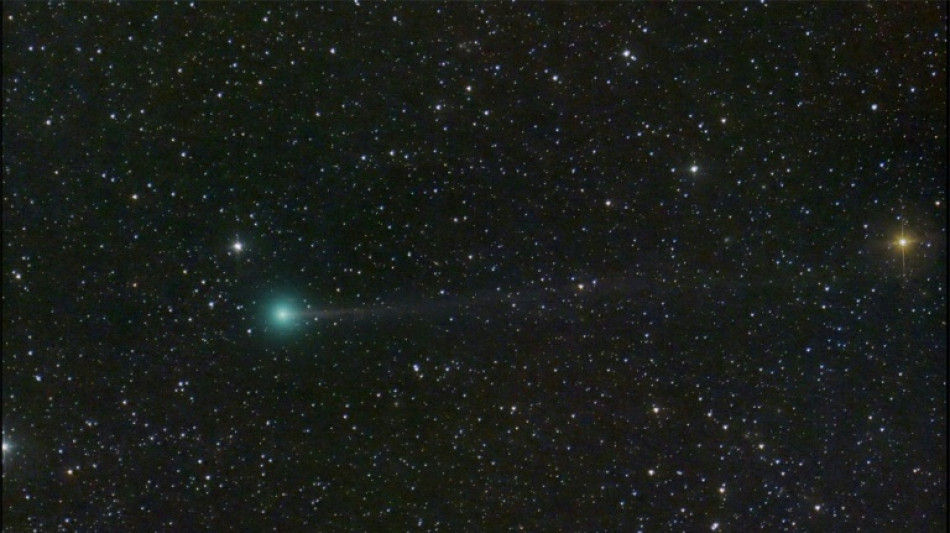
Newly discovered comet visible in night sky this weekend / Photo: Dan Bartlett - NASA/AFP

 Lula, Bolsonaro wrap up campaigns ahead of Brazil's knife-edge vote

 Toulouse edge Castres in Top 14 derby

 Murakami homer propels White Sox to MLB playoff win over Guardians

 Israel targets top Hamas leader in deadly Gaza strike on anniversary

 Houthis say struck oil facility near Riyadh, as Saudis hit Sanaa

 AI needs safety layers like nuclear plants: ex-OpenAI engineer

 MVP Judge will miss Yankees' MLB playoff series against Rays

 New lizard species discovered in Peru

 Fernandes hails Portugal's 'greatest symbol' Ronaldo, calls for unity

 Grandidier-Nkanang double takes Pau to Top 14 summit despite Vannes fightback

 Trainer Scott gets perfect Arc boost with top notch double

 Ex-PM says Putin cannot admit 'mistake' over Ukraine

 Houthis say Saudi Arabia launches dozens of strikes on Yemen capital

 Qatar and Abu Dhabi F1 Grand Prix to go ahead - F1 boss

 South Korea lift gloom with smash-and-grab Games football gold

 Ireland news conference before Israel game cut short amid tensions

 Protests over housing flare in Spain after relief measures rejected

 Zverev thrashes Shang to set up Djokovic quarter-final at China Open

 Turkey football ref chief jailed pending trial for graft
 North Korea says test of intermediate-range strategic missile included use of AI

 Rampant Sayers leads Hong Kong to third men's rugby gold in a row

 Ethiopia's Tigray rebels abandon regional capital as govt advances

 Bulgaria's Tsar Samuel returns 'home' after 1,000 years

 'Glad it's over': Kim powers to Games gold and military exemption

 After 11 World Cups, football finally comes home for one Indian fan

A comet called Nishimura discovered just a month ago could be visible to the naked eye this weekend, offering stargazers a once-in-a-437-year chance to observe the celestial visitor.
The ball of rock and ice, whose exact size remains unknown, is named after the Japanese amateur astronomer Hideo Nishimura who first spotted it on August 11.
It is rare that comets reach their moment of peak visibility so soon after being discovered, said Nicolas Biver, an astrophysicist at the Paris Observatory.
"Most are discovered months, even years before they pass closest to the Sun," he told AFP.
The comet only swings by the Sun every 437 years, he said, a long orbital period which sees it spend much of its time in the freezing outer Solar System.
When comets approach the Sun from the vastness of space, the heat causes its ice core to turn into dust and gas, which form a long tail.
The Sun's light reflects off this tail, allowing us to view comets from Earth.
Nishimura, which has the scientific name C/2023 P1, will pass closest to the Sun on September 17.
It will be 33 million kilometres (20 million miles) from the Sun, which is less than a quarter of the distance between the Earth and the Sun, Biver pointed out.
The comet will then pass harmlessly by Earth at a distance of 125 million kilometres.
For stargazers, the comet will be easiest to observe this Saturday and Sunday, particularly in the Northern Hemisphere.
"The best thing to do is look at the sky before sunrise, in a northeastern direction to the left of Venus, in a clear sky, free of pollution," Biver advised.
People with small binoculars will easily be able to enjoy the spectacle. But, if conditions allow, the comet may also be visible by the naked eye.
The comet's tail is greenish, because it contains "more gas than dust," Biver said.
G.Teles--PC



