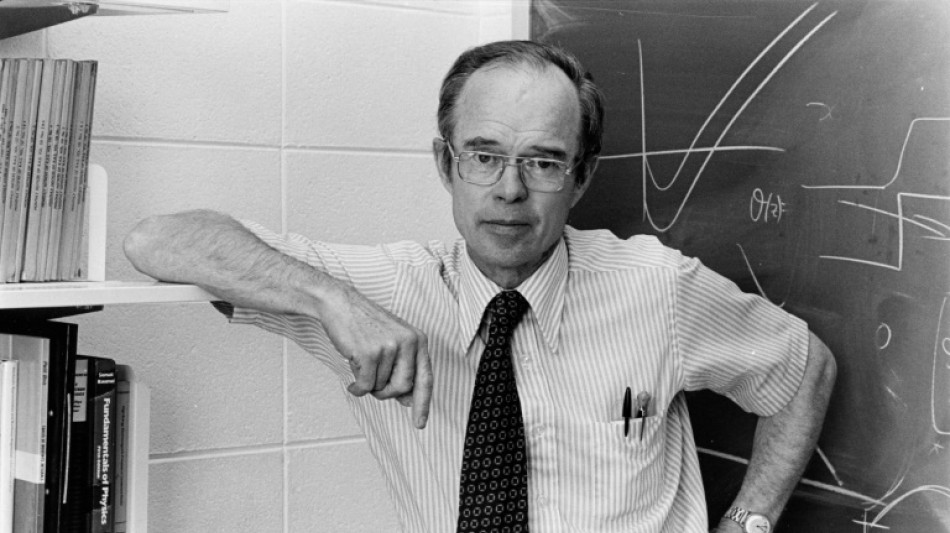
'Visionary' US astrophysicist Eugene Parker dead at 94

 Botched US execution leaves murderer unconscious on ventilator: lawyers

 Cornell rape case exposes sexual violence at US colleges

 France held by Italy in Zidane's homecoming after Olise stunner

 Ethiopian pro-government militia claims Tigray airport as regional tensions spike

 Ohtani shaking off injuries as Dodgers launch MLB post-season

 Sea levels to rise in California as coastal wave surges up west coast

 New rallies urged in France as protests disrupt over 730 schools

 Djokovic survives China Open scare, Sabalenka starts strong

 King Charles to evoke colonial 'darkest days' on Caribbean tour

 Tesla shares jump after global car sales top estimates

 DR Congo Ebola outbreak killed more than 4,000: official figures

 Djokovic survives China Open scare against wildcard world no. 104

 Lula, Bolsonaro trade blows in final scramble for votes in Brazil

 New clashes erupt as protests disrupt over 560 French schools

 NY governor vows to close loophole after alleged Cornell gang rape

 Ethiopia Tigray rebels pushed back as regional tensions spike

 Stocks rise, yields fall as US job numbers disappoint

 Man City verdict a 'big topic' for England players, says Tuchel

 NY attorney general tasked with investigating alleged Cornell gang rape

 China widens military footprint with Laos air base

 G7 talks as US pressures Europe over diesel stocks

 Man City launch appeal against explosive financial ruling

 Swiss president to quit government
 Europe rejects US threats over diesel stocks, urges joint G7 action

 Philippines tennis star Eala says 'I get overwhelmed sometimes'

Eugene Parker, a pioneering American astrophysicist whose mathematical prediction that charged particles streamed from stars in a solar wind was met with disbelief before he was ultimately vindicated, has died aged 94, NASA said on Wednesday.
Parker was hailed as a visionary who laid the groundwork for the field of heliophysics, the science of understanding the Sun and its interactions with Earth and the solar system, including space weather.
In 2018, he became the first person to witness the launch of a spacecraft bearing his name, NASA's Parker Solar Probe.
"We were saddened to learn the news that one of the great scientific minds and leaders of our time has passed," said NASA Administrator Bill Nelson in a statement. Parker died Tuesday, according to the University of Chicago, his longtime academic home.
"Gene Parker was a legendary figure in our field -- his vision of the Sun and the solar system was way ahead of his time," added Angela Olinto, dean of the Physical Sciences Division at the University of Chicago.
Born on June 10, 1927 in Michigan, Parker earned a bachelor's degree in physics from Michigan State University and a PhD from Caltech, then taught at the University of Utah before settling at UChicago in 1955.
He began studying the temperature of the Sun's corona, and his calculations showed the conditions should produce a supersonic flow of particles off the surface.
The idea was initially met with skepticism -- even ridicule.
- 'Utter nonsense' -
"The first reviewer on the paper said, 'Well, I would suggest that Parker go to the library and read up on the subject before he tries to write a paper about it, because this is utter nonsense,'" Parker told UChicago News in 2018.
His idea only saw publication in the Astrophysical Journal when then editor and future Nobel prize winner Subrahmanyan Chandrasekhar realized he could not find a flaw in Parker's math, and overrode the objections of both of the reviewers.
The theory was proved correct in 1962 when NASA's Mariner II spacecraft, which flew to Venus, encountered the stream of particles, called the solar wind.
Scientists now know that solar wind blankets all the planets, protecting them from harmful radiation, but also at times disrupting communications here on Earth when solar flares occur.
Parker also proposed the idea of "nanoflares" -- small solar explosions that occur all over the Sun -- which are responsible for its superheated corona. The corona is hotter than the surface itself, a fact that couldn't be explained by known physics at the time.
He went on to study cosmic rays, the magnetic fields of galaxies and myriad other topics, and won numerous accolades including the US National Medal of Science, the Kyoto Prize, the Crafoord Prize and the American Physical Society Medal for Exceptional Achievement in Research.
"Anyone who knew Dr. Parker, knew that he was a visionary," said Nicola Fox, director of NASA's heliophysics division.
NASA's Parker Solar Probe, named after Parker, was launched in 2018, circling the Sun closer than any spacecraft had previously ventured.
It has already sent back troves of valuable data leading to new discoveries about space weather and the detection of a long theorized zone where the Sun's radiation vaporizes all cosmic dust.
G.Machado--PC



