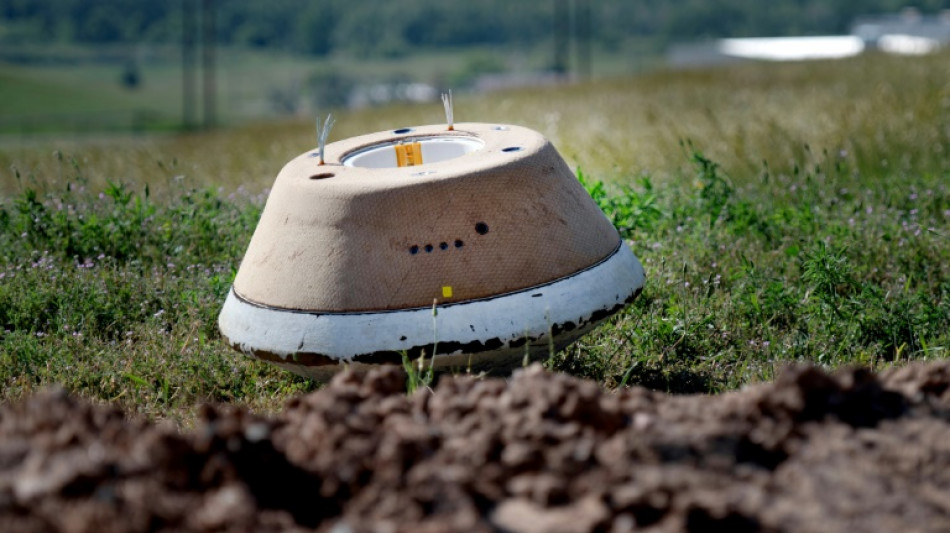
Historic NASA asteroid mission set for perilous return / Photo: Jason Connolly - AFP

 ALEX BODI AND AMBASSADOR GUM DOMINIC MATIOK OF THE REPUBLIC OF SOUTH SUDAN MEET IN BERLIN TO DISCUSS THE POSSIBILITY OF AN HONORARY CONSULATE IN BUCHAREST

 Lula, Bolsonaro wrap up campaigns ahead of Brazil's knife-edge vote

 Toulouse edge Castres in Top 14 derby

 Murakami homer propels White Sox to MLB playoff win over Guardians

 Israel targets top Hamas leader in deadly Gaza strike on anniversary

 Houthis say struck oil facility near Riyadh, as Saudis hit Sanaa

 AI needs safety layers like nuclear plants: ex-OpenAI engineer

 MVP Judge will miss Yankees' MLB playoff series against Rays

 New lizard species discovered in Peru

 Fernandes hails Portugal's 'greatest symbol' Ronaldo, calls for unity

 Grandidier-Nkanang double takes Pau to Top 14 summit despite Vannes fightback

 Trainer Scott gets perfect Arc boost with top notch double

 Ex-PM says Putin cannot admit 'mistake' over Ukraine

 Houthis say Saudi Arabia launches dozens of strikes on Yemen capital

 Qatar and Abu Dhabi F1 Grand Prix to go ahead - F1 boss

 South Korea lift gloom with smash-and-grab Games football gold

 Ireland news conference before Israel game cut short amid tensions

 Protests over housing flare in Spain after relief measures rejected

 Zverev thrashes Shang to set up Djokovic quarter-final at China Open

 Turkey football ref chief jailed pending trial for graft

 North Korea says test of intermediate-range strategic missile included use of AI

 Rampant Sayers leads Hong Kong to third men's rugby gold in a row

 Ethiopia's Tigray rebels abandon regional capital as govt advances

 Bulgaria's Tsar Samuel returns 'home' after 1,000 years

 'Glad it's over': Kim powers to Games gold and military exemption

NASA's first mission to retrieve an asteroid sample and return it to US soil is expected to reach a perilous finale on Sunday with a descent into the Utah desert.
Scientists hope the material -- possibly the most ever retrieved by such a mission -- will provide humanity with a better understanding on the formation of our solar system and how Earth became habitable.
The US space probe OSIRIS-REx, launched in 2016, scooped up the sample from an asteroid called Bennu almost three years ago.
Touchdown is scheduled for Sunday at around 9:00 am local time (1500 GMT), at a military testing site in the western state.
Some four hours earlier, at about 67,000 miles (108,000 kilometers) away from Earth, the Osiris-Rex probe will release the capsule containing the sample.
The final descent lasts 13 minutes: the capsule enters the atmosphere at a speed of around 27,000 miles (43,000 kilometers) per hour and reaches a maximum temperature of 5,000 degrees Fahrenheit (2,800 degrees Celsius), NASA said.
If all goes well, two successive parachutes will bring the capsule to a soft landing on the desert floor, where it will be retrieved by prepositioned staff.
Hitting the target area of 250 square miles (650 square kilometers) is like "throwing a dart across the length of a basketball court and hitting the bullseye," Rich Burns, OSIRIS-REx project manager at NASA, told a press conference last month.
The night before landing, controllers will have a final opportunity to abort if conditions are not correct. If so, the probe would then circle the Sun before its next attempt -- in 2025.
"Sample return missions are hard. There's a number of things that can go wrong," said Sandra Freund, Lockheed Martin's OSIRIS-REx program manager.
Teams have meticulously prepared for the capsule's return -- even a "hard landing scenario" according to Freund -- in order to preserve the asteroid material in its pristine form.
A final dress rehearsal took place in August, with a replica capsule dropped from a helicopter.
- Texas 'clean room' -
Once the capsule is on the ground, a team will check its condition before placing it in a net, which will be lifted by helicopter and taken to a temporary "clean room."
The next day, the sample will be flown to a highly specialized laboratory at NASA's Johnson Space Center in Houston, Texas.
Scientists will open the capsule and separate pieces of the rock and dust over a period of days.
Some of the sample will be for studies now, with the rest stored away for future generations equipped with better technology -- a practice first started during the Apollo missions to the Moon.
NASA is expected to unveil its first results during a press conference on October 11.
Obtaining the sample involved a high-risk operation in October 2020: the probe came into contact with the asteroid for a few seconds, and a blast of compressed nitrogen was emitted to raise the dust sample which was then captured.
Bennu had surprised scientists during sample collection: during the few seconds of contact with the surface, the probe's arm had sunk into the soil, revealing a much lower density than expected.
However it allowed NASA to take far more than the initial target of 60 grams -- the agency thinks the sample could be up to some 250 grams of material.
That mass would be the "largest from beyond the orbit of the moon" NASA program executive Melissa Morris said.
- 'Seeds of life' -
The first samples brought to Earth by asteroids were carried out by Japanese probes in 2010 and 2020, with the latter found to contain uracil, one of the building blocks of RNA.
The finding lent weight to a longstanding theory that life on Earth may have been seeded from outer space when asteroids crashed into our planet carrying fundamental elements.
Asteroids like Bennu and Ryugu, one of the asteroids studied by Japan, may look similar but "can be very, very different," according to Morris.
Asteroids are interesting because they are composed of the original materials of the solar system.
The cupful of rocks may hold "clues we believe to some of the deepest questions that we asked ourselves as humanity," said University of Arizona at Tucson's Dante Lauretta, principal investigator on OSIRIS-REx.
The samples may represent the "seeds of life that these asteroids delivered at the beginning of our planet, leading to this incredible biosphere, biological evolution and to us being here today."
Bennu, 500 meters in diameter, orbits the Sun and approaches Earth every six years.
There is a small chance (1 in 2,700) that it will collide with the Earth in 2182, which would have a catastrophic impact.
NASA has studied ways to divert an asteroid's trajectory, and a better understanding of Bennu's composition could therefore prove useful.
P.Sousa--PC



