
Nations vet 3,000-page handbook to halt climate crisis

 Botched US execution leaves murderer unconscious on ventilator: lawyers
 Cornell rape case exposes sexual violence at US colleges
 France held by Italy in Zidane's homecoming after Olise stunner

 Ethiopian pro-government militia claims Tigray airport as regional tensions spike
 Ohtani shaking off injuries as Dodgers launch MLB post-season
 Sea levels to rise in California as coastal wave surges up west coast
 New rallies urged in France as protests disrupt over 730 schools

 Djokovic survives China Open scare, Sabalenka starts strong
 King Charles to evoke colonial 'darkest days' on Caribbean tour

 Tesla shares jump after global car sales top estimates
 DR Congo Ebola outbreak killed more than 4,000: official figures
 Djokovic survives China Open scare against wildcard world no. 104
 Lula, Bolsonaro trade blows in final scramble for votes in Brazil
 New clashes erupt as protests disrupt over 560 French schools
 NY governor vows to close loophole after alleged Cornell gang rape

 Ethiopia Tigray rebels pushed back as regional tensions spike
 Stocks rise, yields fall as US job numbers disappoint

 Man City verdict a 'big topic' for England players, says Tuchel

 NY attorney general tasked with investigating alleged Cornell gang rape

 China widens military footprint with Laos air base
 G7 talks as US pressures Europe over diesel stocks
 Man City launch appeal against explosive financial ruling
 Swiss president to quit government
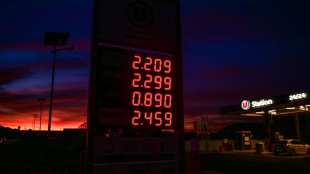 Europe rejects US threats over diesel stocks, urges joint G7 action
 Philippines tennis star Eala says 'I get overwhelmed sometimes'
Nearly 200 nations gather Monday to grapple with a question that will outlive Covid-19 and Russia's invasion of Ukraine: how does a world addicted to fossil fuels prevent carbon pollution from making Earth unliveable?
A partial answer is set for April 4 after closed-door, virtual negotiations approve a nearly 3,000-page report detailing options for drawing down greenhouse gases and extracting them from the air.
"The impacts are costly and mounting, but we still have some time to close the window and get ahead of the worst of them if we act now," said Alden Meyer, a senior analyst at climate and energy think-tank E3G.
"This report will supply the answers as to what we need if we're serious about getting there."
In August 2021, the Intergovernmental Panel on Climate Change (IPCC) laid out the physical science: the pace of global warming and sea level rise, along with shifts in the frequency, duration and intensity of cyclones, heatwaves and droughts.
That was part one in a three-part assessment, the sixth since 1990.
It projected that Earth's surface temperature will rise 1.5 degrees Celsius above preindustrial levels, perhaps within a decade.
A 1.5C cap on global warming -- the aspirational goal of the 2015 Paris climate accord -- has been embraced as a target by most of the world's nations.
It's not hard to see why: barely 1.1C of warming so far has ushered in a crescendo of deadly extreme weather across the globe.
Recently renewed national carbon-cutting commitments, however, still put us on a catastrophic path toward 2.7C of warming by 2100.
- 'Overshooting' 1.5C -
Part two of the IPCC report -- described by UN chief Antonio Guterres as an "atlas of human suffering" -- details past and future climate impacts and the limits of our ability to adapt.
Delaying climate action would severely reduce the chances of a "livable future," it concluded.
Part three is about how to keep planet-warming gases out of the atmosphere, with chapters on the key sectors where rapid and deep change is needed: energy, transport, industry, agriculture, among others.
"We are talking about the large-scale transformation of all the major systems," climate economist and co-author Celine Guivarch told AFP.
The main focus is on weaning the global economy of fossil fuels and moving to low- or zero-carbon sources of energy, from solar and wind to nuclear, hydro and hydrogen.
Helping that transition is the fact that renewable energy is now cheaper than energy generated by fossil fuels in many markets.
The IPCC also details ways to reduce demand for oil, gas and coal, whether by making buildings more energy efficient or encouraging shifts in lifestyle, such as eating less beef and not flying half-way around the world for a week-long holiday.
But humanity has waited so long to take action that switching supply and reducing demand are not enough: we also need to pull CO2 out of the air.
In theory -- because the technology does not yet exist at scale -- carbon dioxide removal will compensate for hard-to-decarbonise sectors such as aviation and shipping, and extract excess CO2 if temperatures "overshoot" the Paris Agreement targets.
- Likely to fail? -
"Delivering on the climate commitments that we've made internationally and nationally is far more challenging than we have been prepared to accept," said Kevin Anderson, a professor of energy and climate change at the University of Manchester.
"Right now, we are very likely to fail. But if we don't try, we are guaranteed to fail," he told AFP.
The IPCC "solutions" report draws from hundreds of models projecting development pathways that keep Earth within the bounds of the Paris temperature goals.
"There are scenarios that show high renewables and low nuclear, and scenarios that show the opposite," said Taryn Fransen, an analyst at the World Resources Institute in Washington DC.
"This report lays out those pathways. Now it's up now to our leaders to take that to heart."
Besides feeding into UN political negotiations, which resume in November in Egypt at COP 27, the IPCC findings will also be important "for the conversation going on in the US and Europe around the need to transition away from Russian oil and gas," said Meyer.
The head of the IPCC delegation from Ukraine made this point in a dramatic statement at a closed plenary in February, only days after Russian troops invaded her country.
"Human-induced climate change and the war on Ukraine have the same roots -- fossil fuels -- and our dependence on them," said Svitlana Krakovska, according to multiple sources.
A.P.Maia--PC



