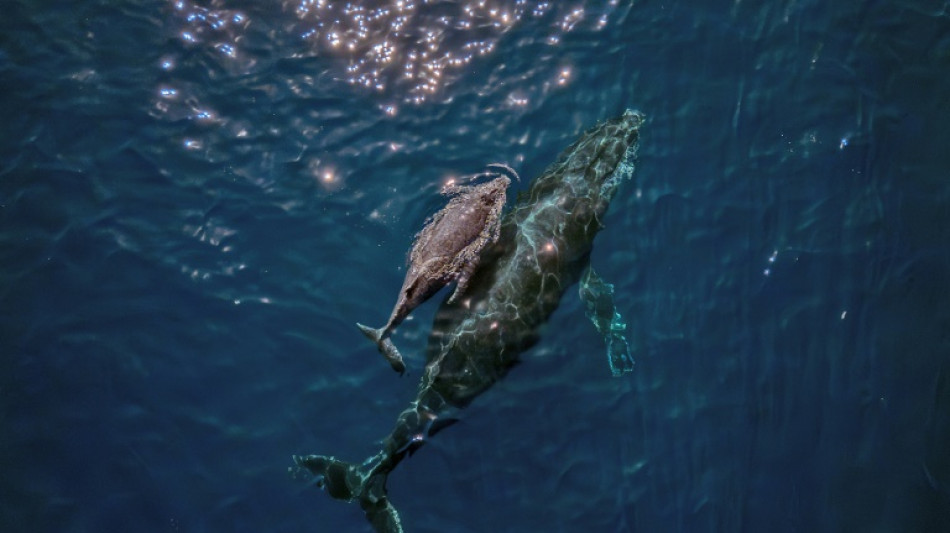
Whales 'cannot out-sing' human noise pollution / Photo: CARL DE SOUZA - AFP

 'Act before it's too late': Tokyo residents fight for more trees

 'Disappointing' as South Korea flag mishap sees Games end on sour note

 Pre-COP host Tuvalu at frontline of climate change

 Hungary's dwindling paprika producers battle to save signature spice

 Cornell president vows review in wake of alleged student gang rape

 Latvian partial election results suggest pro-European choice

 In Egypt's Sinai, Gazan builds school for children displaced by war

 Trump tariffs a mixed bag for US auto industry

 Yemen government forces say struck Houthi targets

 Music links past, present for Pedro Pascal's cellist in 'Behemoth!'

 ALEX BODI ȘI AMBASADORUL REPUBLICII SUDANUL DE SUD, GUM DOMINIC MATIOK, DISCUTĂ LA BERLIN DESPRE POSIBILITATEA ÎNFIINȚĂRII UNUI CONSULAT ONORIFIC LA BUCUREȘTI

 Dodgers step up World Series three-peat bid with 5-3 win over Braves

 Spain break down Czechs as England outclass Croatia in Nations League

 Yamal on target as Spain hold off Czech Republic

 Latvian exit polls suggest pro-European choice

 Lula, Bolsonaro wrap up campaigns ahead of knife-edge election

 Tuchel hails 'complete' England after Croatia demolition

 Fury to invite Trump to lead ring walk before Joshua showdown

 Fashion industry in 'precarious moment', says Vivienne Westwood supremo

 Seventh heaven for England in Nations League rout of Croatia

 Storms, flooding cause chaos on Greek holiday island of Crete

 #IAmJaneDoe: online support campaign in US university rape case

 Brazil shine on Selecao's first visit to India

 Zverev sets up Djokovic quarter-final at China Open, Rybakina out

 Happier at home, Bordeaux hammer Lyon in Top 14

Baleen whales have evolved a special voice box to help them to sing underwater -- but this could also make them uniquely vulnerable to being drowned out by human noise pollution, according to new research published Wednesday.
Complex whale melodies, first recorded some 50 years ago, are known to play a key role in the social and reproductive communication of these massive marine mammals.
While toothed whales have a nasal vocal organ, filter-feeding baleen whales use a larynx, although scientists had not figured out exactly how it created the vocalisations.
In a new study published in the journal Nature, a team of scientists in Denmark, Austria, and the United States examined the larynxes of three stranded baleen whales -- the sei, minke, and humpback species -- using scanning and modelling techniques to reconstruct how they produce sound.
They found several differences from land mammals, including a U-shaped structure instead of vocal cords, that allows them to generate their low-frequency songs.
"We've never seen this in any other animal," lead author Coen Elemans, professor of bioacoustics at the University of Southern Denmark, told AFP.
"This is a completely novel adaptation, and we think this allowed these large whales to make sound in the water while basically holding their breath."
But the scientists also found a potentially serious challenge for the whales: the struggle to make themselves heard over noise pollution from ships.
- No escape -
Computer models showed that baleen whale songs can travel long distances through water, but at a maximum depth of 100 metres (330 feet) and at a frequency of up to 300 Hz -- within the range noise made by shipping vessels.
This means that whales in a noisy ocean soundscape are essentially trying to talk across a busy motorway or at a loud party: the further away you are, the less you'll be able to hear, Elemans said.
"It's really sad that baleen whale vocalisations exactly overlap with the sounds we make, predominantly with shipping noise, and there is no way for the whales to sing louder, at a higher frequency, or deeper in the water," Elemans said.
"These animals really can't escape this, and we really need to mitigate the noise we make."
They cannot even dive down to escape the din.
The deeper they go, the greater the pressure which reduces the volume of air available for vocalising, said Joy Reidenberg, a professor at the Icahn School of Medicine at Mount Sinai, who was not involved in the study.
Noise pollution can force whales to change their behaviour, such as remaining silent until quiet returns, moving to another location, or trying to communicate over the noise –- the latter two requiring whales to exert extra energy, potentially weakening their body condition and affecting long-term survival, Reidenberg said.
She said that understanding whale vocalisations could aid conservation efforts by helping understand which depths are "critical habitats".
This is particularly important at mating sites where, depending on the season, noise pollution can disrupt reproduction.
"We must be smarter about when and where we put sound into the water," Reidenberg said.
Researchers say there is an urgent need to regulate underwater noise.
The harm goes beyond whales -- there is evidence that scores of marine species are negatively affected by underwater noise pollution, Melanie Lancaster, senior Arctic species specialist at the World Wildlife Fund, who was not involved in the study, told AFP.
"We know the most about marine mammals, which is why they feature so prominently, yet the impacts are much farther reaching, essentially impacting entire marine ecosystems," she said.
X.M.Francisco--PC



