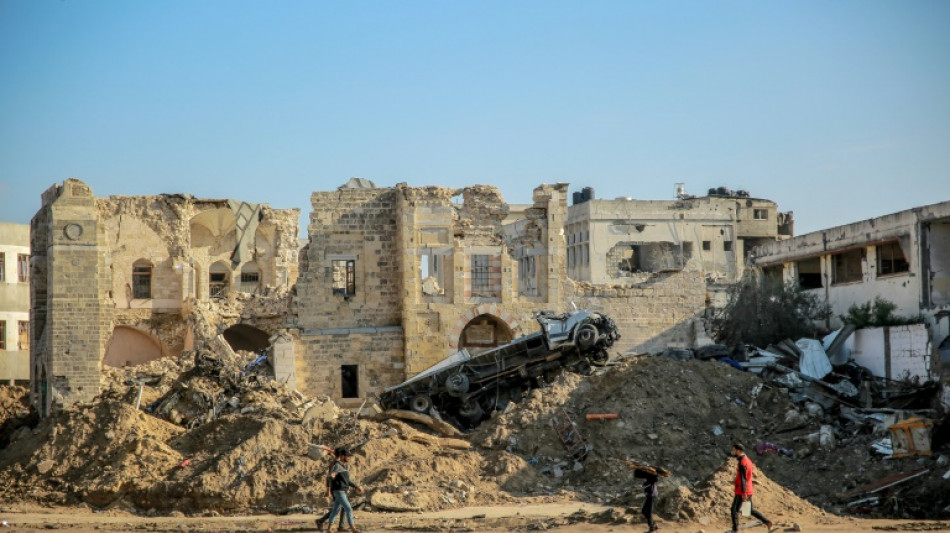
Gaza's historic treasures saved by 'irony of history' / Photo: - - AFP

 Asian Games set to close after records, rancour and rain

 Cry for help as French-Swiss lake dries up

 Sabalenka swept out of China Open in third round

 US urges 'restraint' as Ethiopia's Tigray crisis rocks region

 Teens on target again as USA down Mexico 3-0

 World records prove Asian Games were a hit, says top official

 US prison chief who oversaw botched execution resigns

 'Chaotic' Asian Games threaten Japan hopes of hosting Olympics again

 Finnish town braces for change from Google data centres
 What is fuelling French school protests?

 Without lawyers, migrant children face deportation from the US
 Three-peat seeking Dodgers open playoffs with a win, Rays hold off Yankees

 Brazil votes in nail-biter polls closely watched by Trump

 'Just be you': Kim reveals Tiger text that inspired him to gold

 Myanmar migrants returned to war-torn nation from Malaysia

 ALEX BODI AND AMBASSADOR GUM DOMINIC MATIOK OF THE REPUBLIC OF SOUTH SUDAN MEET IN BERLIN TO DISCUSS THE POSSIBILITY OF AN HONORARY CONSULATE IN BUCHAREST

 Lula, Bolsonaro wrap up campaigns ahead of Brazil's knife-edge vote

 Toulouse edge Castres in Top 14 derby

 Murakami homer propels White Sox to MLB playoff win over Guardians

 Israel targets top Hamas leader in deadly Gaza strike on anniversary

 Houthis say struck oil facility near Riyadh, as Saudis hit Sanaa

 AI needs safety layers like nuclear plants: ex-OpenAI engineer

 MVP Judge will miss Yankees' MLB playoff series against Rays

 New lizard species discovered in Peru

 Fernandes hails Portugal's 'greatest symbol' Ronaldo, calls for unity
Gaza's ancient Greek site of Anthedon has been bombed, its "Napoleon's Palace" destroyed and the only private museum burned down: the war has taken a terrible toll on the rich heritage of the Palestinian territory.
But in a strange twist of fate, some of its greatest historical treasures are safe in a warehouse in Switzerland.
And ironically, it is all thanks to the blockade that made life in the Gaza Strip such a struggle for the past 16 years.
Based on satellite images, the UN cultural organisation reckons some 41 historic sites have been damaged since Israel began pounding the besieged territory after the October 7 Hamas attack.
On the ground, Palestinian archaeologist Fadel al-Otol keeps tabs on the destruction in real time.
When he has electricity and internet access, photos pour into a WhatsApp group he set up with 40 or so young peers he mobilised to watch over the territory's vast array of ancient sites and monuments.
As a teenager in the 1990s, Otol was hired by European archaeological missions before going on to study in Switzerland and at the Louvre Museum in Paris.
"All the archaeological remains in the north have been hit," he told AFP by phone from Gaza.
The human toll since the October 7 Hamas attack has been chilling.
A total of 1,170 people were killed in the unprecedented raid on Israel, according to an AFP tally of Israeli official figures.
Almost 34,000 have died in Gaza in unrelenting Israeli retaliation, according to the territory's health ministry.
The damage to Gaza's history has also been immense.
- Napoleon's HQ flattened -
"Blakhiya (the ancient Greek city of Anthedon) was directly bombed. There's a huge hole", said Otol.
He said part of the site, near a Hamas barracks where "we hadn't started excavating", was hit.
The 13th-century Al-Basha palace in Gaza City's old town "has been completely destroyed. There was bombing and (then) it was bulldozed.
"It held hundreds of ancient objects and magnificent sarcophagi," Otol added as he shared recent photos of the ruins.
Napoleon is said to have based himself in the ochre stone edifice at the disastrous end of his Egyptian campaign in 1799.
The room where the French emperor supposedly slept was full of Byzantine artefacts.
"Our best finds were displayed in the Basha," Jean-Baptiste Humbert of the French Biblical and Archaeological School in Jerusalem (EBAF) told AFP.
But we know little of their fate, he said. "Did someone remove the objects before blowing the building up?"
Nerves were frayed even further when the director of Israeli Antiquities, Eli Escusido, posted a video on Instagram of Israeli soldiers surrounded by vases and ancient pottery in the EBAF warehouse in Gaza City.
Much of what has been unearthed in digs in Gaza was stored either at the Al-Basha museum or the warehouse.
Palestinians quickly accused the army of pillaging. But EBAF archaeologist Rene Elter said he has seen no evidence of "state looting".
"My colleagues were able to return to the site. The soldiers opened boxes. We don't know if they took anything," he told AFP.
However, he added: "Every day when Fadel (al-Otol) calls me, I'm afraid he'll tell me that one of our colleagues has died or that such and such a site has been destroyed".
Archaeology is a highly political issue in Israel and the Palestinian territories, with discoveries often used to justify the claims of the two warring peoples.
While Israel has an army of archaeologists who have unearthed an impressive number of ancient treasures, Gaza remains relatively untouched by the trowel despite a rich past stretching back thousands of years.
- Ancient crossroads -
The only sheltered natural harbour between the Sinai and Lebanon, Gaza has been for centuries a crossroads of civilisations.
A pivot point between Africa and Asia and a hub of the incense trade, it was coveted by the Egyptians, Persians, Greeks, Romans and Ottomans.
A key figure in excavating this glorious past over the last few decades has been Jawdat Khoudary, a Gazan construction magnate and collector.
Gaza, with its "seafront real estate", had a property boom in the 1990s after the Oslo peace accords and the creation of the Palestinian Authority.
When building workers dug up the soil, they came across lots and lots of ancient objects. Khoudary amassed a treasure trove of artefacts that he opened up to foreign archaeologists.
Marc-Andre Haldimann, then curator of MAH, Geneva's art and history museum, couldn't believe his eyes when he was invited to have a look around the garden of Khoudary's mansion in 2004.
"We found ourselves in front of 4,000 objects, including an avenue of Byzantine columns," he told AFP.
Quickly an idea took shape to organise a major exhibition to highlight Gaza's past at the MAH, and then to build a museum in the territory itself so that the Palestinians could take ownership of their own heritage.
At the end of 2006, around 260 objects from the Khoudary collection left Gaza for Geneva, with some later going on to be part of another hit show at the Institut du Monde Arabe (IMA) in Paris.
But geopolitics changed along the way. In June 2007, Hamas drove the Palestinian Authority from Gaza. And Israel imposed its blockade.
As a result, the Gazan artefacts could no longer return home and remained stuck in Geneva, while the archaeological museum project fizzled out.
But Khoudary did not give up hope. He built a museum-hotel called Al-Mathaf, museum in Arabic, on the Mediterranean coast north of Gaza City.
But then came the Israeli ground offensive after the Hamas attack on October 7, which began in Gaza's north.
- 'Anything but a black hole' -
"Al-Mathaf remained under Israeli control for months," Khoudary, who fled Gaza for Egypt, told AFP. "As soon as they left, I asked some people to go there to see what state the place was in. I was shocked. Several items were missing and the hall had been set on fire.
His mansion was also destroyed during fierce fighting in the Sheikh Radwan neighbourhood of Gaza City.
"The Israelis flattened the garden with bulldozers... I don't know whether objects were buried (by the bulldozers) or whether the marble columns were broken or looted. I can't find words," he added.
The Israeli military did not comment on specific sites. But it accused Hamas of systematically using civilian structures like cultural heritage sites, government buildings, schools, shelters and hospitals for military purposes.
"Israel maintains its commitments to international law, including by affording the necessary special protections," the army added in a statement.
While part of Khoudary's collection has been lost, the treasures held in Switzerland remain intact, saved by the blockade and the red tape that delayed their return.
"There were 106 crates ready to go" for years, said Beatrice Blandin, the MAH museum's current curator.
Safely far from the war raging in Gaza, "the objects are in good condition", she added. "We restored some of the bronze pieces that were slightly corroded and repacked everything.
"We just had to be sure that the convoy would not be blocked," she told AFP. "We were waiting for that green light."
But with any return impossible for the moment, Blandin said "discussions are under way" for a new Gaza exhibition in Switzerland.
Khoudary is excited by the idea.
"The most important collection of objects on the history of Gaza is in Geneva. If there is a new show, it will allow the whole world to learn about our history," he told AFP from Cairo.
"It's an irony of history," said Haldimann, who is trying to get his friend Fadel al-Otol safely out of Gaza.
"A new Gaza exhibition would show once again that Gaza... is anything but a black hole."
V.F.Barreira--PC



