NASA Mars rover captures rock that could hold fossilized microbes / Photo: HANDOUT - NASA/JPL-Caltech/MSSS/AFP

 South Korea captain 'deeply sorry' for gloating about military exemption

 Alcaraz through to Japan Open semis after Shapovalov injury

 Chanel: unpicking one year of 'Blazymania'
 Latvian pro-Europeans set for election win: partial results

 China swim sensation Yu Zidi, 13, says 'I'm no prodigy'

 Yu Zidi to Ohashi: Asian Games stars who can light up LA Olympics

 'Act before it's too late': Tokyo residents fight for more trees

 'Disappointing' as South Korea flag mishap sees Games end on sour note

 Pre-COP host Tuvalu at frontline of climate change

 Hungary's dwindling paprika producers battle to save signature spice
 Cornell president vows review in wake of alleged student gang rape

 Latvian partial election results suggest pro-European choice

 In Egypt's Sinai, Gazan builds school for children displaced by war

 Trump tariffs a mixed bag for US auto industry

 Yemen government forces say struck Houthi targets

 Music links past, present for Pedro Pascal's cellist in 'Behemoth!'

 ALEX BODI ȘI AMBASADORUL REPUBLICII SUDANUL DE SUD, GUM DOMINIC MATIOK, DISCUTĂ LA BERLIN DESPRE POSIBILITATEA ÎNFIINȚĂRII UNUI CONSULAT ONORIFIC LA BUCUREȘTI

 Dodgers step up World Series three-peat bid with 5-3 win over Braves

 Spain break down Czechs as England outclass Croatia in Nations League

 Yamal on target as Spain hold off Czech Republic

 Latvian exit polls suggest pro-European choice

 Lula, Bolsonaro wrap up campaigns ahead of knife-edge election

 Tuchel hails 'complete' England after Croatia demolition

 Fury to invite Trump to lead ring walk before Joshua showdown

 Fashion industry in 'precarious moment', says Vivienne Westwood supremo

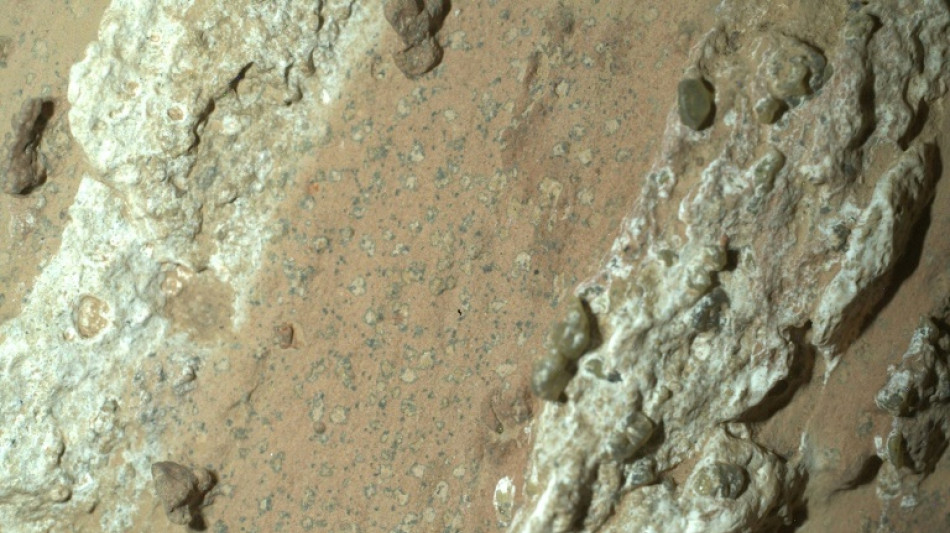
NASA's Perseverance Mars rover has made what could be its most astonishing discovery to date: possible signs of ancient life on the Red Planet.
The six-wheeled robotic explorer came across an intriguing, arrow-shaped rock dubbed "Cheyava Falls" that may harbor fossilized microbes from billions of years ago, when Mars was a watery world.
Perseverance drilled into the enigmatic rock to collect a core sample on July 21, as it traversed Neretva Vallis, an ancient river valley.
The samples carefully stowed beneath the rover's belly are destined to eventually return to Earth, where they will undergo more comprehensive analysis.
"Cheyava Falls is the most puzzling, complex, and potentially important rock yet investigated by Perseverance," project scientist Ken Farley of Caltech said Thursday.
Three compelling clues have scientists buzzing.
White calcium sulfate veins run the length of the rock, a telltale sign that water once flowed through it.
Between these veins is a reddish middle area, teeming with organic compounds, as detected by the rover's SHERLOC (Scanning Habitable Environments with Raman and Luminescence for Organics and Chemicals) instrument.
Finally, tiny off-white splotches ringed with black, reminiscent of leopard spots, contain chemicals that suggest energy sources for ancient microbes, according to scans by the PIXL (Planetary Instrument for X-ray Lithochemistry) instrument.
"On Earth, these types of features in rocks are often associated with the fossilized record of microbes living in the subsurface," said David Flannery, an astrobiologist and member of the Perseverance science team from the Queensland University of Technology in Australia.
The quest to confirm ancient Martian life is far from over, however.
The real test will come when Perseverance's precious rock samples are returned to Earth as part of the Mars Sample Return Program, a collaboration between NASA and the European Space Agency slated for the 2030s.
While there are alternative explanations for these findings that do not involve microbes, there is a tantalizing chance that Perseverance's core sample might contain actual fossilized microbes -- potentially making history as the first proof of life beyond Earth.
"We have zapped that rock with lasers and X-rays and imaged it literally day and night from just about every angle imaginable," said Farley.
"Scientifically, Perseverance has nothing more to give. To fully understand what really happened in that Martian river valley at Jezero Crater billions of years ago, we'd want to bring the Cheyava Falls sample back to Earth, so it can be studied with the powerful instruments available in laboratories."
X.Matos--PC



