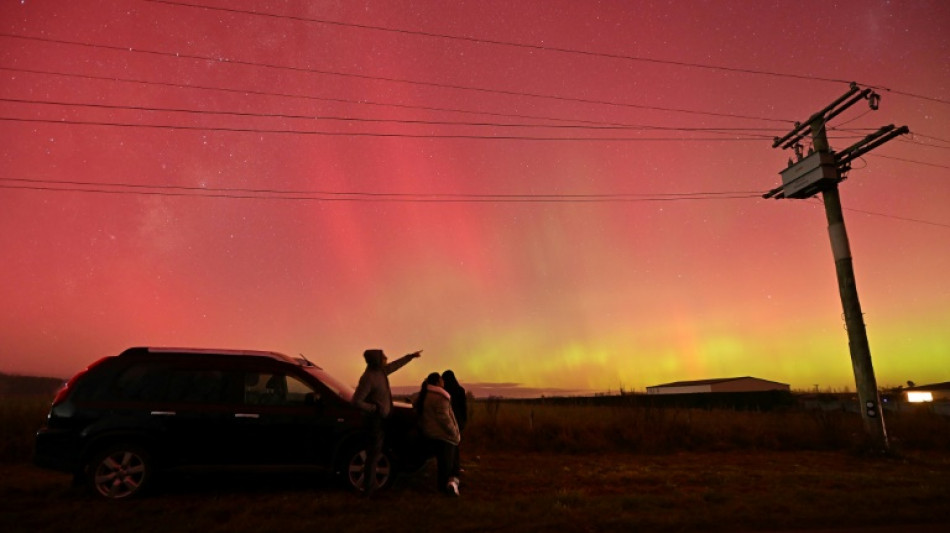
Solar storms could cause more auroras on Tuesday night / Photo: Sanka Vidanagama - AFP/File

 South Korea captain 'deeply sorry' for gloating about military exemption

 Alcaraz through to Japan Open semis after Shapovalov injury

 Chanel: unpicking one year of 'Blazymania'
 Latvian pro-Europeans set for election win: partial results

 China swim sensation Yu Zidi, 13, says 'I'm no prodigy'

 Yu Zidi to Ohashi: Asian Games stars who can light up LA Olympics

 'Act before it's too late': Tokyo residents fight for more trees

 'Disappointing' as South Korea flag mishap sees Games end on sour note

 Pre-COP host Tuvalu at frontline of climate change

 Hungary's dwindling paprika producers battle to save signature spice

 Cornell president vows review in wake of alleged student gang rape

 Latvian partial election results suggest pro-European choice

 In Egypt's Sinai, Gazan builds school for children displaced by war

 Trump tariffs a mixed bag for US auto industry

 Yemen government forces say struck Houthi targets

 Music links past, present for Pedro Pascal's cellist in 'Behemoth!'

 ALEX BODI ȘI AMBASADORUL REPUBLICII SUDANUL DE SUD, GUM DOMINIC MATIOK, DISCUTĂ LA BERLIN DESPRE POSIBILITATEA ÎNFIINȚĂRII UNUI CONSULAT ONORIFIC LA BUCUREȘTI

 Dodgers step up World Series three-peat bid with 5-3 win over Braves

 Spain break down Czechs as England outclass Croatia in Nations League

 Yamal on target as Spain hold off Czech Republic

 Latvian exit polls suggest pro-European choice

 Lula, Bolsonaro wrap up campaigns ahead of knife-edge election

 Tuchel hails 'complete' England after Croatia demolition

 Fury to invite Trump to lead ring walk before Joshua showdown

 Fashion industry in 'precarious moment', says Vivienne Westwood supremo

Massive explosions on the Sun have triggered warnings of geomagnetic storms that could create dazzling auroras in the northern United States, Europe and southern Australia on Tuesday night.
In May, the most powerful geomagnetic storm to strike Earth in more than two decades lit up night skies with colourful light displays in Hawaii, Spain, South Africa and other places far from the extreme latitudes where they are normally seen.
These storms are caused by coronal mass ejections (CMEs) -- expulsions of plasma and magnetic fields from the Sun which take days to reach Earth.
At least four CMEs that erupted in recent days are headed towards Earth, the US-based National Oceanic and Atmospheric Administration (NOAA) said late Monday.
They will arrive from Tuesday to Thursday, with "geomagnetic storm watches" declared by the NOAA on those days.
But "the brunt of the activity is most likely" to come on Tuesday, when there is a "strong" geomagnetic storm warning of G3, the NOAA said.
May's record storms were classified as the most extreme level of G5. This means any potential auroras this week are unlikely to stray as far, or as be as powerful, as those seen earlier this year.
But if the current forecast is correct, during the late evening hours in the US on Tuesday, an "aurora could become visible as far south as the northeast US through the upper Midwest and across the rest of the northern states to include northern Oregon", the NOAA said.
"With a bit of luck," aurora borealis -- also known as the northern lights -- could also be seen in areas such as England, northern Germany, the Netherlands and Belgium, according to the website SpaceWeatherLive.
Australia's Bureau of Meteorology said that a sequence of CMEs arriving in the next few days mean that aurora australis might be visible in some areas.
- 'Cannibal CME' -
When CMEs erupt, they shoot around a billion tons of plasma -- with an accompanying magnetic field -- from the Sun towards our home planet.
One of the CMEs coming towards Earth this week merged with another, forming what is called a "Cannibal CME", according to spaceweather.com.
The NOAA warned that more CMEs are continuing to erupt, so more could be coming our way.
When the CMEs slam into Earth's magnetosphere, they can create geomagnetic storms.
These storms can mess with satellites orbiting Earth and affect things like radio signals and GPS positioning systems.
They can also knock out electricity grids -- the "Halloween Storms" of October 2003 sparked blackouts in Sweden and damaged power infrastructure in South Africa.
Astronauts on the International Space Station often shelter during extreme solar activity to avoid being exposed to radiation.
Numerous strong solar flares -- huge explosions on the Sun's surface which can cause CMEs -- have also been emitted in recent days.
Most CMEs and flares come from sunspots, which are massive, darker areas of intense activity on the solar surface. The sunspot cluster that caused May's storms was 17 times the size of Earth.
More geomagnetic storms could be yet to come, because solar activity is only just approaching the peak of its roughly 11-year cycle.
The peak -- called "solar maximum" -- is expected between late 2024 and early 2026.
A.Magalhes--PC



