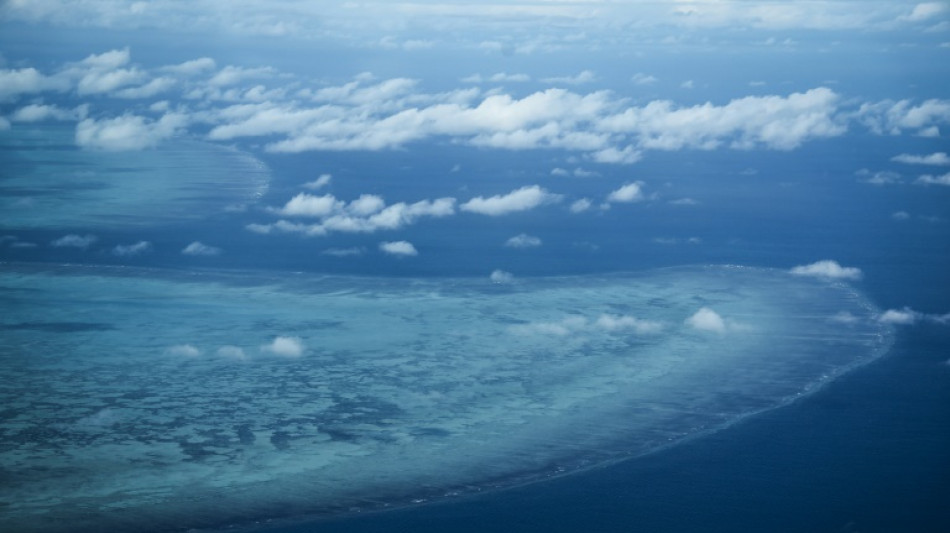
Great Barrier Reef ocean temperatures hit 400-year record: study / Photo: DAVID GRAY - AFP

 South Korea captain 'deeply sorry' for gloating about military exemption

 Alcaraz through to Japan Open semis after Shapovalov injury

 Chanel: unpicking one year of 'Blazymania'

 Latvian pro-Europeans set for election win: partial results

 China swim sensation Yu Zidi, 13, says 'I'm no prodigy'

 Yu Zidi to Ohashi: Asian Games stars who can light up LA Olympics

 'Act before it's too late': Tokyo residents fight for more trees

 'Disappointing' as South Korea flag mishap sees Games end on sour note

 Pre-COP host Tuvalu at frontline of climate change

 Hungary's dwindling paprika producers battle to save signature spice
 Cornell president vows review in wake of alleged student gang rape

 Latvian partial election results suggest pro-European choice

 In Egypt's Sinai, Gazan builds school for children displaced by war

 Trump tariffs a mixed bag for US auto industry

 Yemen government forces say struck Houthi targets

 Music links past, present for Pedro Pascal's cellist in 'Behemoth!'

 ALEX BODI ȘI AMBASADORUL REPUBLICII SUDANUL DE SUD, GUM DOMINIC MATIOK, DISCUTĂ LA BERLIN DESPRE POSIBILITATEA ÎNFIINȚĂRII UNUI CONSULAT ONORIFIC LA BUCUREȘTI

 Dodgers step up World Series three-peat bid with 5-3 win over Braves

 Spain break down Czechs as England outclass Croatia in Nations League

 Yamal on target as Spain hold off Czech Republic

 Latvian exit polls suggest pro-European choice

 Lula, Bolsonaro wrap up campaigns ahead of knife-edge election

 Tuchel hails 'complete' England after Croatia demolition

 Fury to invite Trump to lead ring walk before Joshua showdown

 Fashion industry in 'precarious moment', says Vivienne Westwood supremo

For the past decade, water temperatures along Australia's famed Great Barrier Reef have been the warmest in 400 years, a major study said on Thursday.
Ocean temperatures around the spectacular coral system have increased yearly since 1960 but were particularly hotter during recent mass coral bleaching events, according to a study in the science journal Nature.
The warmer waters are most likely down to human-induced climate change, the report said.
Co-author Helen McGregor said she was "extremely concerned" about the reef, describing the temperature increases as "unprecedented".
"These are corals that have lived for 400 years and this is the warmest temperatures they're experiencing. These are the Redwood trees of the reef," she told AFP.
Often dubbed the world's largest living structure, the Great Barrier Reef is a 2,300-kilometre (1,400-mile) long expanse, home to a stunning array of biodiversity that includes more than 600 types of coral and 1,625 fish species.
But repeated mass bleaching events -- when extreme heat saps the coral of nutrients and colour -- threaten the reef's fragile ecosystem.
Coral bleaching occurs when water temperatures rise more than one degree Celsius (1.8 degrees Fahrenheit).
- 'Changes happening too quickly' -
The Australian researchers examined sea surface temperatures in the Coral Sea –- a 2,000-kilometre (1,200-mile) stretch of ocean that extends down the northeast coast and includes the Great Barrier Reef.
Scientists used coral skeleton samples to reconstruct sea surface temperatures from 1618 to 1995, as well as more recent data.
They found temperatures before 1900 had been relatively stable but the sea had warmed 0.12C (0.2F) on average since 1960 until the present.
Those temperatures were even higher during the past five mass bleaching events in 2016, 2017, 2020, 2022 and 2024, the report found.
McGregor said that although corals could recover, increasing high temperatures and repeated bleaching events were straining that ability.
"These changes -- from what we're seeing so far -- appear to be happening too rapidly for the corals to adapt to so it really threatens the reef as we know it," said McGregor, a climate researcher at the University of Wollongong.
This year's bleaching event has left 81 percent of the reef with extreme or high levels of damage -- one of the most severe and widespread on record, the latest government data shows.
It will take scientists a few more months to determine how much of the reef is beyond recovery.
- 'Existentially threatened' -
Richard Leck, World Wide Fund Australia's head of oceans, said the future of the reef was "increasingly vulnerable".
"At the moment, we can see the reef is resilient. It's bounced back from previous coral bleaching events but at some point that elastic band will snap," he told AFP.
"Coral reefs, as an ecosystem, are the first ecosystem on the planet to be existentially threatened by climate change."
"I think we have to be hopeful that the world is not going to stand by and let that happen. But it is a fraction of a second to midnight," he said.
Governments around the globe are ramping up efforts to help curb greenhouse gases or invest in reef adaptation and mitigation efforts.
Australia has invested about Aus$5 billion ($3.2 billion) in improving water quality, reducing the effects of climate change, and protecting threatened species.
But Australia, one of the world's largest gas and coal exporters, has only recently set targets to become carbon neutral.
G.M.Castelo--PC



