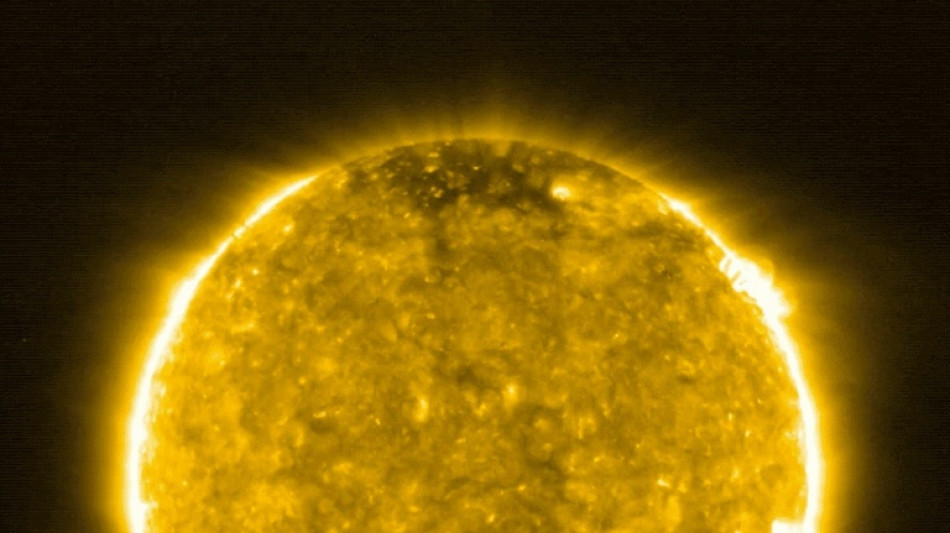
Earth hit by 'severe' solar storm / Photo: - - Solar Orbiter/EUI/ESA/NASA/AFP

 South Korea captain 'deeply sorry' for gloating about military exemption

 Alcaraz through to Japan Open semis after Shapovalov injury

 Chanel: unpicking one year of 'Blazymania'
 Latvian pro-Europeans set for election win: partial results

 China swim sensation Yu Zidi, 13, says 'I'm no prodigy'

 Yu Zidi to Ohashi: Asian Games stars who can light up LA Olympics

 'Act before it's too late': Tokyo residents fight for more trees

 'Disappointing' as South Korea flag mishap sees Games end on sour note

 Pre-COP host Tuvalu at frontline of climate change

 Hungary's dwindling paprika producers battle to save signature spice

 Cornell president vows review in wake of alleged student gang rape

 Latvian partial election results suggest pro-European choice

 In Egypt's Sinai, Gazan builds school for children displaced by war

 Trump tariffs a mixed bag for US auto industry

 Yemen government forces say struck Houthi targets

 Music links past, present for Pedro Pascal's cellist in 'Behemoth!'

 ALEX BODI ȘI AMBASADORUL REPUBLICII SUDANUL DE SUD, GUM DOMINIC MATIOK, DISCUTĂ LA BERLIN DESPRE POSIBILITATEA ÎNFIINȚĂRII UNUI CONSULAT ONORIFIC LA BUCUREȘTI

 Dodgers step up World Series three-peat bid with 5-3 win over Braves

 Spain break down Czechs as England outclass Croatia in Nations League

 Yamal on target as Spain hold off Czech Republic

 Latvian exit polls suggest pro-European choice

 Lula, Bolsonaro wrap up campaigns ahead of knife-edge election

 Tuchel hails 'complete' England after Croatia demolition

 Fury to invite Trump to lead ring walk before Joshua showdown

 Fashion industry in 'precarious moment', says Vivienne Westwood supremo

The Earth was hit Monday by an intense solar storm that could bring the northern lights to night skies further south than normal, a US agency announced.
Conditions of a level-four geomagnetic storm -- on a scale of five -- were observed Monday from 1500 GMT, according to a specialized center at the US National Oceanic and Atmospheric Administration (NOAA).
These conditions may persist for several hours, but were not expected to increase further in intensity, NOAA added in a statement.
"A severe geomagnetic storm includes the potential for aurora to be seen faintly as far south as Alabama and northern California," NOAA said in a statement, referring to US states.
The new solar storm is caused by coronal mass ejections (CMEs), which are explosions of particles leaving the Sun. When these particles arrive on Earth, they disrupt its magnetic field.
"There are a lot of auroras now... If it lasts until nightfall here, we might be able to see some," Eric Lagadec, an astrophysicist at the Cote d'Azur Observatory in France, said on X.
On Sunday, NASA astronaut Matthew Dominick published on X a superb photo of the aurora borealis -- or Northern Lights -- taken from the International Space Station, where he is currently stationed.
But solar or geomagnetic storms can also trigger undesirable effects.
For example, they can degrade high-frequency communications, disrupt satellites, and cause overloads on the electricity grid. Operators of sensitive infrastructure have been notified to put in place measures to limit these effects, NOAA said.
In May, the planet went through the most powerful geomagnetic storms recorded in 20 years. They caused auroras to light up the night sky in the United States, Europe, and Australia, at much lower latitudes than usual.
This type of event has increased recently because the Sun is currently close to its peak activity, as per its 11-year cycle.
O.Salvador--PC



