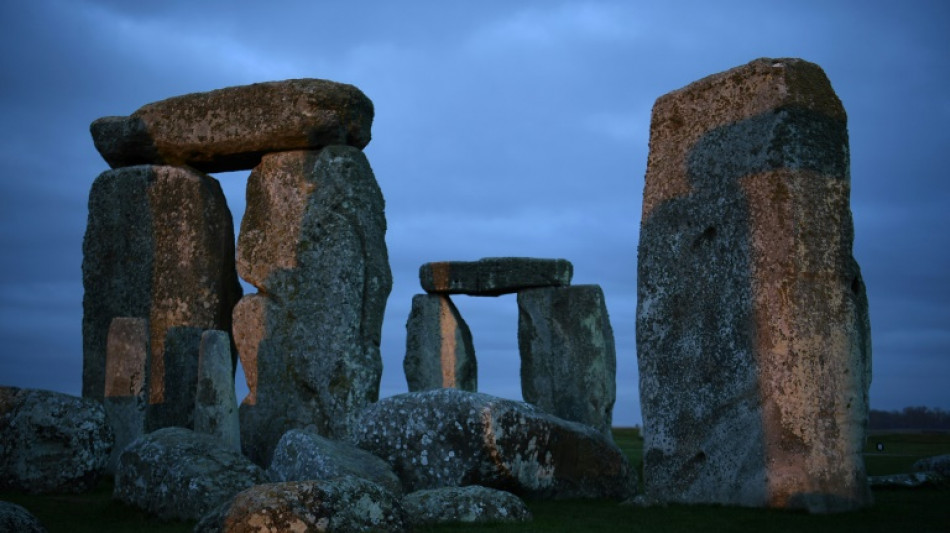
Stonehenge mystery deepens as altar traced to Scotland / Photo: Daniel LEAL - AFP/File

 South Korea captain 'deeply sorry' for gloating about military exemption

 Alcaraz through to Japan Open semis after Shapovalov injury

 Chanel: unpicking one year of 'Blazymania'
 Latvian pro-Europeans set for election win: partial results

 China swim sensation Yu Zidi, 13, says 'I'm no prodigy'

 Yu Zidi to Ohashi: Asian Games stars who can light up LA Olympics

 'Act before it's too late': Tokyo residents fight for more trees

 'Disappointing' as South Korea flag mishap sees Games end on sour note

 Pre-COP host Tuvalu at frontline of climate change

 Hungary's dwindling paprika producers battle to save signature spice
 Cornell president vows review in wake of alleged student gang rape
 Latvian partial election results suggest pro-European choice

 In Egypt's Sinai, Gazan builds school for children displaced by war

 Trump tariffs a mixed bag for US auto industry

 Yemen government forces say struck Houthi targets

 Music links past, present for Pedro Pascal's cellist in 'Behemoth!'

 ALEX BODI ȘI AMBASADORUL REPUBLICII SUDANUL DE SUD, GUM DOMINIC MATIOK, DISCUTĂ LA BERLIN DESPRE POSIBILITATEA ÎNFIINȚĂRII UNUI CONSULAT ONORIFIC LA BUCUREȘTI

 Dodgers step up World Series three-peat bid with 5-3 win over Braves

 Spain break down Czechs as England outclass Croatia in Nations League

 Yamal on target as Spain hold off Czech Republic

 Latvian exit polls suggest pro-European choice

 Lula, Bolsonaro wrap up campaigns ahead of knife-edge election

 Tuchel hails 'complete' England after Croatia demolition

 Fury to invite Trump to lead ring walk before Joshua showdown

 Fashion industry in 'precarious moment', says Vivienne Westwood supremo

A central stone of the famous Stonehenge monument in southwest England came from 750 kilometres away in northeast Scotland, surprised scientists said Wednesday, solving one mystery but raising another: how did its prehistoric builders move the huge slab so far?
The Neolithic circle of giant stones has been a source of wonder and mystery for nearly 5,000 years -- in the Middle Ages, the wizard Merlin of Arthurian legend was said to have stolen the monument from Ireland.
More recently, scientists have determined that the site's upright sandstones came from relatively nearby Marlborough, while the bluestones arrayed near its centre came from Wales.
But the origin of the Altar Stone, a unique six-tonne slab laying on its side at the heart of the circle, remained elusive.
It was long thought to have also come from Wales, but tests along those lines always "drew a blank," said Richard Bevins, a professor from Aberystwyth University, mid-Wales, and co-author of a new study.
This prompted a team of British and Australian researchers to broaden their horizons -- and in turn discover something "quite sensational", he told AFP.
Using chemical analysis, they determined that the Altar Stone came from Scotland's Orcadian Basin, which is at least 750 kilometres (460 miles) from Stonehenge, according to the study in the journal Nature.
- 'Genuinely shocking' -
The researchers were stunned.
"This is a genuinely shocking result," study co-author Robert Ixer of University College London said in a statement.
The "astonishing" distance was the longest recorded journey for any stone at the time, said fellow co-author Nick Pearce of Aberystwyth University.
Whether people around 2,500 BC were capable of transporting such huge stones from Wales had already been a matter of heated debate among archaeologists and historians.
That a five-by-one-metre (16-by-three-feet) stone made the trip across much of the length of the UK suggests that the British isles were home to a highly organised and well-connected society at the time, the researchers said.
They called for further research to find out exactly where in Scotland the stone came from -- and how it made its way to Stonehenge.
One theory is that the stone was brought to southern England not by humans but by naturally moving ice flows.
However research has shown that ice would actually have carried such stones "northwards, away from Stonehenge", lead study author Anthony Clarke from Australia's Curtin University told a news conference.
Another option was that the Neolithic builders moved the stones over land -- though this would have been extraordinarily difficult.
Dense forest, marshy bogs and mountains all formed "formidable barriers" for prehistoric movers, Clarke said.
- 'Incredibly important' -
Another option is that the stone was transported by sea.
There is evidence of an "extensive network of Neolithic shipping," which moved pottery and gems around the region, Clarke said.
To work out where it came from, the researchers fired laser beams into the crystals of a thin slice of the Altar Stone.
The ratio of uranium and lead in these crystals act as "miniature clocks" for rocks, providing their age, said study co-author Chris Kirkland of Curtin University.
The team then compared the stone's age to other rocks across the UK and found "with a high degree of certainty" that it came from the Orcadian Basin, Kirkland said.
Susan Greaney, an archaeologist at the UK's University of Exeter not involved in the study, said it established the first "direct link" between southern England and northern Scotland during this time.
"The placement of this stone at the heart of the monument, on the solstice axis, shows that they thought this stone, and by implication, the connection with the area to the north, was incredibly important," she told AFP.
A.Santos--PC



