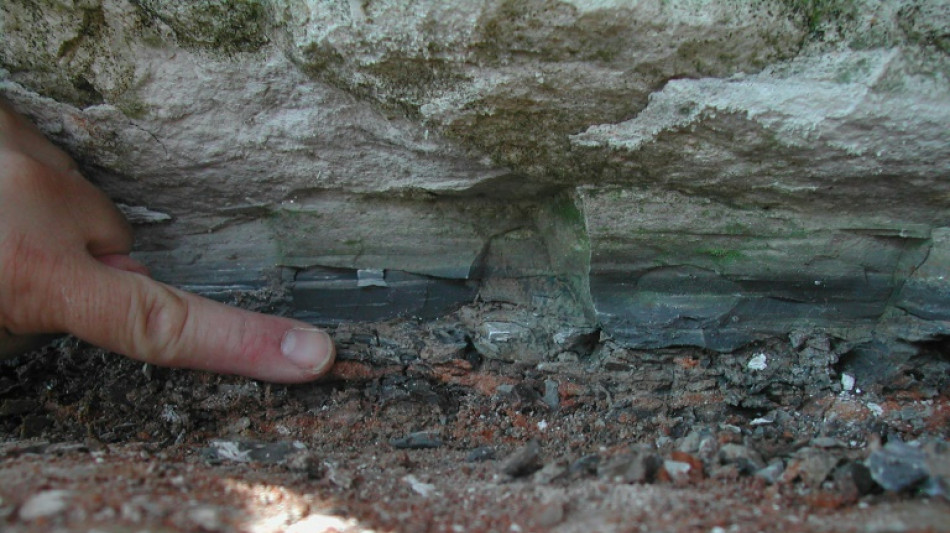
Scientists pinpoint dino-killing asteroid's origin: past Jupiter / Photo: Philippe CLAEYS - EUREKALERT!/AFP

 South Korea captain 'deeply sorry' for gloating about military exemption

 Alcaraz through to Japan Open semis after Shapovalov injury

 Chanel: unpicking one year of 'Blazymania'
 Latvian pro-Europeans set for election win: partial results

 China swim sensation Yu Zidi, 13, says 'I'm no prodigy'

 Yu Zidi to Ohashi: Asian Games stars who can light up LA Olympics

 'Act before it's too late': Tokyo residents fight for more trees

 'Disappointing' as South Korea flag mishap sees Games end on sour note

 Pre-COP host Tuvalu at frontline of climate change

 Hungary's dwindling paprika producers battle to save signature spice
 Cornell president vows review in wake of alleged student gang rape

 Latvian partial election results suggest pro-European choice

 In Egypt's Sinai, Gazan builds school for children displaced by war

 Trump tariffs a mixed bag for US auto industry

 Yemen government forces say struck Houthi targets

 Music links past, present for Pedro Pascal's cellist in 'Behemoth!'

 ALEX BODI ȘI AMBASADORUL REPUBLICII SUDANUL DE SUD, GUM DOMINIC MATIOK, DISCUTĂ LA BERLIN DESPRE POSIBILITATEA ÎNFIINȚĂRII UNUI CONSULAT ONORIFIC LA BUCUREȘTI

 Dodgers step up World Series three-peat bid with 5-3 win over Braves

 Spain break down Czechs as England outclass Croatia in Nations League

 Yamal on target as Spain hold off Czech Republic

 Latvian exit polls suggest pro-European choice

 Lula, Bolsonaro wrap up campaigns ahead of knife-edge election

 Tuchel hails 'complete' England after Croatia demolition

 Fury to invite Trump to lead ring walk before Joshua showdown

 Fashion industry in 'precarious moment', says Vivienne Westwood supremo

An intense debate surrounding the cosmic rock that killed the dinosaurs has stirred scientists for decades, but a new study has revealed some important -- and far-out -- data about the impactor's origin story.
Researchers, whose findings were published Thursday in the journal Science, used an innovative technique to demonstrate that the apocalyptic culprit which slammed into the Earth's surface 66 million years ago, causing the most recent mass extinction, had formed beyond Jupiter's orbit.
They also refute the idea that it was a comet.
The new insights into the apparent asteroid that cratered into Chicxulub, in what is present-day Mexico's Yucatan Peninsula, could improve the understanding of celestial objects that have struck our planet.
"Now we can, with all this knowledge... say that this asteroid initially formed beyond Jupiter," Mario Fischer-Godde, lead author of the study and a geochemist at the University of Cologne, told AFP.
The conclusions are particularly notable, given how rarely this type of asteroid collides with Earth.
Such information may well prove useful in assessing future threats, or determining how water arrived on this planet, Fischer-Godde said.
- Samples -
The new findings are based on analysis of sediment samples formed at the period between the Cretaceous and Paleogene eras, the time of the asteroid's cataclysmic impact.
Researchers measured the isotopes of the element ruthenium, not uncommon on asteroids but extremely rare on Earth. So by inspecting the deposits in multiple geological layers that mark the debris from the impact at Chicxulub, they could be sure that the ruthenium studied came "100 percent from this asteroid."
"Our lab in Cologne is one of the rare labs that can do these measurements," and it was the first time such study techniques were used on impact debris layers, Fischer-Godde said.
Ruthenium isotopes can be used to distinguish between the two main groups of asteroids: C-type, or carbonaceous, asteroids that formed in the outer solar system, and S-type silicate asteroids from the inner solar system, nearer the sun.
The study affirms that the asteroid that triggered a mega-earthquake, precipitated a global winter and wiped out the dinosaurs and most other life, was a C-type asteroid that formed beyond Jupiter.
Studies from two decades ago had already made such an assumption, but with far less certainty.
The conclusions are striking, because most meteorites -- pieces of asteroids that fall to Earth -- are S-types, Fischer-Godde pointed out.
Does that mean the Chicxulub impactor formed beyond Jupiter and made a beeline for our planet? Not necessarily.
"We cannot be really sure where the asteroid was kind of hiding just before it impacted on Earth," Fischer-Godde said, adding that after its formation, it may have made a stopover in the asteroid belt, located between Mars and Jupiter and where most meteorites originate.
- Not a comet -
The study also dismisses the idea that the destructive impactor was a comet, an amalgam of icy rock from the very edge of the solar system. Such a hypothesis was put forward in a much-publicized study in 2021, based on statistical simulations.
Sample analyses now show that the celestial object was far different in composition from a subset of meteorites which are believed to have been comets in the past. It is therefore "unlikely" the impactor in question was a comet, Fischer-Godde said.
As to the wider usefulness of his findings, the geochemist offered two suggestions.
He believes that more accurately defining the nature of asteroids that have struck Earth since its beginnings some 4.5 billion years ago could help solve the enigma of the origin of our planet's water.
Scientists believe water may have been brought to Earth by asteroids, likely of the C-type like the one that struck 66 million years ago, even though they are less frequent.
Studying past asteroids also allows humanity to prepare for the future, Fischer-Godde said.
"If we find that earlier mass extinction events could also be related to C-type asteroid impacts, then... if there's ever going to be C-type asteroid on an Earth-crossing orbit, we have to be very careful," he said, "because it might be the last one we witness."
V.F.Barreira--PC



