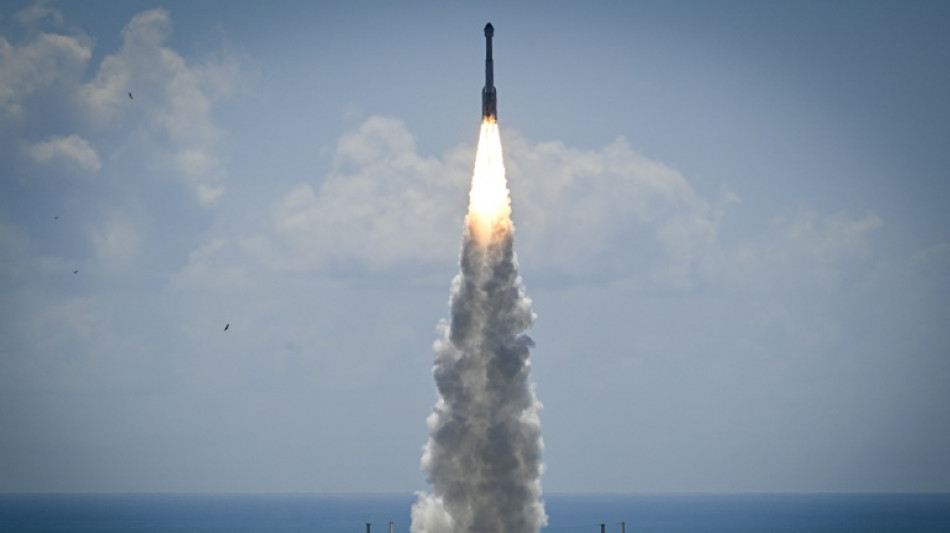
Boeing's Starliner: a saga marked by setbacks / Photo: Miguel J. Rodriguez Carrillo - AFP

 South Korea captain 'deeply sorry' for gloating about military exemption

 Alcaraz through to Japan Open semis after Shapovalov injury

 Chanel: unpicking one year of 'Blazymania'

 Latvian pro-Europeans set for election win: partial results

 China swim sensation Yu Zidi, 13, says 'I'm no prodigy'

 Yu Zidi to Ohashi: Asian Games stars who can light up LA Olympics

 'Act before it's too late': Tokyo residents fight for more trees

 'Disappointing' as South Korea flag mishap sees Games end on sour note

 Pre-COP host Tuvalu at frontline of climate change

 Hungary's dwindling paprika producers battle to save signature spice

 Cornell president vows review in wake of alleged student gang rape

 Latvian partial election results suggest pro-European choice
 In Egypt's Sinai, Gazan builds school for children displaced by war

 Trump tariffs a mixed bag for US auto industry

 Yemen government forces say struck Houthi targets

 Music links past, present for Pedro Pascal's cellist in 'Behemoth!'
 ALEX BODI ȘI AMBASADORUL REPUBLICII SUDANUL DE SUD, GUM DOMINIC MATIOK, DISCUTĂ LA BERLIN DESPRE POSIBILITATEA ÎNFIINȚĂRII UNUI CONSULAT ONORIFIC LA BUCUREȘTI

 Dodgers step up World Series three-peat bid with 5-3 win over Braves

 Spain break down Czechs as England outclass Croatia in Nations League

 Yamal on target as Spain hold off Czech Republic

 Latvian exit polls suggest pro-European choice

 Lula, Bolsonaro wrap up campaigns ahead of knife-edge election
 Tuchel hails 'complete' England after Croatia demolition

 Fury to invite Trump to lead ring walk before Joshua showdown

 Fashion industry in 'precarious moment', says Vivienne Westwood supremo
The decision to transfer the crew of Boeing's Starliner to a SpaceX mission after the spacecraft malfunctioned is just the latest twist in a long saga that has undermined the credibility of the US aerospace giant.
Here is a recap of the setbacks and delays on Starliner's journey to fly a crew to the International Space Station -- and how it was unable to bring them back again.
- 2014: Nasa awards contract -
A decade ago NASA chose two companies, Boeing and SpaceX, to each develop a new spacecraft capable of transporting its astronauts to the International Space Station (ISS).
The US space agency asked both to be ready for 2017, as it sought to end its dependence on the Russian spacecraft it had used to ferry astronauts to the ISS since the end of the space shuttle program in 2011.
Boeing was awarded a $4.2 billion contract, against SpaceX's $2.6 billion. At the time, billionaire Elon Musk's young company was widely seen as the underdog against Boeing's aerospace might.
- 2019: Failed unmanned flight -
During a first unmanned flight in December 2019, the capsule failed to set itself on the right trajectory and returned to Earth prematurely after two days, without reaching the ISS.
The problem was due to a clock that was eleven hours late, preventing the capsule from firing its thrusters at the scheduled time.
NASA then realized that another software problem could have led to a catastrophic collision.
The manufacturer was given a long list of recommendations and modifications to make.
- 2021: False hope -
In August 2021, when the rocket was already on the launch pad for another attempt at flight, unexpected moisture caused a chemical reaction that blocked the opening of some of the capsule's valves.
The capsule returned to the factory for inspection over a period of several months.
The delay was in stark contrast to the progress being made by SpaceX, which had been successfully transporting astronauts to the ISS since 2020.
- 2022: First (unmanned) success -
In May 2022, Starliner finally completed its first unmanned test flight.
Despite a few glitches -- including a propulsion system problem detected in flight, but with no adverse consequences -- the capsule lifted off, reached the ISS where it remained docked for several days, and returned safely to Earth.
- 2023: New worries, new delays -
Starliner's nascent momentum was arrested in 2023 when new problems emerged, delaying preparations for its first manned flight.
One concerned the design of the parachutes that would slow the capsule as it re-entered the atmosphere. It was modified and new tests carried out.
The other was even more surprising: adhesive tape, used over several meters to wrap electrical cables inside the capsule, proved to be flammable and had to be removed.
- 2024: First manned flight goes awry -
The big day finally arrived on June 5, 2024: the capsule lifted off with two astronauts for the first time, a final test mission to prove it was safe before beginning regular operations to the ISS.
But leaks of helium, the gas used to create pressure in the propulsion system, were discovered in flight.
Several thrusters then failed before the capsule docked with the ISS, although all but one were eventually reignited.
NASA feared the capsule would not be able to achieve the thrust necessary to return to Earth.
As a result, the space agency took a radical decision: to transfer the two astronauts to a SpaceX mission, and return Starliner empty.
Analysis of the flight will determine the path forward -- and how long any new delays will last.
Boeing has already gone $1.6 billion over budget on the program.
R.Veloso--PC



