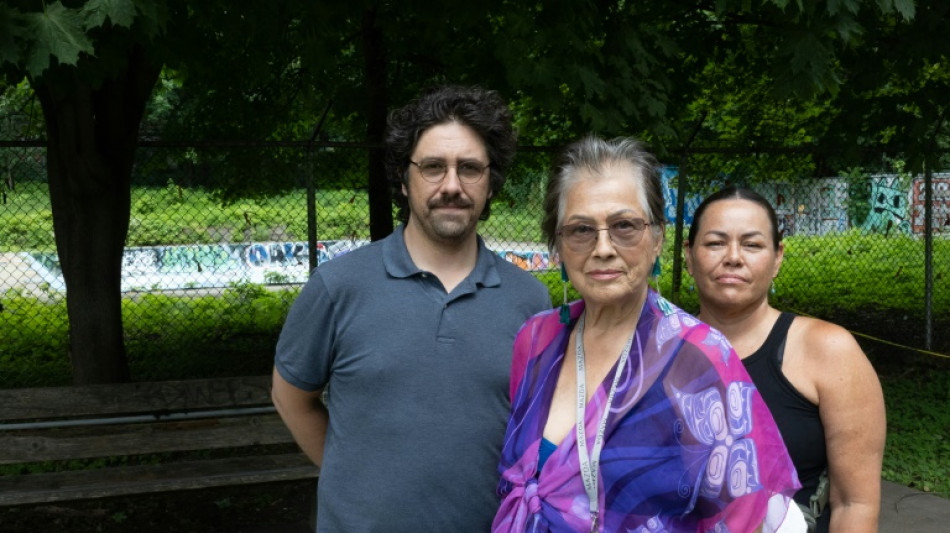
Indigenous mothers fight to search CIA experiment site in Montreal / Photo: Alexis Aubin - AFP

 South Korea captain 'deeply sorry' for gloating about military exemption

 Alcaraz through to Japan Open semis after Shapovalov injury

 Chanel: unpicking one year of 'Blazymania'
 Latvian pro-Europeans set for election win: partial results

 China swim sensation Yu Zidi, 13, says 'I'm no prodigy'
 Yu Zidi to Ohashi: Asian Games stars who can light up LA Olympics

 'Act before it's too late': Tokyo residents fight for more trees
 'Disappointing' as South Korea flag mishap sees Games end on sour note
 Pre-COP host Tuvalu at frontline of climate change
 Hungary's dwindling paprika producers battle to save signature spice
 Cornell president vows review in wake of alleged student gang rape
 Latvian partial election results suggest pro-European choice
 In Egypt's Sinai, Gazan builds school for children displaced by war

 Trump tariffs a mixed bag for US auto industry

 Yemen government forces say struck Houthi targets
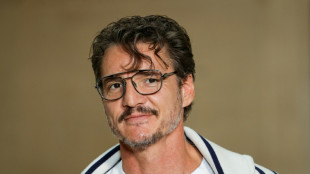 Music links past, present for Pedro Pascal's cellist in 'Behemoth!'
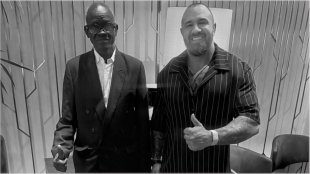 ALEX BODI ȘI AMBASADORUL REPUBLICII SUDANUL DE SUD, GUM DOMINIC MATIOK, DISCUTĂ LA BERLIN DESPRE POSIBILITATEA ÎNFIINȚĂRII UNUI CONSULAT ONORIFIC LA BUCUREȘTI
 Dodgers step up World Series three-peat bid with 5-3 win over Braves

 Spain break down Czechs as England outclass Croatia in Nations League

 Yamal on target as Spain hold off Czech Republic

 Latvian exit polls suggest pro-European choice
 Lula, Bolsonaro wrap up campaigns ahead of knife-edge election

 Tuchel hails 'complete' England after Croatia demolition

 Fury to invite Trump to lead ring walk before Joshua showdown

 Fashion industry in 'precarious moment', says Vivienne Westwood supremo

A group of Indigenous women are hoping to stop the bulldozers at a former Montreal hospital which they believe could hold the truth about children still missing from a grisly half-century-old CIA experiment.
They have spent the last two years trying to delay the construction project by McGill University and the Quebec government.
"They took our children and had all kinds of things done to them. They were experimenting on them," said Kahentinetha, an 85-year-old activist from the Mohawk community of Kahnawake, southwest of Montreal, who goes by just one name.
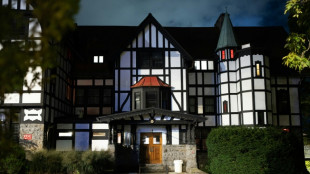
The activists are relying on archives and testimonies that suggest the site contains unmarked graves of children formerly interned at the Royal Victoria Hospital and Allan Memorial Institute, a neighboring psychiatric hospital.
In the 1950s and 1960s, behind the austere walls of the old psychiatric institute, the US Central Intelligence Agency funded a human experiments program called MK Ultra.
During the Cold War, the program aimed to develop procedures and drugs to effectively brainwash people.
Experiments were conducted in Britain, Canada and the United States, subjecting people -- including Indigenous children in Montreal -- to electroshocks, hallucinogenic drugs, and sensory deprivation.
"They wanted to erase us," said Kahentinetha.
A leading figure in the Indigenous rights movement who has traveled to Britain and the United States to denounce colonialism, she called this fight "the most important of (her) life."
"We want to know why they did this and who's going to take the blame for it," she said.
- Sniffer dogs -
In the fall of 2022, the mothers obtained an injunction to suspend work on a new university campus and research center at the site -- a project worth Can$870 million (US$643 million).
Fellow activist Kwetiio, 52, who also uses just one name, said they insisted on arguing the case themselves without lawyers, "because in our ways, no one speaks for us."
Last summer, sniffer dogs and specialized probes were brought in to search the property's expansive and dilapidated buildings. They managed to identify three areas of interest for excavations.
But, according to McGill and the government's Societe Quebecoise des Infrastructure (SQI), "no human remains have been discovered."
The Mohawk mothers accuse the university and the government infrastructure agency of breaching an agreement by selecting the archaeologists who did the search and then ending their work too soon.
"They gave themselves the power to lead the investigation of crimes that were potentially committed by their own employees in the past," says Philippe Blouin, an anthropologist working with the mothers.
Even though their appeal was dismissed earlier this month, they have vowed to continue their fight.
"People should know history, so that it does not repeat itself," said Kwetiio.
In recent years, Canada has opened its eyes to past atrocities.
Generations of Indigenous children were sent to residential schools where they were stripped of their language, culture and identities in what a 2015 truth and reconciliation report said amounted to "cultural genocide."
Between 1831 and 1996, some 150,000 Indigenous children were taken from their homes and placed in 139 such schools. Several thousand never returned to their communities.
In May 2021, the discovery of unmarked graves of 215 children at the Kamloops Indian Residential School in British Columbia started a national reflection on this dark chapter of Canadian history, while sparking searches for more graves across Canada.
"It was not only residential schools, it involved hospitals, sanatoriums, churches and orphanages too," said Kwetiio.
For her, what is most important is shedding light on what happened in order for "things to change," and to recreate "the harmony that we had before colonialism."
T.Vitorino--PC



